The resurgence of analog photography in the third decade of the 21st century has prompted a renewed technical interest in the transitional technology of the late 1980s, specifically the early iterations of autofocus single-lens reflex (SLR) cameras. A recent field assessment conducted by the photographic researcher known as Sneakerzoom has highlighted the enduring utility and inherent technical challenges of the Yashica 230AF, a pivotal but often overlooked piece of hardware in the history of the Kyocera-Yashica partnership. This report examines the performance of the 1987-era system during a documentation transit through Southwestern Ontario, evaluating the synergy between vintage optics and expired chemical emulsions.
Historical Context and the Evolution of the Yashica 230AF
To understand the implications of the recent field test, one must first look at the competitive landscape of the mid-to-late 1980s. Following the 1985 release of the Minolta Maxxum 7000, which revolutionized the industry by integrating autofocus into the camera body, other manufacturers were forced to innovate rapidly. Yashica, under the ownership of Kyocera, responded in 1987 with the 230AF.
The 230AF was significant for introducing the Yashica AF mount, a departure from the celebrated Contax/Yashica (C/Y) manual focus mount. While this transition alienated some purists, the 230AF offered advanced features for its time, including a built-in motor drive, multiple metering modes (center-weighted and spot), and an innovative "trap focus" mode. The system was designed to bridge the gap between amateur convenience and professional-grade SLR capabilities. However, as noted in the recent field documentation, the electronic components of this era—specifically the integrated circuits and liquid crystal displays (LCDs)—were not necessarily engineered for a half-century of service life.

Technical Observations: Electronic Instability and Mechanical Sensitivities
The recent deployment of the Yashica 230AF in Paris, Ontario, revealed critical data points regarding the degradation of 1980s consumer electronics. The primary point of failure observed was the top-deck LCD panel. In professional photographic environments, the reliability of status displays is paramount; however, the unit tested exhibited what was described as an "indecisive" refresh rate. This suggests a potential breakdown in the conductive adhesive or the liquid crystal layers within the display, a common ailment in hardware of this vintage.
Furthermore, the tactile response of the shutter release mechanism demonstrated extreme sensitivity. In the context of ergonomic engineering, a "hair-trigger" shutter can lead to accidental exposures and resource wastage, particularly when using finite media like 35mm film. The tester noted that the actuation pressure required was significantly lower than that of contemporary compact cameras, such as the Olympus XA. This mechanical behavior indicates either a deliberate design choice by Kyocera to minimize camera shake during exposure or a weakening of the physical spring-detent system within the shutter assembly over time.
The autofocus (AF) system, a hallmark of the 230AF’s identity, also underwent rigorous scrutiny. By modern standards, the phase-detection AF of the late 1980s is characterized by significant latency. The field test confirmed that the "seek" time for the lens to achieve focus lock was substantial, illustrating the massive leaps in processing power and motor efficiency that have occurred in the intervening four decades. Despite these delays, the system eventually achieved focus, indicating that the internal circuitry remains functional despite the environmental stressors of the last 30 years.
Analysis of Media: Kodak UltraMax 400 and Chemical Degradation
The choice of media for this technical assessment was a roll of expired Kodak UltraMax 400. This consumer-grade color negative film is known for its versatility and saturated color palette. However, the use of expired film introduces variables that are of particular interest to the field of archival preservation and lomography.
As film ages, the silver halide crystals and color-coupling chemicals undergo a slow process of degradation caused by ambient background radiation and thermal fluctuations. This typically results in a loss of sensitivity (requiring more light for a proper exposure), an increase in grain (base fog), and unpredictable color shifts. In the case of the Paris, Ontario road trip, the expired film was reported to have "just worked," yielding over 30 usable frames. This success rate points to the robustness of the Kodak UltraMax emulsion, which often retains a high degree of latitude even when stored outside of optimal, refrigerated conditions.
The resulting imagery was described as having a "surprisingly sharp" quality, a testament to the glass-molding technologies employed by Yashica during the Kyocera era. Even as the electronics of the camera body faltered, the optical performance of the Yashica AF lenses remained consistent, capable of resolving fine detail even on a degraded chemical substrate.
Geographical and Cultural Context: The Paris to Port Dover Corridor
The documentation took place along a specific transit route in Southwestern Ontario, moving from the town of Paris toward the lakeside community of Port Dover. This region is characterized by its historical architecture and unique roadside attractions, providing a diverse range of subjects for an optical stress test.
Paris, Ontario, often cited for its cobblestone masonry and European-style vistas at the confluence of the Grand and Nith Rivers, offered high-contrast architectural subjects. The transition to Port Dover, a hub for the Great Lakes fishing industry and a focal point for motorcycle culture, introduced different lighting conditions and textures.

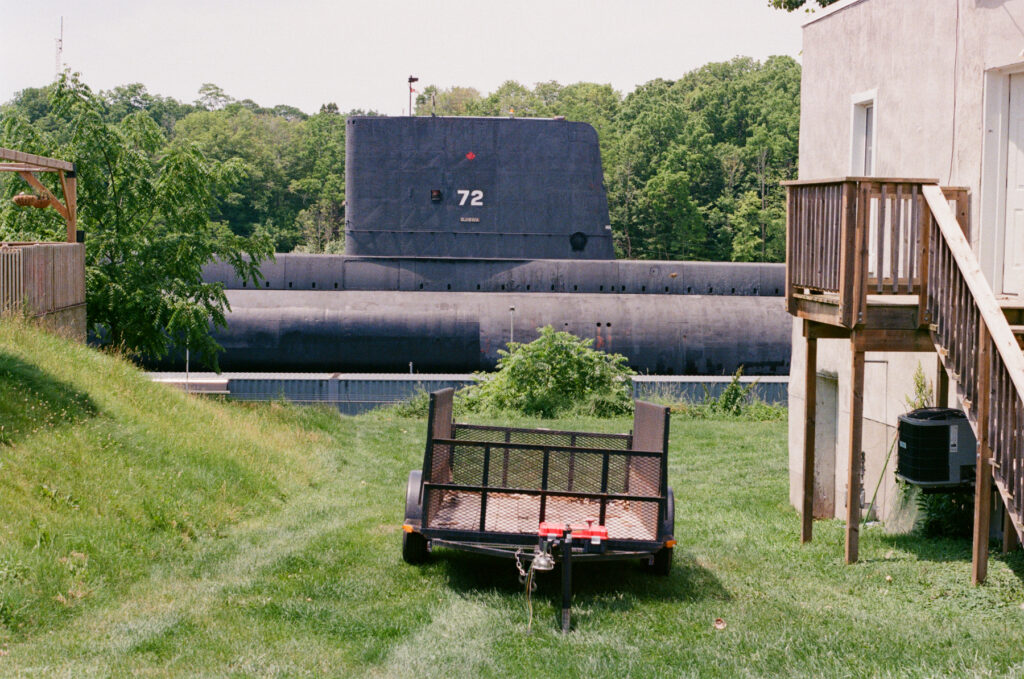
A notable discovery during the transit was the sighting of a submarine in a residential backyard. While seemingly anomalous, this region of Ontario has a deep connection to naval history. The HMCS Ojibwa, an Oberon-class submarine, is a permanent museum fixture in nearby Port Burwell. However, the discovery of smaller, private nautical artifacts in the "backyards" of the Lake Erie north shore is a documented phenomenon in local folk geography, representing the intersection of private hobbyism and regional maritime heritage.
Broader Implications for the Analog Photography Market
The successful retrieval of images from a "stubborn" and "expired" system like the Yashica 230AF has broader implications for the current photographic market. As prices for "prestige" vintage cameras (such as those from Leica, Contax, and Nikon) continue to escalate, there is a growing movement toward "electronic-era" SLRs that were previously dismissed as "plastic" or "unreliable."
- Sustainability and E-Waste: The ability to "dust off" and utilize 40-year-old electronics reduces the demand for new resource extraction. It highlights a form of technological recycling where the "drama" of the equipment becomes part of the creative process.
- The "Lo-Fi" Aesthetic: The market for expired film and glitchy hardware is driven by a desire for "authentic" imperfection—a reaction to the sterile, high-definition perfection of modern smartphone sensors. The light leaks and color shifts mentioned in the Sneakerzoom report are increasingly seen as features rather than bugs.
- Educational Value: Using early AF systems provides contemporary photographers with a tangible history of user interface (UI) design. The transition from manual dials to the "indecisive" LCD screens of the 80s marks a pivotal moment in how humans interact with capturing devices.
Conclusion and Technical Summary
The field test of the Yashica 230AF serves as a case study in the longevity of transitional technology. Despite the erratic behavior of the LCD and the sluggishness of the autofocus motor, the core functionality—the synchronization of light, optics, and chemistry—remained intact.
Technical Summary of Results:

- Device: Yashica 230AF (circa 1987)
- Optics: Yashica AF Mount Lens (unspecified focal length, noted for high sharpness)
- Media: Kodak UltraMax 400 (Expired)
- Yield: >30 usable frames out of 36
- Primary Failure Points: LCD refresh rate instability, extreme shutter sensitivity, slow AF acquisition.
- Key Findings: Optical quality remains high despite electronic degradation; expired film maintains significant latitude in outdoor lighting.
As the analog community continues to expand, the Yashica 230AF and its contemporaries represent a frontier of affordable, functional, albeit temperamental, tools for regional documentation. The project concludes that while the "cameradrama" of the 1980s may require patience and technical tolerance, the resulting imagery justifies the effort of salvaging these "stubborn" boxes from the annals of photographic history. The full photographic series and extended narrative are available via the Sneakerzoom digital archives, contributing to the ongoing dialogue regarding the intersection of heritage hardware and modern creative exploration.