The rapid integration of generative artificial intelligence into the creative industry has fundamentally altered the lifecycle of visual content production, shifting the primary challenge for marketers from asset scarcity to asset governance. While AI tools allow for the near-instantaneous generation of high-fidelity imagery, the transition from a digital concept to a commercially viable marketing asset remains a complex process involving legal, technical, and brand-specific hurdles. In the current landscape, the ability to produce a visual is no longer the competitive advantage; instead, the advantage lies in ensuring that visuals are "commercial-ready"—a standard that encompasses licensing clarity, technical scalability, and brand consistency.
The Evolution of the Creative Bottleneck
For decades, the primary constraint in visual marketing was the high cost and logistical complexity of production. Traditional workflows required substantial lead times for photography, model casting, location scouting, and post-production. The emergence of stock photography in the late 20th century provided a significant efficiency boost, allowing brands to license professionally produced content at a fraction of the cost of a custom shoot. However, even with stock libraries, teams were limited to what had already been captured.
Generative AI has effectively removed the production bottleneck by allowing creative teams to visualize concepts that were previously impossible or prohibitively expensive to create. According to industry reports from McKinsey and Gartner, AI-driven content creation can reduce time-to-market for digital campaigns by up to 70%. Yet, this explosion in speed has created a new bottleneck: the verification of "commercial readiness." As production volume increases, marketing departments are finding that the time saved in generation is often lost during the vetting process, as teams struggle to confirm whether AI-generated assets meet the rigorous legal and quality standards required for global distribution.
Defining the Parameters of Commercial Readiness
A "good-looking" image is not necessarily a "usable" image in a professional context. Commercial readiness is defined by a multi-layered framework of requirements that ensure an asset can be deployed across various media without exposing a brand to risk.
1. Legal Provenance and Licensing
The most critical component of commercial readiness is provenance. In an era of increasing copyright litigation surrounding AI training sets, enterprise brands require a clear "paper trail" for every asset. This includes ensuring that the AI model used was trained on ethically sourced data and that the resulting image does not infringe upon the intellectual property of third parties. Established stock platforms like Shutterstock have addressed this by developing AI tools trained on their own vast, licensed libraries, offering marketers the same legal indemnification they provide for traditional photography.

2. Technical Quality and Scalability
While AI can generate images suitable for a social media post, many generated files lack the resolution or bit-depth required for high-format print, large-scale outdoor advertising, or high-definition video backgrounds. Commercial-ready visuals must be technically robust, allowing for non-destructive editing, color grading, and significant upscaling without the introduction of artifacts or "hallucinations"—errors where the AI misinterprets physical forms.
3. Brand Consistency and Coherence
Brand equity is built through visual repetition. One of the inherent risks of generative AI is "aesthetic drift," where images generated through different prompts or at different times lack a cohesive look and feel. Commercial readiness requires that assets adhere to a brand’s specific color palette, lighting style, and emotional tone. Without a controlled source of truth, a brand’s visual identity can become fragmented across different channels.
A Chronology of AI Integration in Visual Marketing
The trajectory of AI in the visual sector has moved from experimental curiosity to enterprise-grade utility in a remarkably short period.

- Phase 1 (2021–2022): The Experimental Era. Early generative models like DALL-E and Midjourney were primarily used by individual creators for "mood boarding" and concept exploration. Corporate adoption was minimal due to concerns over image quality and legal uncertainty.
- Phase 2 (2023): The Integration Boom. Major creative software suites began integrating generative tools directly into their platforms. Enterprises started using AI for internal presentations and low-stakes social media content, though "commercial-ready" standards remained a point of contention.
- Phase 3 (2024–Present): The Hybrid Standard. The industry has largely moved toward a hybrid model where AI is used to adapt and extend professionally produced stock or custom photography. This phase is characterized by a focus on "Responsible AI," where provenance and legal safety are prioritized over raw output speed.
The Persistence of Professional Photography and Stock Media
The rise of AI has not rendered traditional photography or stock media obsolete; rather, it has transformed their role. Professional photography is increasingly viewed as the "creative raw material" or the "ground truth" for AI-assisted workflows.
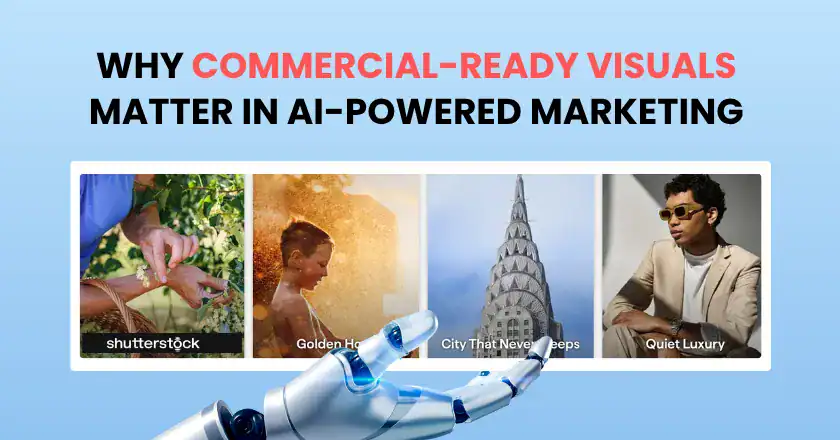
Industry analysts suggest that the value of high-quality stock libraries has increased because these assets provide the structured, high-resolution foundation that AI lacks. For instance, a marketing team might license a professionally shot landscape from a library like Shutterstock and then use AI to adjust the weather, add a product, or reformat the composition for different social media platforms. In this scenario, the stock image provides the essential elements—realistic lighting, correct perspective, and legal clearance—while the AI provides the modularity.
This hybrid approach addresses the problem of "creative fatigue." In digital advertising, audience engagement typically drops after repeated exposure to the same visual. By using AI to generate variations of a single, high-quality "anchor" image, brands can refresh their creative assets more frequently without losing the core visual identity that drives recognition.

Global Market Implications and Cultural Sensitivity
For global corporations, commercial readiness also involves cultural and regional nuances. A visual that is effective in a Western market may require significant adjustments for audiences in East Asia or the Middle East to account for different cultural cues, demographics, and lifestyle representations.
Relying solely on AI to generate these variations can be risky, as models may inadvertently rely on stereotypes or produce culturally inaccurate details. Professional stock libraries offer a curated alternative, providing teams with localized content that has already been vetted for cultural appropriateness. When combined with AI-assisted editing tools, these libraries allow global teams to maintain a consistent brand message while tailoring the visual execution to specific local markets.
Industry Responses and the Move Toward Standardization
The move toward "commercial-ready" standards has prompted a significant response from tech providers and legal experts. Organizations like the Content Authenticity Initiative (CAI) are working to implement "Content Credentials"—a type of digital nutrition label that tracks the origin and edit history of an image.

Major stock agencies have also introduced "AI-ready" tiers of service, which include enhanced legal protections and higher technical standards for AI-generated or AI-modified content. CMOs (Chief Marketing Officers) at Fortune 500 companies have reportedly shifted their focus from "AI adoption" to "AI governance," prioritizing tools that offer transparency and mitigate the risk of trademark infringement.
Broader Impact and the Future of Visual Communication
As generative AI continues to mature, the distinction between "created" and "captured" content will likely blur. However, the requirement for commercial readiness will remain a constant. The future of visual marketing is not a zero-sum game between human creativity and machine generation; it is a collaborative ecosystem where each component serves a specific purpose.
The economic implications are significant. The global stock image and video market, valued at approximately $4 billion, is evolving into a "visual data" market. Companies that possess large, ethically sourced datasets of professional imagery are becoming the primary gatekeepers of commercial-ready content.

In conclusion, while the democratization of image generation has made visual creation accessible to everyone, the threshold for professional marketing remains high. The value of an asset is no longer found in its existence, but in its reliability. As AI saturates the digital landscape with infinite imagery, the brands that succeed will be those that prioritize provenance, quality, and consistency. Knowing which visual is truly ready to represent a brand in the public sphere is now the most critical decision in the modern creative workflow. The emphasis has shifted from the act of making to the act of selecting and certifying, ensuring that in a world of infinite images, the ones that matter are the ones that can be used safely and effectively.