The celestial event of August 12, 2026, marked a significant moment in European astronomical history, as a deep partial solar eclipse coincided with an unprecedented heatwave across the British Isles. In London, where the sun reached approximately 92 percent obscuration, the usual evening rush hour was replaced by a collective pause. At Finchley Central Station in North London, the atmosphere at 7:00 p.m. was characterized by a rare stillness as commuters and staff alike abandoned their schedules to witness the dimming of the summer sun. The event, occurring during a period of extreme thermal stress and Amber Weather Alerts, provided a unique intersection of natural phenomena and human behavior, highlighting the enduring power of celestial cycles to disrupt modern urban life.
Chronology of the August 12 Celestial Event
The solar eclipse of August 12, 2026, was part of Saros Series 126, a cycle known for producing eclipses that cross the Northern Hemisphere. While the path of totality stretched from Greenland through Iceland and into northern Spain, the United Kingdom experienced one of the most significant partial eclipses in decades. In London, the event began in the late afternoon, with the moon first making contact with the solar disk shortly after 6:10 p.m. BST.
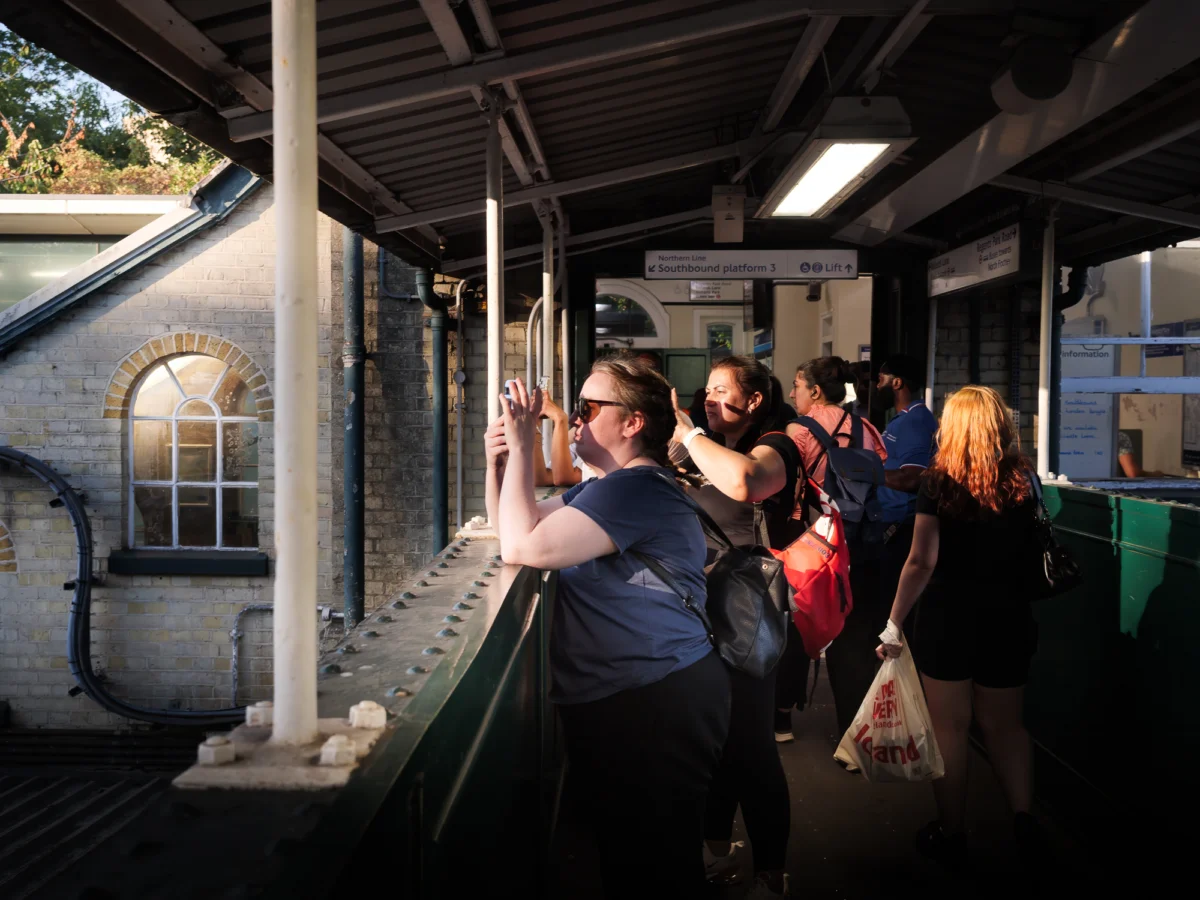
As the moon progressed across the sun, the peak of the eclipse occurred at approximately 7:12 p.m. BST. Observers at Finchley Central Station reported a noticeable shift in ambient light and temperature starting around 6:50 p.m. Unlike the typical gradual transition of a summer sunset, the light took on a "silvery, metallic quality," according to eyewitnesses. By 7:00 p.m., the station bridge had become an impromptu observatory. The event concluded as the moon exited the solar disk around 8:05 p.m., just as the sun was setting below the horizon, leaving the city in a deepened twilight.
Meteorological Context: The 2026 Heatwave and Amber Alerts
The 2026 eclipse occurred against a backdrop of extreme weather. The Met Office had issued an Amber Weather Alert for much of Southeast England, including London, as a persistent high-pressure system brought record-breaking temperatures and a prolonged drought. On the day of the eclipse, temperatures in North London reached 34°C (93.2°F), with high humidity levels making the conditions particularly oppressive.
The lack of rainfall throughout July and early August had already placed significant strain on the city’s infrastructure. The heatwave amplified the visual impact of the eclipse; the "heat shimmer" off the railway tracks at Finchley Central contrasted with the cooling sensation that often accompanies the peak of an eclipse. Meteorologists noted that during the 92 percent obscuration, local temperatures dropped by nearly 3°C within twenty minutes, providing a brief, albeit temporary, respite from the intense summer heat. This thermal shift was recorded across various weather stations in Greater London, marking one of the most rapid temperature fluctuations of the summer season.
The Sociological Phenomenon: From Transit Hub to Observatory
Transportation hubs like Finchley Central are designed for efficiency and movement. However, the 2026 eclipse effectively neutralized the "transit" aspect of the station. Observations from the station bridge revealed a breakdown of traditional commuter behavior. Instead of the typical "head-down" approach to navigating the Northern Line, travelers remained stationary, facing west toward the lowering sun.
This behavioral shift extended to Transport for London (TfL) personnel. Station staff, whose primary mandate is crowd control and the maintenance of passenger flow, were seen participating in the observation. This collective pause transformed the station into a shared public space. The use of technology was ubiquitous; thousands of smartphones were raised toward the sky, capturing the crescent sun through various filters or simply recording the changing light on the urban landscape.
Sociologists observing the event noted that the eclipse acted as a "social leveler." The shared experience of a rare natural event appeared to temporarily dissolve the anonymity of the London commute. The act of "watching the watchers" became a secondary phenomenon, as photographers and documentarians focused their lenses not on the sun itself, but on the human reaction to the celestial alignment.
Technical Data and Infrastructure Impact
The 2026 eclipse presented unique challenges for the UK’s National Grid. With solar power contributing a significant portion of the UK’s renewable energy mix by 2026, the sudden drop in solar radiation required precise management. Between 6:30 p.m. and 7:30 p.m., solar generation across the UK dropped by an estimated 8.5 gigawatts (GW).
Data from the National Grid ESO (Electricity System Operator) indicated that the drop was successfully mitigated by ramping up hydroelectric reserves and gas-fired peaker plants. However, the timing of the eclipse—coinciding with the evening peak in domestic demand—made it a critical test for the grid’s flexibility. In London, the dimming of the sky also triggered automatic street lighting systems in several boroughs, further increasing the load on the electrical network during the period of reduced solar input.
TfL reported no major disruptions to train services, though they did acknowledge "significant crowding" on bridges and open-air platforms across the network. Safety announcements were adjusted to remind passengers to stay clear of the yellow lines while observing the sky, particularly at stations with high-elevation walkways like Finchley Central.
Public Health and Safety Responses
Leading up to August 12, the NHS and the Royal College of Ophthalmologists issued several public health warnings. The primary concern was "eclipse blindness" or solar retinopathy, caused by looking directly at the sun without adequate protection. Despite the 92 percent coverage in London, the remaining 8 percent of the sun’s surface was still bright enough to cause permanent retinal damage.
Health officials reported a surge in the sale of ISO-certified eclipse glasses, though many residents resorted to indirect viewing methods. At Finchley Central, many observers were seen using their smartphones as a buffer, viewing the event through the camera’s digital interface rather than looking directly at the sky. While this protected the eyes, it also changed the nature of the experience, mediating a cosmic event through a digital screen.
In addition to ocular safety, the Amber Weather Alert necessitated warnings regarding heat exhaustion. St. John Ambulance volunteers were stationed at major transit hubs to assist commuters affected by the combination of high temperatures and the dense crowds gathered for the eclipse.
The Role of Digital Documentation and Photography
The 2026 eclipse may be the most photographed celestial event in London’s history. The ubiquity of high-resolution mobile cameras and the rise of real-time social media sharing created a massive digital archive of the event. However, professional photographers sought to capture the nuance of the light that mobile sensors often struggled to process.
Technical documentation from the scene at Finchley Central highlights the use of specialized equipment to record the event’s impact on the environment. Using cameras like the Panasonic Lumix G9 with an Olympus Zuiko 12–40 mm f/2.8 lens, photographers focused on the high dynamic range required to capture both the deep shadows of the station and the intense, filtered sunlight. By utilizing Program mode and a mid-range ISO of 400, documentarians were able to freeze the movement of the crowd while maintaining the integrity of the unique "eclipse light" falling on the station’s architecture.
The photographic record of the day emphasizes a shift in focus from the celestial body to the terrestrial impact. The images captured at Finchley Central serve as a testament to the "observer effect"—the way the presence of a witness, and the tools they use, becomes part of the event itself. The eclipse was not just an astronomical occurrence; it was a cultural moment defined by the people who stood on a bridge in North London, holding their phones to the sky.
Broader Implications and Historical Significance
The August 2026 eclipse serves as a prelude to future astronomical events in Europe, including the highly anticipated total solar eclipse of 2027. For the United Kingdom, the 2026 event was a reminder of the fragility of modern systems when faced with natural extremes. The combination of the eclipse and the heatwave forced a reconsideration of urban resilience and the importance of public spaces that can accommodate communal experiences.
Furthermore, the event highlighted the psychological impact of rare natural phenomena in an increasingly digital and indoor-centric world. The instinctive "turning toward the sun" observed at Finchley Central suggests that despite technological advancements, human beings remain deeply connected to the rhythms of the solar system. The 20-minute window of the eclipse’s peak provided a rare moment of collective reflection for a city usually defined by its relentless pace.
As the shadow of the moon passed and the heatwave continued into the night, the 2026 eclipse left a lasting impression on the capital. It was a day when the sun, usually a background element of daily life, became the central protagonist, forcing a city of millions to stop, look up, and acknowledge their place in a much larger celestial mechanics. The photograph of the crowd at Finchley Central remains a definitive image of that summer—a record of a moment when, amidst a climate of extreme heat and uncertainty, the people of London were united by a few minutes of altered light.