The captivating journey of Rowan Dear, a renowned underwater photographer, illustrates a remarkable transformation from a childhood spent on a Welsh farm to a celebrated professional immersed in the vibrant marine ecosystems of the world. His story, a testament to passion, perseverance, and the courage to conquer personal fears, forms a pivotal entry in the "From Amateur to Professional" interview series, which delves into the evolution of established nature photographers.
Early Life and the Genesis of a Passion for Nature
Born and raised amidst the rolling hills and rich biodiversity of a Welsh farm, Rowan Dear developed an innate and profound appreciation for the natural world from a tender age. His days were often characterized by exploration, roaming the fields and discovering the diverse array of wildlife native to the United Kingdom, including elusive badgers, cunning foxes, nocturnal hedgehogs, and a myriad of captivating bird species. This early immersion in nature’s embrace laid the foundational stones for his future endeavors.

Like countless children of his generation, Dear’s imagination was ignited by the iconic BBC nature documentaries, particularly those narrated by the legendary Sir David Attenborough. These cinematic windows into the planet’s most fascinating creatures, especially the enigmatic underwater realm, fueled a burgeoning dream within him: to witness and experience these wonders firsthand. His initial foray into photography, albeit rudimentary, involved a disposable camera, capturing images of his family pets—dogs and cats—and attempting, with limited success, to approach and photograph the wild animals surrounding his farm. At this nascent stage, the aspiration of becoming a wildlife photographer seemed a distant, almost unattainable dream, perceived as a pursuit reserved for individuals of significant financial means and privilege. This early perception underscored a common barrier for aspiring artists in specialized fields, highlighting the significant investment often required for professional-grade equipment and extensive travel.
Conquering Fear: The Underwater Awakening
A pivotal turning point in Dear’s life occurred in 2017 when he confronted a long-standing fear of water. Embarking on dive courses in the bustling coastal city of Sydney, Australia, marked not only a personal triumph but also the gateway to an entirely new world. Sydney’s rich temperate and subtropical marine environments, offering diverse dive sites ranging from kelp forests to vibrant reef systems, provided an ideal training ground. This courageous step allowed him to physically enter the underwater world he had only dreamt of, transitioning from a terrestrial nature enthusiast to an aquatic explorer.
The year 2020 proved to be a watershed moment for Dear, as he fully embraced underwater photography. This new artistic avenue quickly blossomed, leading to a string of significant competition wins and the organic emergence of an exciting and fulfilling career as a professional underwater photographer. The transition was not a calculated career shift but rather a natural progression, driven by an escalating passion and a burgeoning talent for capturing the ethereal beauty beneath the waves.

The First Lens: A Journey of Discovery and Learning
Reflecting on his early photographic endeavors, Dear recounts his first "proper" underwater image, taken with a dedicated dive camera rather than a basic GoPro. The subject was a majestic giant cuttlefish (Sepia apama), encountered at a dive site outside Sydney. This moment was highly anticipated, as seeing and photographing a giant cuttlefish had long been a personal aspiration. The initial excitement, however, was tempered by the technical realities of early attempts.
"I had long wanted to see a giant cuttlefish, and was desperate to capture an image with my new, expensive dive camera," Dear explains. "Unfortunately, it didn’t quite work out how I had pictured it, and I was left with a quite flat, uninteresting, and not very colourful image." Despite the image falling short of his nascent professional aspirations, he recalls being "pretty happy" at the time, sharing it on social media with the hope of impressing others. While general audiences might have found it appealing, Dear himself acknowledged its limitations when compared to the work of professional or even semi-professional underwater photographers. This early experience served as a crucial learning opportunity, highlighting the gap between casual observation and the technical mastery required to produce truly compelling underwater imagery. It instilled in him an understanding of the complexities of underwater lighting, composition, and the unique challenges posed by water clarity and the movement of marine life.
Mastering the Depths: Iconic Captures and Personal Significance

Dear’s photographic evolution is vividly illustrated through his favorite images, which stand in stark contrast to his early attempts. His enduring fascination with giant cuttlefish is evident in one particular shot: two male giant cuttlefish engaged in a dramatic dominance display to mate with a female. This image, rich in color and dynamic behavior, encapsulates the interactive, intelligent, and visually stunning nature of these cephalopods.
"Giant cuttlefish have long been on my list to photograph and are one of my favorite animals underwater for many reasons; they are incredibly interactive, colourful, intelligent, and stunning creatures," Dear shares. "You can experience so many different behaviours with them, and the challenge is to be able to capture that and then showcase it to the world so people who don’t dive can feel like they were there with you and can get the same emotion you did." This statement underscores his artistic philosophy: to not just document, but to evoke emotion and provide a window into an alien world for those who cannot experience it directly. The chosen image, with its intricate layers of color and narrative, serves as a powerful testament to this objective, allowing viewers to appreciate the complex social dynamics of these creatures.
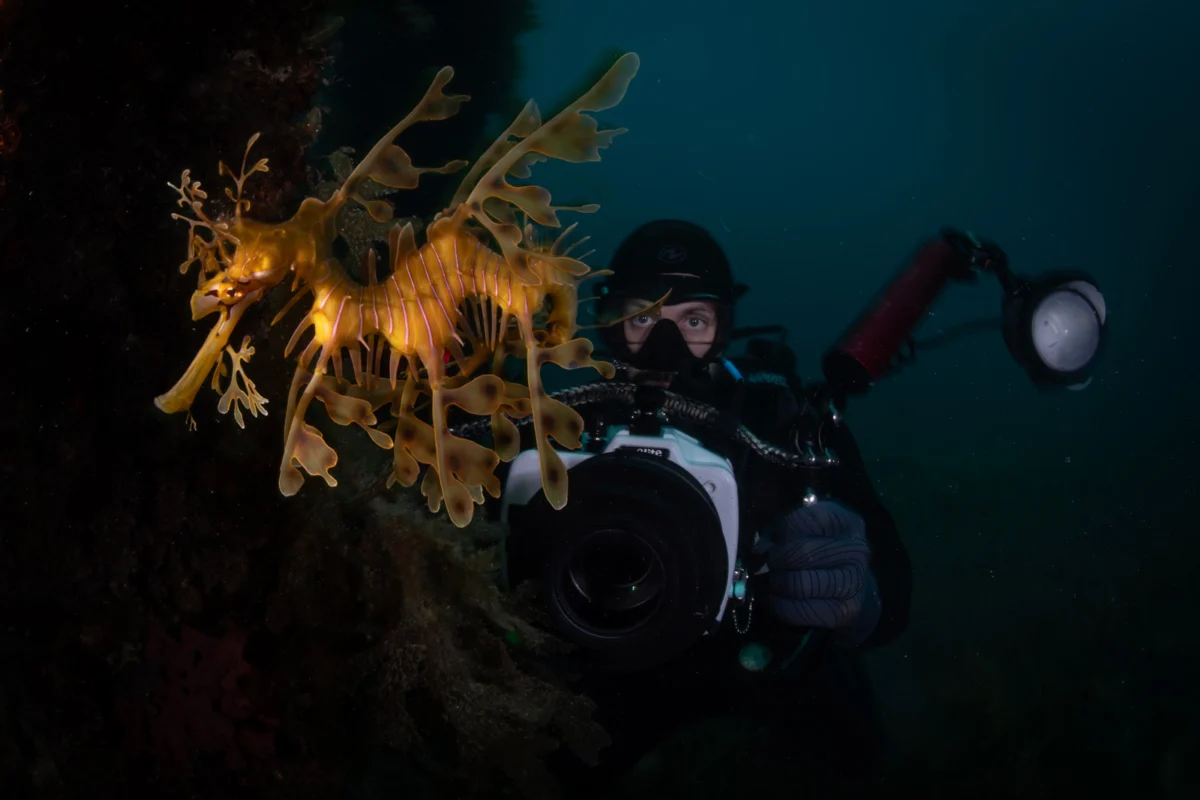
Another image holding significant personal meaning for Dear is a striking portrait of a leafy seadragon (Phycodurus eques). This elusive and exquisitely camouflaged species, native to the waters of Southern Australia, presents considerable photographic challenges. "I love the symmetry of the image, as well as knowing how hard it was to achieve a shot which I had wanted to get for a long time," he notes. The process of capturing this shot involved meticulous planning and immense patience. Shooting at night, utilizing a red focus light to minimize disturbance to the delicate seadragon, Dear waited for the creature to orient itself perfectly, its head tilted just so, to achieve a full, front-on headshot. This dedication highlights the blend of artistic vision, technical skill, and ethical consideration that defines his work. The leafy seadragon, a species particularly vulnerable to habitat loss and illegal collection, benefits greatly from the increased awareness generated by such compelling imagery.
Revisiting Nature’s Wonders: Evolution of Technique and Ecological Context

A cornerstone of effective wildlife photography, as Dear emphasizes, is a deep understanding of the subject species—its habitat, behaviors, and ecological role. This comprehensive knowledge enables photographers to capture animals authentically, revealing their true beauty and facilitating a deeper connection with the viewer. This philosophy underpins his practice of revisiting specific locations and species, allowing for an evolution in his approach and technique over time.
One such site is Whyalla in South Australia, a location globally renowned for its annual aggregation of over 10,000 giant cuttlefish. This spectacular natural event, occurring each year as cuttlefish gather to mate, offers unparalleled opportunities for underwater photography. The site’s unique accessibility, with depths of approximately 5 meters and shore entry, allows for multiple dives daily and extended underwater sessions. "You get to capture different light coming through the water column and are surrounded by so many different characters and colours, totally immersing yourself into the world of the giant cuttlefish," Dear elaborates. This repeated engagement allows him to experiment with various lenses—from wide-angle to fisheye for capturing the vast spectacle, to macro for intimate details of their intricate skin patterns and eyes—thereby achieving a comprehensive spectrum of shots and an unparalleled understanding of their behavior.
Beyond Whyalla, Dear frequently returns to Byron Bay, New South Wales, where large aggregations of leopard sharks (Stegostoma tigrinum) congregate each summer. This location provides a dynamic environment for diverse photographic compositions, ranging from shallow, sun-drenched close-ups to top-down perspectives capturing numerous sharks at varying depths. Byron Bay’s marine park status helps protect these gatherings, offering a reliable, albeit condition-dependent, photographic opportunity.
Heron Island, situated within the iconic Great Barrier Reef, is another favored destination, particularly for freediving during the critical turtle hatching season, which typically runs from February to April. Here, Dear witnesses and photographs the poignant sight of newly hatched turtles embarking on their perilous journey to the ocean. The island is also home to year-round residents like lemon sharks, countless ray species, and adult turtles, offering a rich tapestry of marine life. By meticulously planning dives around tide times, Dear maximizes his underwater hours, ensuring ample opportunities to photograph this diverse and ecologically significant community. The Great Barrier Reef, a UNESCO World Heritage site, faces existential threats from climate change and pollution, making photographic documentation like Dear’s increasingly vital for conservation advocacy.

The Unplanned Ascent: Transition to Professionalism
Rowan Dear’s transition to professional photography was less a conscious decision and more an organic evolution driven by an unwavering passion. "I don’t ever really remember deciding I wanted to go professional," he states. His primary motivation was always the pursuit of "magical underwater experiences," coupled with a relentless drive to refine his craft and improve his ability to capture these moments. Initially, this pursuit was for personal satisfaction, then for sharing with friends and acquaintances, and ultimately, for a broader community of animal and ocean enthusiasts.
The journey to professionalism, therefore, unfolded naturally as a direct consequence of his profound love for the ocean and photography. His ability to skillfully merge these two passions created a path where his art began to gain recognition and demand. This "organic" trajectory contrasts with many traditional career paths, highlighting how genuine enthusiasm and consistent effort can lead to unexpected professional fulfillment.
Validation and Vision: The Role of Competition and Planning

A significant turning point, or "eureka moment," in Dear’s career was the validation received from major photography competitions. "I think it helped a lot when I started winning some major competitions, as that gave me confidence in my work and reinforced the idea that my images were up to the standard of my peers, who I looked up to in the underwater photography space," he explains. In an era dominated by social media metrics like likes and follows, which can often distort one’s perception of actual artistic merit, competition wins offered a tangible, objective measure of his work’s quality and impact. This external validation provided a crucial confidence boost, empowering him to pursue more significant photographic assignments and opportunities.
Beyond raw talent, Dear emphasizes the critical role of meticulous planning in wildlife photography. Success, he argues, is often about "making those opportunities happen and planning ahead to make sure you are best prepared to take the images that you want." This involves extensive research into optimal times of year, specific locations, prevailing weather patterns, and environmental conditions to maximize the chances of capturing desired shots. This proactive, strategic approach transforms the seemingly serendipitous nature of wildlife encounters into carefully orchestrated photographic expeditions.
Refining the Craft: A Philosophy of In-Camera Excellence
Over time, Dear’s photographic process has undergone significant refinement, particularly in his post-production workflow. He now dedicates "far less time editing photos than I used to," attributing this efficiency to improved skills and knowledge that enable him to capture better images directly in-camera. This shift reflects a fundamental philosophy: "if a photo takes too long to edit, you just need to go back out and take a better one." This pragmatic approach discourages excessive reliance on post-processing to correct fundamental errors.

He candidly admits that while the desire for a particular image to work can be strong, attempts to salvage poorly exposed or backscatter-ridden shots through extensive editing often lead to more obvious flaws. His preferred style is characterized by abundant natural light, aiming to create images that appear as authentic and unaltered as possible. This commitment to realism means that most of his editing now takes "a couple of minutes per image," a testament to his mastery of in-camera techniques and a rejection of heavily manipulated aesthetics. This approach not only saves time but also reinforces the integrity and natural beauty of the marine subjects.
Navigating the Unpredictable: Challenges of Wildlife Photography
Wildlife photography, by its very nature, is fraught with challenges, primarily the inherent unpredictability of working with wild animals and dynamic environments. For Dear, the biggest hurdle remains "being in the right place at the right time to get the images you want." Despite exhaustive planning, which he meticulously undertakes for every trip, success is never guaranteed.
He recounts instances where meticulous planning was thwarted by the capricious hand of nature. On a trip to photograph minke whales, for example, adverse weather conditions resulted in zero sightings. "Sometimes, it doesn’t matter how well you have planned, as nature has other ideas," he reflects. This unpredictability is amplified in underwater photography, especially for wide-angle shots, where photographers "pray for those days with great visibility and perfect lighting, where everything comes together for you perfectly."

The reality, however, is that such ideal conditions are rare. Photographers often "have to make do with the hand you are dealt." Dear emphasizes that with experience, one learns to "make the most of the opportunity and still come away with some amazing shots despite the less-than-ideal conditions." He cites a recent trip to Argentina to photograph southern right whales (Eubalaena australis) under a government permit. Despite challenging conditions—poor visibility and strong winds—the experience remained "magical," and he was confident that the images captured were the best possible under the circumstances. This resilience and adaptability are crucial traits for any professional wildlife photographer.
Wisdom from the Deep: Advice for Aspiring Photographers
Reflecting on his journey, Dear offers profound advice to his past self and aspiring photographers. He acknowledges a past lack of confidence, which, while sometimes holding him back from taking on work he was capable of, also served as a catalyst for continuous growth and learning. His perfectionist tendencies, making it difficult to release work he wasn’t "1000% happy with," underscore his commitment to excellence.
His distilled wisdom for future generations of nature photographers is multi-faceted:

- Define Your Destination: "Work out where you want to get to." Having a clear vision provides direction and purpose.
- Seek Inspiration: "Follow the people who inspire you." Learning from masters and peers is invaluable.
- Trust Your Instincts and Forge Your Path: "Follow your instincts, create your own style, hone your craft." Developing a unique artistic voice is paramount.
- Embrace Continuous Improvement: "Always try to improve. Never be content with where you are at." Stagnation is the enemy of progress.
- Cultivate Self-Awareness: "Be self-critical, but also appreciate the value of the work you have done and trust in your process and your ability." This balance between critique and confidence is essential for sustainable growth.
Rowan Dear’s journey from a curious child on a Welsh farm to a celebrated underwater photographer exemplifies the power of passion, resilience, and continuous learning. His work not only captures the breathtaking beauty of the marine world but also serves as a potent reminder of its fragility, inspiring viewers to connect with and protect the planet’s invaluable underwater ecosystems. Through his lens, the unseen wonders of the deep are brought to light, transforming personal fears into a professional legacy of breathtaking imagery and vital conservation advocacy.