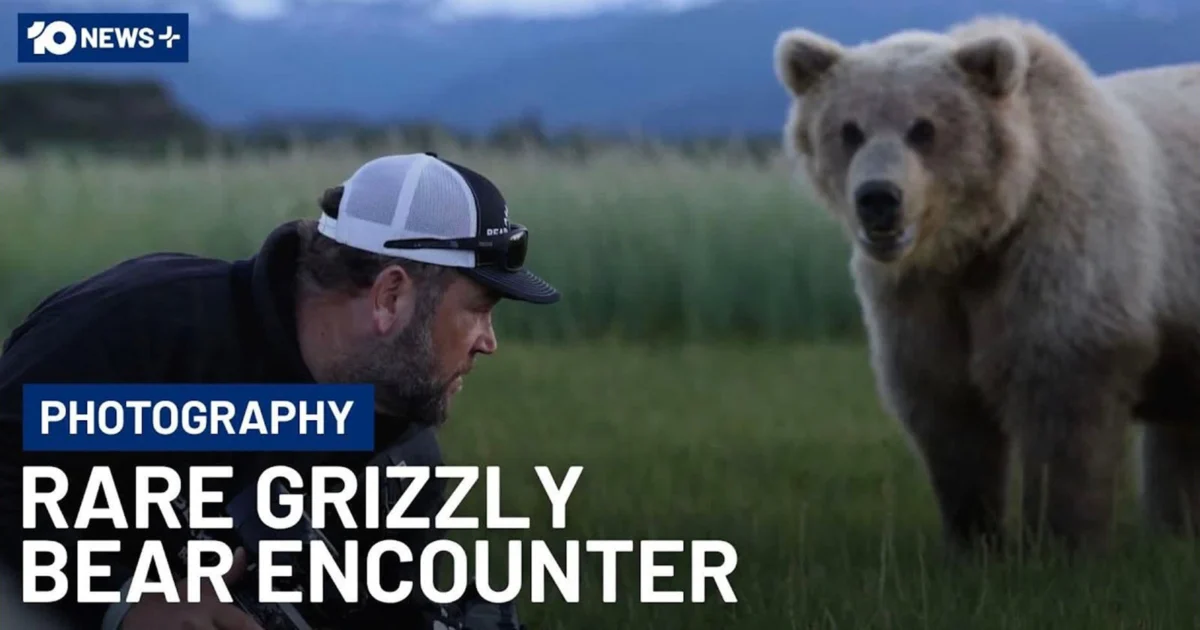
A wildlife photographer on a guided tour in Katmai National Park, Alaska, recently found himself within inches of a grazing grizzly bear, an encounter he described as profoundly peaceful despite its viral circulation sparking widespread public astonishment and concern. Matt Addington, whose video of the incident garnered nearly 40 million views on Instagram since its posting on July 10, maintained that at no point did he experience fear or anxiety, contrasting sharply with the reactions of millions who viewed the footage. This remarkable proximity, facilitated by the unique conditions of Katmai, highlights the delicate balance between wildlife observation, human safety, and ethical photography practices in one of the world’s premier bear habitats.
The Serene Proximity: Detailing the Encounter
The event unfolded during Addington’s guided expedition in Katmai, a remote national park renowned for its dense population of brown bears. Initially, the bears—a sow and her cubs—were observed at a considerable distance, approximately 150 yards away. Addington, positioned on the ground and leaning against his backpack, was engaged in documenting their natural behaviors. As the sow continued her diligent grazing, consuming nutrient-rich grasses to build crucial fat reserves for the upcoming winter hibernation, she and her offspring gradually and organically drifted closer to Addington’s group. This progression was not a result of human provocation or deliberate approach, but rather an unperturbed, natural movement of the bears within their habitat.
"Contrary to what the millions and millions of people who have chimed in on this think, it honestly was one of the most surreal and peaceful encounters that I’ve ever had," Addington relayed to Fox News. He further elaborated, "This was the complete opposite. It was, again, one of the more peaceful, serene, surreal moments that I’ve ever had." The photographer estimated that the apex of this close encounter saw the grizzly sow come within two feet of his position and camera lens. Throughout the duration, the bear exhibited no signs of aggression, alarm, or even particular interest in the human presence, remaining entirely focused on its foraging activity. This behavior is critical to understanding the context of the encounter and the specific environmental factors at play in Katmai.
Katmai National Park: A Sanctuary for Brown Bears
Katmai National Park and Preserve, sprawling over 4 million acres in southwestern Alaska, is a designated wilderness area famous for its volcanic landscape, "Valley of Ten Thousand Smokes," and, most notably, its extraordinary concentration of brown bears (a subspecies of grizzly bears). Home to an estimated 2,200 brown bears, Katmai boasts one of the highest bear densities on Earth. This abundance is primarily attributed to the park’s rich ecosystem, particularly the prolific salmon runs in rivers like Brooks River, which provide a crucial food source for bears during late summer and fall. However, in early summer, before the salmon arrive in force, bears primarily subsist on sedges, grasses, and other vegetation, consuming vast quantities—up to 120 pounds of grass daily—to begin accumulating fat reserves. Addington’s encounter occurred during this early summer grazing period.
The park’s unique management strategy also plays a significant role in facilitating such close, yet typically safe, encounters. Visitor access to prime bear-viewing areas is highly restricted and often requires guided tours or permits, ensuring that human presence is carefully managed. Furthermore, the bears in Katmai, particularly those around Brooks Camp, have become habituated to human presence over decades, largely due to strict regulations enforced by the National Park Service. These regulations mandate specific viewing distances (typically 50 yards from bears, though bears are allowed to approach humans if unprovoked), prohibit food in viewing areas, and require visitors to attend a bear safety briefing. This habituation, combined with an abundant food supply that reduces competitive stress, often results in bears that largely ignore humans, perceiving them as part of the natural landscape rather than a threat or a food source. This distinction is crucial when comparing Katmai to other bear habitats, such as Yellowstone, where bears generally maintain a greater distance from people.
The Role of Expert Guides and Safety Protocols
Addington’s encounter was not a solitary venture but occurred under the supervision of experienced guides, Scott and Jackie Stone. Their expertise and adherence to established safety protocols were paramount in managing the situation. As Addington emphasized, "We didn’t go marching or barging in and say, ‘We’re going to get as close as we can to this bear.’ Everything that we do as photographers – and Scott and Jackie would say this 1000 times over – is to stay back enough that you let bears be bears."
Guided tours in Katmai are designed to minimize human impact and maximize safety. Guides are trained to read bear behavior, understand their movement patterns, and position groups in areas that allow for observation without interference. When bears approach, as in Addington’s case, guides ensure that the group remains still, quiet, and non-threatening, allowing the bears to pass unhindered. This "passive viewing" strategy, where humans yield to the bears, is a cornerstone of Katmai’s bear management philosophy. The guides’ primary responsibility is to ensure that both humans and bears remain safe, and their presence provides a critical layer of judgment and control that is absent in unguided excursions. Their knowledge of individual bear temperaments and local movement patterns is invaluable in predicting and safely navigating such close proximity events.
Understanding Grizzly Behavior: A Scientific Perspective
Grizzly bears (Ursus arctos horribilis), a North American subspecies of brown bear, are apex predators known for their strength, intelligence, and complex social structures. Despite their formidable reputation, aggression towards humans is often a defensive reaction, typically triggered by surprise, a perceived threat to cubs, or competition over food. Bears are primarily driven by survival instincts: finding food, mating, and raising young.
In Katmai, the bears’ behavior is significantly influenced by the sheer abundance of food, particularly salmon during late summer. This reduces the need for bears to compete aggressively or expend energy on potential threats, including humans. When bears are focused on foraging, their sensory attention is primarily directed towards their immediate environment – the scent of food, the sounds of insects, the texture of vegetation. Their hearing and sense of smell are exceptionally acute, far surpassing human capabilities. While their eyesight is generally considered comparable to humans, it is their other senses that often dictate their awareness of their surroundings.
The sow’s behavior in Addington’s video—grazing calmly, head down, seemingly oblivious to the photographer—is indicative of a bear that is highly habituated and utterly unconcerned by human presence. It suggests that the bear did not perceive the human group as a threat, a food source, or a plaything. This level of indifference, while remarkable, is a testament to decades of consistent park management and strict visitor behavior guidelines that have taught these bears that humans are largely benign elements of their landscape. However, it is crucial to reiterate that such indifference is specific to certain habituated populations and does not apply universally to all grizzly bears, nor does it negate the inherent power and unpredictability of wild animals.
Ethical Wildlife Photography and Public Perception
The viral nature of Addington’s video has ignited a broader discussion on the ethics of wildlife photography and the public’s perception of wild animals. While Addington vehemently states his actions were ethical and guided, the visual impact of a human mere inches from a massive predator can be unsettling and potentially misleading for viewers unfamiliar with Katmai’s specific context.
Ethical wildlife photography prioritizes the welfare of the animal and its habitat above all else. Key tenets include:
- Maintaining Distance: Generally, minimum safe distances are prescribed (e.g., 50-100 yards for bears), to avoid disturbing natural behavior. In Katmai, the allowance for bears to approach humans requires photographers to remain stationary and passive.
- No Baiting or Luring: Animals should not be enticed or habituated to human food.
- Minimizing Disturbance: Photographers should avoid making loud noises, sudden movements, or anything that could alter an animal’s natural behavior.
- Respecting Habitat: Staying on designated trails and minimizing footprint.
- Educating the Public: Using imagery to foster appreciation and understanding of wildlife, rather than promoting dangerous behaviors.
Addington’s narrative aligns with the principles of passive observation practiced in Katmai. He did not actively pursue the bear or provoke its approach. His emphasis on "letting bears be bears" underscores a philosophy that respects the animal’s autonomy within its environment. However, the online reaction, with comments ranging from playful jests about being "salad before steak" to genuine expressions of alarm, reveals a widespread lack of understanding regarding the nuances of bear behavior and park-specific regulations. This highlights a challenge for wildlife communicators: how to share compelling close-up imagery without inadvertently encouraging dangerous or unethical practices by others in less controlled environments.
Broader Implications: Conservation and Coexistence
This extraordinary encounter serves as a powerful reminder of the delicate balance required for human-wildlife coexistence, particularly with large predators. On one hand, it showcases the success of Katmai’s conservation efforts, which have fostered a robust and relatively tolerant bear population, allowing for unparalleled viewing opportunities that educate and inspire. These experiences can be vital for generating public support for conservation initiatives.
On the other hand, the viral spread of such close-up footage carries inherent risks. It can inadvertently normalize extreme proximity to wildlife, leading inexperienced individuals to believe similar interactions are safe or achievable in different, less controlled environments. Park services and wildlife agencies across North America consistently advise against approaching bears and emphasize maintaining significant distances to ensure safety for both humans and animals. A bear habituated to humans in one specific, managed park like Katmai may react very differently in another park or wilderness area where human encounters are rare or perceived as a threat.
The incident underscores the ongoing need for robust public education campaigns that differentiate between controlled, guided experiences in unique environments like Katmai and general bear safety guidelines applicable to most wilderness areas. It reinforces the message that while wildlife photography can capture breathtaking moments, it must always be underpinned by a deep respect for animal welfare, rigorous safety protocols, and an understanding of the specific ecological and behavioral contexts of the species being photographed. Addington’s experience, while remarkable and personally serene, is an anomaly born from a confluence of specific circumstances in a highly regulated environment, rather than a blueprint for general wildlife interaction. It ultimately serves as a powerful visual testament to the majesty of wild grizzlies and the potential for coexistence when managed with profound care and respect.