
The recent discontinuation of the Mac Pro in March 2026, marking the end of a brief and somewhat contentious experiment that essentially merged Mac Studio internals with a larger Mac Pro chassis, has led many to mourn the demise of Apple’s flagship professional workstation. However, a deeper examination suggests that the spirit of the Mac Pro has not vanished but has instead been powerfully transmuted into the latest iteration of the Mac Studio, particularly the M5 Ultra model. This strategic evolution signifies a redefinition of Apple’s professional desktop offering, presenting a compact yet immensely powerful solution that eclipses its predecessors in raw performance, particularly for the most demanding creative workflows.
The Mac Pro’s Storied History and Recent Discontinuation
To understand the significance of the M5 Ultra Mac Studio, it’s crucial to contextualize the Mac Pro’s journey. Apple’s professional desktop line has always represented the pinnacle of its computing power, designed for the most intensive tasks in fields like video editing, 3D rendering, and scientific research.
The original Mac Pro, based on Intel Xeon processors, was known for its modularity and expandability. This era culminated in the 2013 "trash can" Mac Pro, a radical departure in design that prioritized a compact, cylindrical form factor. While innovative, its limited upgradeability proved challenging for some professionals. Apple responded with the 2019 modular Mac Pro, a return to traditional tower design, offering extensive PCIe expansion slots, user-upgradable RAM, and powerful discrete GPUs. This machine, while expensive (a fully loaded configuration could exceed $50,000), was a clear statement of intent to cater to the highest-end professional market.
The transition to Apple Silicon marked a paradigm shift. In 2020, Apple began phasing out Intel processors in favor of its custom-designed System on a Chip (SoC) architecture, starting with the M1 chip. This move promised unparalleled performance per watt, unified memory architecture, and tight integration between hardware and software. The Mac Studio, introduced in 2022 with M1 Max and M1 Ultra chips, quickly established itself as a formidable contender in the professional space, offering performance previously associated with the Mac Pro in a significantly smaller and more power-efficient package.

The 2023 Mac Pro, released as part of the Apple Silicon transition, was met with mixed reactions. While it adopted the M2 Ultra chip, making it the most powerful Mac Pro to date, it shared virtually identical core specifications with the M2 Ultra Mac Studio. The primary distinction was the Mac Pro’s larger housing and the inclusion of a few PCIe expansion slots, which, disappointingly for some, offered limited utility for GPU upgrades due to the M2 Ultra’s integrated GPU architecture. This created an awkward overlap in Apple’s product line, where the Mac Pro struggled to justify its higher price and larger footprint over the equally powerful Mac Studio. Consequently, its discontinuation in March 2026, less than three years after its debut, was perhaps an inevitable consequence of this internal product cannibalization.
The Rise of the Mac Studio and the M5 Ultra’s Ascendancy
With the Mac Pro now officially off the roster, the Mac Studio with the M5 Ultra emerges as the undisputed king of Apple’s desktop offerings for professional users. The M5 Ultra represents the pinnacle of Apple’s chip design, integrating a massive 36-core CPU (comprising 12 high-performance and 24 efficiency cores) and an astonishing 80-core GPU, paired with up to 256GB of unified memory in the review unit, with a 512GB option slated for later release in October 2026. This configuration, priced at $12,300 for the tested model (256GB RAM, 4TB SSD), clearly targets the segment previously served by the Mac Pro.

Comparing this price point to previous Mac Pro models further underscores its positioning. The 2023 Mac Pro started at $11,800, and the 2013 "trash can" model could reach $10,000 in higher configurations. The M5 Ultra Mac Studio, while a significant investment, offers a generational leap in performance at a price that is competitive with, or even more value-rich than, its "Pro" branded predecessors, especially when considering the extreme $52,600 price tag of a fully-loaded 2019 Mac Pro. This indicates a clear strategic shift by Apple: the "Pro" experience, once defined by expandability, is now synonymous with raw, integrated silicon power delivered in a more compact form factor.
Design and Connectivity: Subtle Enhancements for Professional Workflows
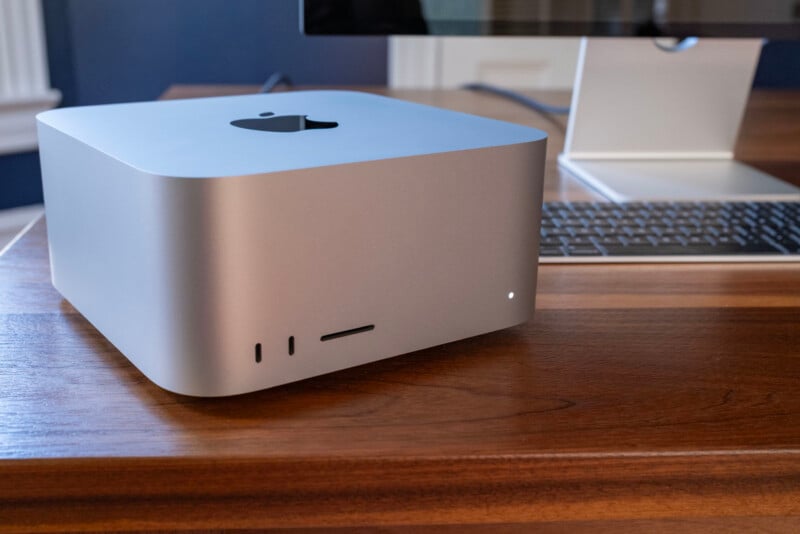
From a physical design perspective, the M5 Ultra Mac Studio maintains the familiar, minimalist aesthetic introduced with the original Mac Studio. It retains the same compact dimensions—3.7 inches tall, 7.7 inches wide, and 7.7 inches deep (9.5 x 19.7 x 19.7 centimeters)—and a weight of approximately eight pounds (3.6 kilograms). This compact form factor is a stark contrast to the bulky Mac Pro towers and remains a significant advantage for space-constrained professional environments. The build quality is robust, and the thermal management system is exceptionally quiet, a hallmark of Apple Silicon, ensuring that even under heavy loads, fan noise remains imperceptible.

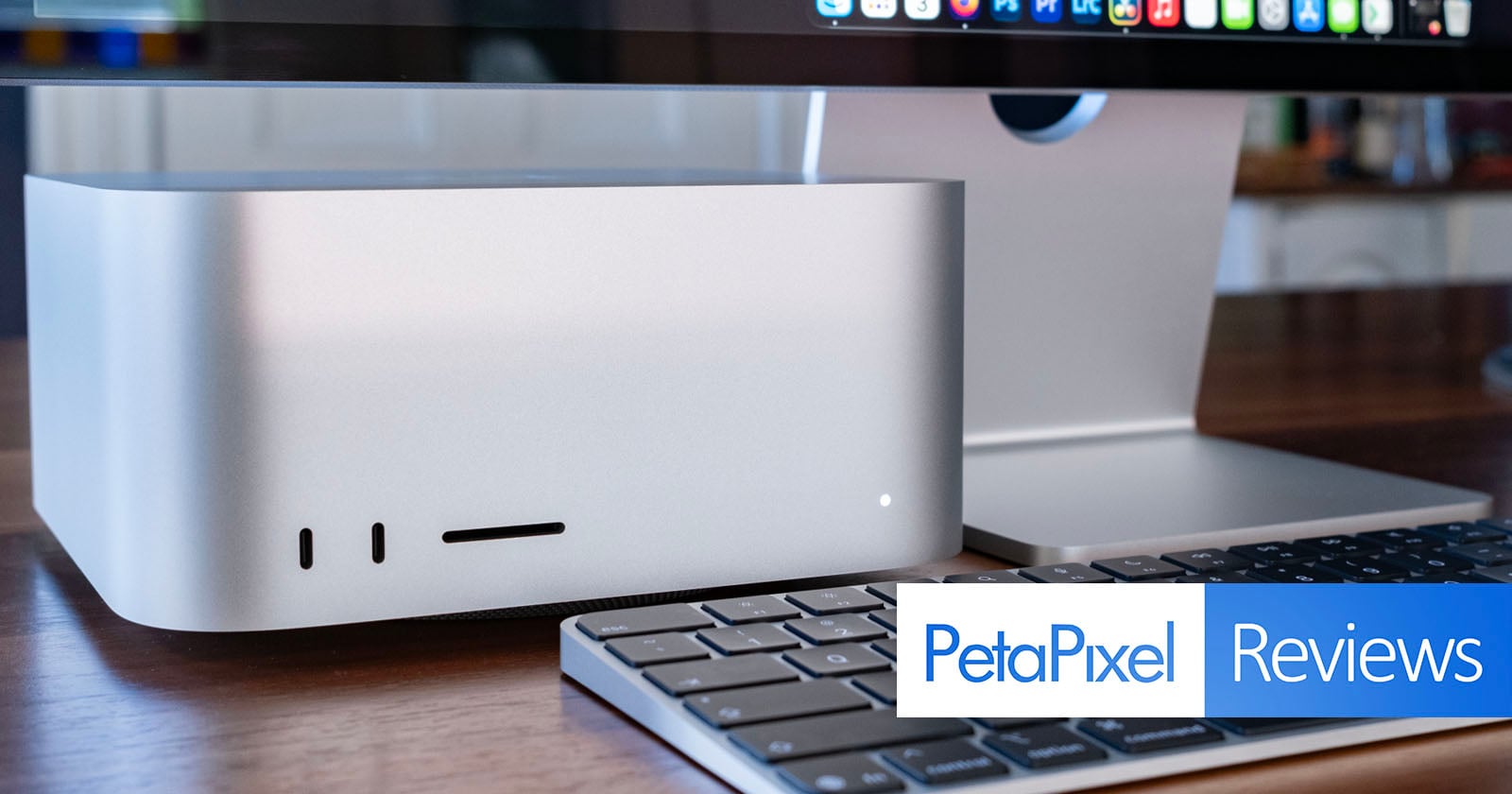
While the overall chassis design is unchanged, the M5 Ultra variant offers a notable enhancement in front-facing connectivity compared to its M5 Max counterpart. The M5 Ultra model features two front-facing Thunderbolt 5 ports, supporting speeds of up to 80 Gb/s, in addition to an SD card reader and a power indicator light. The M5 Max, by contrast, provides two USB-C 10Gb/s ports on the front. This distinction is crucial for video editors and other professionals who frequently ingest large amounts of data from external SSDs. The ability to plug high-speed drives directly into front-accessible Thunderbolt 5 ports streamlines workflows, particularly for those who frequently transfer footage or edit directly from external storage.
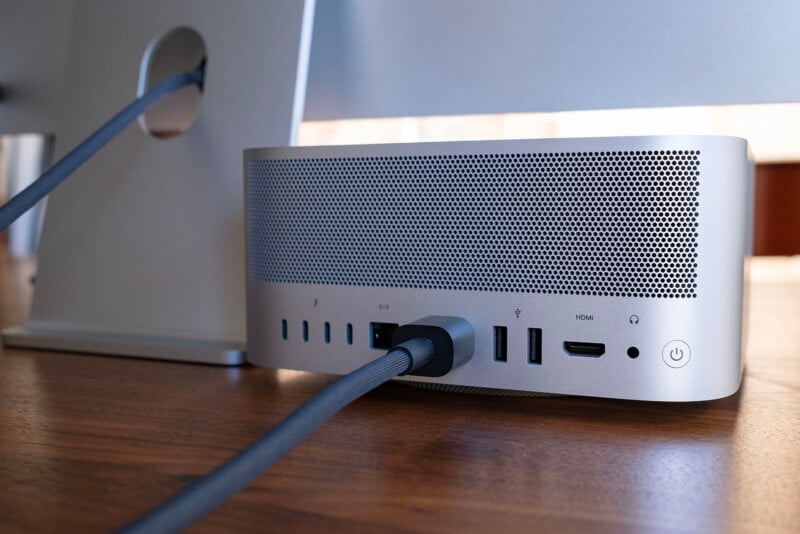
The rear panel remains comprehensive, offering four Thunderbolt 5 ports, a 10Gb Ethernet port, two USB-A ports, an HDMI 2.1 port, a 3.5mm headphone jack, and the power button. The M5 Ultra also boasts enhanced display support, capable of driving up to eight 5K displays, with four of those potentially being Apple Studio Display XDR monitors at 5K resolution and 120Hz. This surpasses the M5 Max’s capacity for five 5K displays, a practical benefit for multi-monitor setups common in professional studios. Connectivity is further bolstered by support for Wi-Fi 7 and Bluetooth 6, ensuring cutting-edge wireless performance.
Unprecedented Performance: Deep Dive into Benchmarks
The true testament to the M5 Ultra Mac Studio’s "Pro" status lies in its benchmark performance. Leveraging Puget Systems’ comprehensive benchmarking tools, the M5 Ultra was rigorously tested across key creative applications, revealing staggering improvements, particularly in GPU-intensive tasks.
Adobe Photoshop Performance:
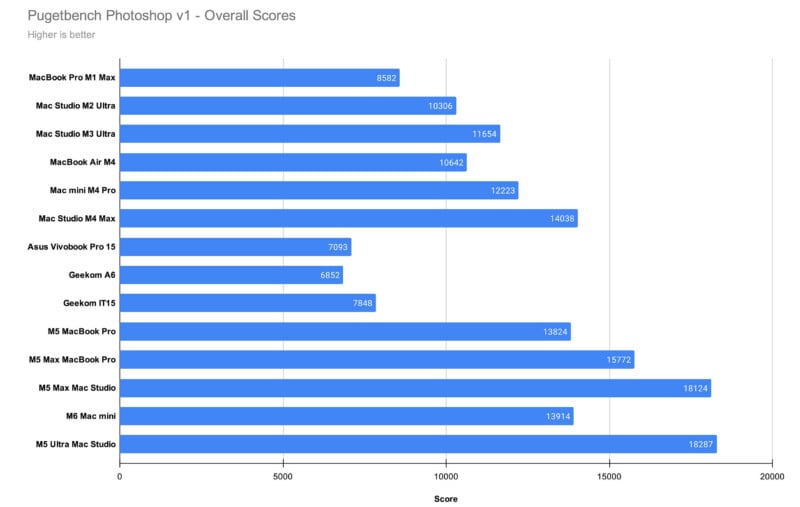
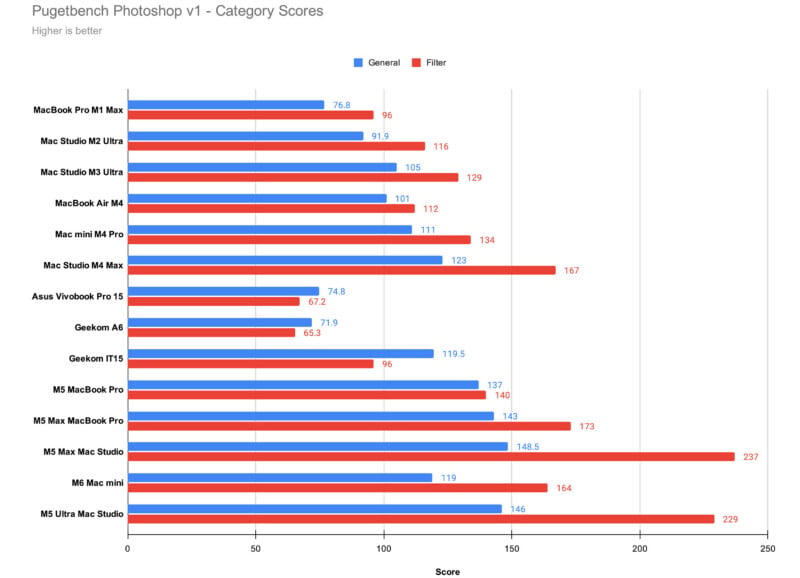
While the M5 Ultra leads in Photoshop performance, the gains over its immediate predecessors, like the M5 Max, are modest. Photoshop remains largely CPU-dependent, and even with the M5 Ultra’s 36-core CPU (double that of the 18-core M5 Max), the application’s current architecture doesn’t fully leverage the extreme GPU power. The M5 Ultra achieved the highest overall scores ever recorded in Pugetbench Photoshop v1, demonstrating its capability, but the incremental improvement over the M5 Max suggests that for photo editors primarily using Photoshop, the M5 Max offers a more cost-effective solution. Users upgrading from older Intel Macs or even M1/M2 generation Apple Silicon will notice a significant leap, but recent Apple Silicon chips already handle Photoshop tasks with considerable efficiency.
Adobe Lightroom Classic Performance:
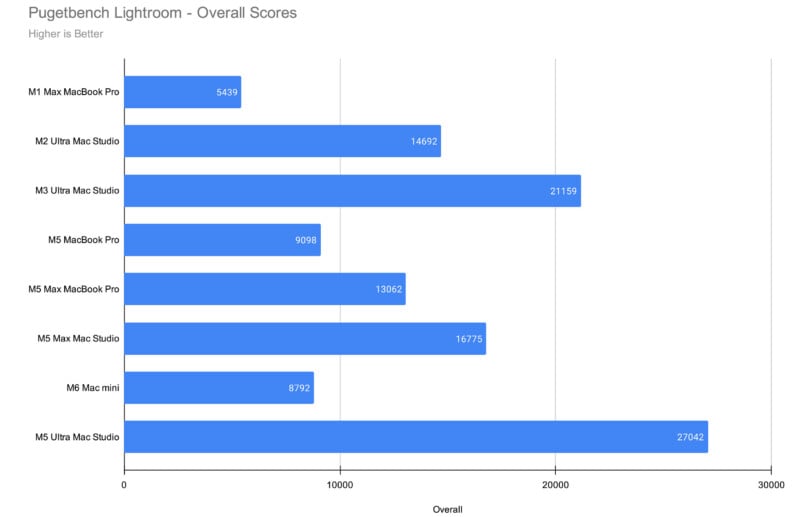
Here, the M5 Ultra truly begins to assert its dominance. Lightroom Classic benefits significantly from GPU acceleration, and the M5 Ultra’s 80-core GPU delivers results that redefine expectations. The M5 Ultra achieved an overall score nearly double that of the M2 Ultra and a 22% improvement over the M3 Ultra. When compared to non-Ultra chips, the performance gap widens dramatically, with the M5 Ultra performing three-and-a-half times better than the baseline M6 and nearly twice as fast as the M5 Max Mac Studio.
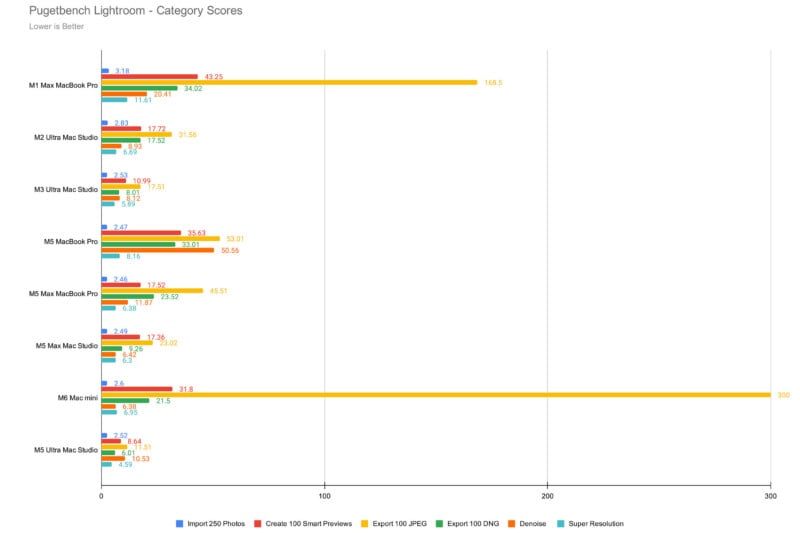
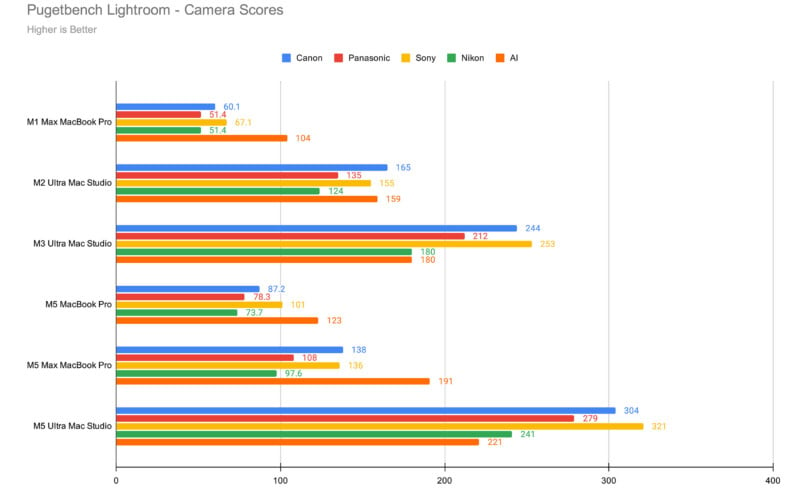
Detailed category scores, especially in AI-powered features like Select Sky, Select Subject, Denoise, and Super Resolution, show the M5 Ultra crushing previous records. The only minor anomaly observed was a slight dip in Lightroom Denoise performance compared to the M6 Mac mini and M5 Max Mac Studio, which is likely attributable to software optimization for newer hardware. This exceptional performance positions the M5 Ultra as the unparalleled choice for photographers managing large volumes of high-resolution RAW files and leveraging advanced AI features within Lightroom.
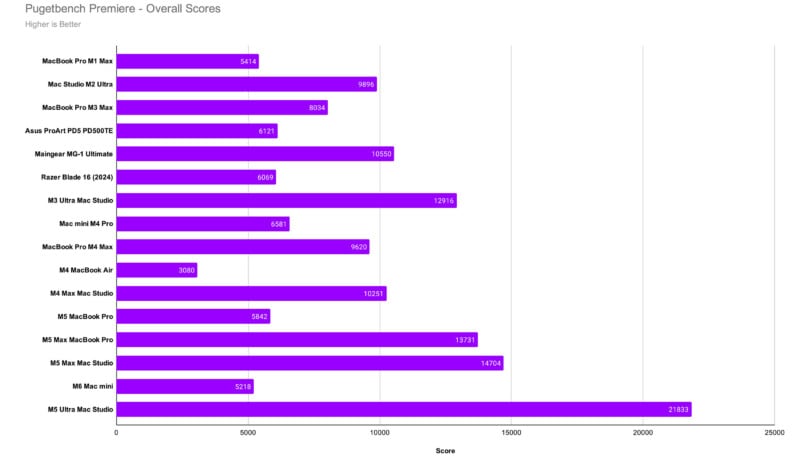
Adobe Premiere Pro Performance:
Video editing is where the M5 Ultra truly shines, justifying its premium price point. The GPU-intensive nature of Premiere Pro tasks, from real-time playback of complex timelines to rendering and exporting, allows the 80-core GPU to unleash its full potential. The M5 Ultra proved to be more than twice as fast as the M2 Ultra and the M4 Max Mac Studio, and substantially faster than both the M5 Max and M3 Ultra Mac Studios. Its GPU effects score was particularly outstanding, contributing significantly to its overall lead.
Similar to Lightroom, a slight dip in the RAW score was noted compared to the M6 and M5 Max, suggesting potential areas for future software optimization. However, across all other critical metrics, the M5 Ultra delivered an "absolute landslide win," as noted by the reviewer. This level of performance is critical for video professionals working with high-resolution, complex projects, where real-time responsiveness and rapid export times directly impact productivity and deadlines.
DaVinci Resolve Performance:
The M5 Ultra’s performance in DaVinci Resolve is nothing short of astounding. Despite a limited comparative benchmark history (due to recent changes in Puget Systems’ Resolve benchmark, allowing comparison only back to the M3 Ultra), the M5 Ultra achieved an overall score of 186,936 – an incredible double the performance of the M3 Ultra, which was previously the top performer. This generational leap is particularly remarkable given that there was no M4 Ultra, making this effectively a direct two-generation jump in performance.
The M5 Ultra excelled across every single task in Resolve, particularly in GPU effects, Fusion, and AI scores. This exponential increase in capability for a single-generation upgrade forces a re-evaluation of expected hardware advancements. For professionals working with high-resolution RAW footage, complex color grading, and advanced visual effects in DaVinci Resolve, the M5 Ultra offers a transformative experience, drastically reducing wait times and enabling more ambitious creative endeavors.
Strategic Implications for Creative Professionals
The M5 Ultra Mac Studio, with its extraordinary performance, firmly reclaims the mantle of Apple’s "Pro" desktop. It’s a machine designed not for the casual user, but for the demanding 4% of creative professionals who push the boundaries of current hardware, particularly in video editing and high-end photography workflows involving large files and complex computational tasks.
For most photographers, even those with professional needs, the M5 Max Mac Studio (or even an M5 Pro MacBook Pro) will provide ample power for Lightroom and Photoshop tasks, offering a more sensible balance of cost and performance. However, for video editors, especially those tackling 6K open-gate and RAW video formats that are increasingly straining older systems, the M5 Ultra offers a clear and compelling upgrade path. The ability to handle these demanding formats with fluidity and speed translates directly into increased productivity and reduced frustration.
The generational performance improvements, especially evident in the leap from the M2 Ultra to the M5 Ultra, underscore Apple’s commitment to delivering significant value for its high-end users. Professionals on a two-to-three-year upgrade cycle will find the M5 Ultra a highly attractive proposition, offering a robust platform that is expected to "crush" demanding workloads for at least the next three to five years, particularly as new compressed RAW formats like Sony’s X-OCN continue to emerge.
Memory Configuration: A Note on Future-Proofing and AI
The forthcoming 512GB memory option for the M5 Ultra Mac Studio, priced at an additional $6,000, warrants careful consideration. While impressive, this extreme memory capacity is unlikely to yield tangible performance benefits for most creative professionals using Adobe Photoshop, Lightroom Classic, Premiere Pro, or DaVinci Resolve. Performance in these applications is primarily driven by the GPU and the M5 Ultra’s massive 1.2TB/s memory bandwidth, not merely the sheer quantity of RAM. Even the most extreme workflows, such as grading 12K RAW multicam timelines or stacking hundreds of Photoshop layers, are improbable to fully saturate 256GB of unified memory.
Apple’s primary rationale for offering the 512GB option appears to be centered around supporting local AI workloads, particularly for running large language models or other compute-intensive AI applications, often showcased through Mac Studio clusters. Creative professionals focused on traditional photo and video editing should therefore exercise caution before investing in this high-cost memory upgrade, as the performance return on investment for their specific use cases is likely to be minimal.
Competitive Landscape and Alternatives
While the M5 Ultra Mac Studio stands alone at the apex of Apple’s desktop lineup, several alternatives exist, each with its own merits and drawbacks.
The M5 Max Mac Studio remains a highly recommended option for the vast majority of photo and video editors. Priced significantly lower, starting around $2,499 for a configuration with an 18-core CPU, 36-core GPU, 36GB unified memory, and 512GB SSD, it delivers a substantial portion of the Ultra’s performance for a fraction of the cost. For many, this represents the optimal balance of power and value.
For those considering a previous generation, the M3 Ultra Mac Studio could theoretically be an alternative. However, its scarcity in new inventory and the M5 Ultra’s demonstrably superior performance (especially the doubling of Resolve scores) make it a less compelling value proposition, particularly if the price difference isn’t substantial. Investing in the latest generation proves more strategic given the performance gap.
The perennial alternative to Apple’s ecosystem is a custom-built Windows or Linux PC. Historically, this route offered greater upgradeability and potentially better value. However, the current market, marked by memory shortages and high component costs, has narrowed this gap. Building a PC capable of rivaling the M5 Max in performance, featuring components like a Ryzen 9 9950X or Intel Core Ultra 9 285K CPU and an NVIDIA GeForce 4070 or 5070 GPU, would likely cost around $2,500 just for the core components, without factoring in RAM, motherboard, cooling, power supply, and case. Achieving comparable video editing performance, especially with high VRAM requirements, often necessitates a more expensive GPU like the RTX Pro 6000 (exceeding $7,000), pushing the total cost well beyond the Mac Studio. While a PC offers superior gaming capabilities and greater modularity, Apple’s integrated approach has made its professional desktops surprisingly competitive on price-to-performance, albeit within the confines of its proprietary ecosystem.
Conclusion: The Enduring Spirit of the Pro
The discontinuation of the Mac Pro was not an end, but a metamorphosis. The M5 Ultra Mac Studio, with its unparalleled performance metrics, particularly in GPU-accelerated applications like Lightroom, Premiere Pro, and DaVinci Resolve, emphatically asserts itself as the true successor to the Mac Pro’s legacy. It embodies the essence of a professional workstation: extreme power, uncompromising efficiency, and a design optimized for the most demanding creative tasks.
While the M5 Max Mac Studio remains the pragmatic choice for the majority of professional photo and video editors due to its exceptional value, the M5 Ultra caters to that elite segment—the 4%—who require the absolute maximum performance Apple can deliver. Its ability to double the performance of its immediate Ultra predecessor in certain benchmarks is a testament to the relentless innovation in Apple Silicon. The M5 Ultra Mac Studio is not just an impressive computer; it is a marvel of engineering, setting a new benchmark for professional desktop computing. For those who lamented the passing of the Mac Pro, the good news is that its spirit lives on, reborn and reinvigorated, in the form of the M5 Ultra Mac Studio. The reports of the Mac Pro’s death, much like Mark Twain’s, have been greatly exaggerated; it has simply evolved.