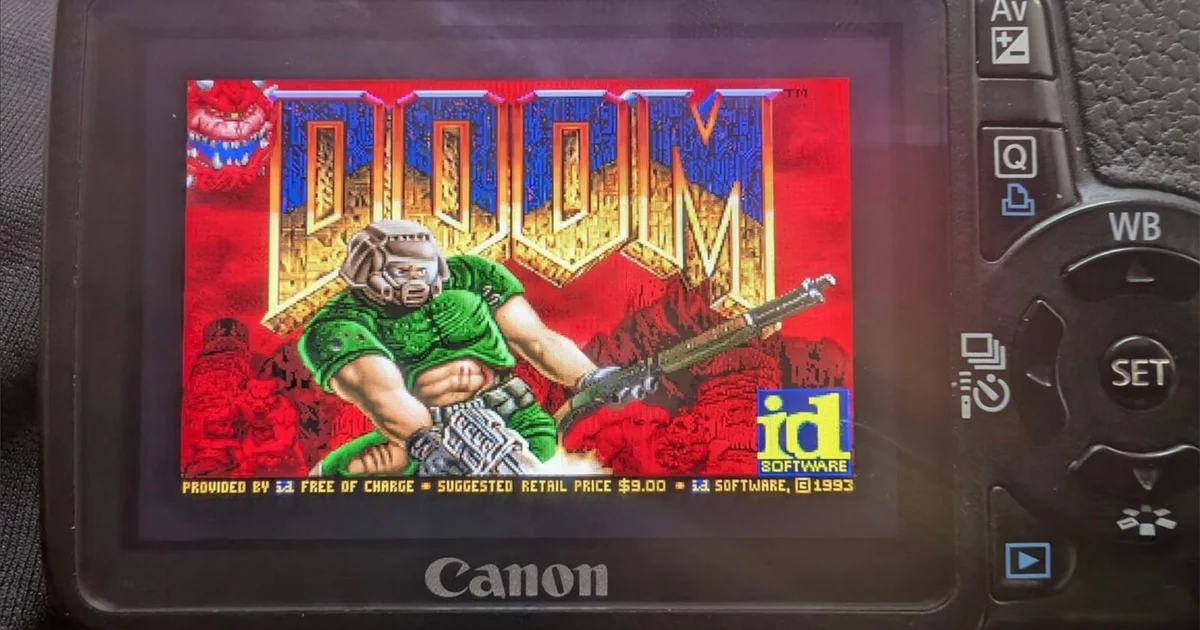
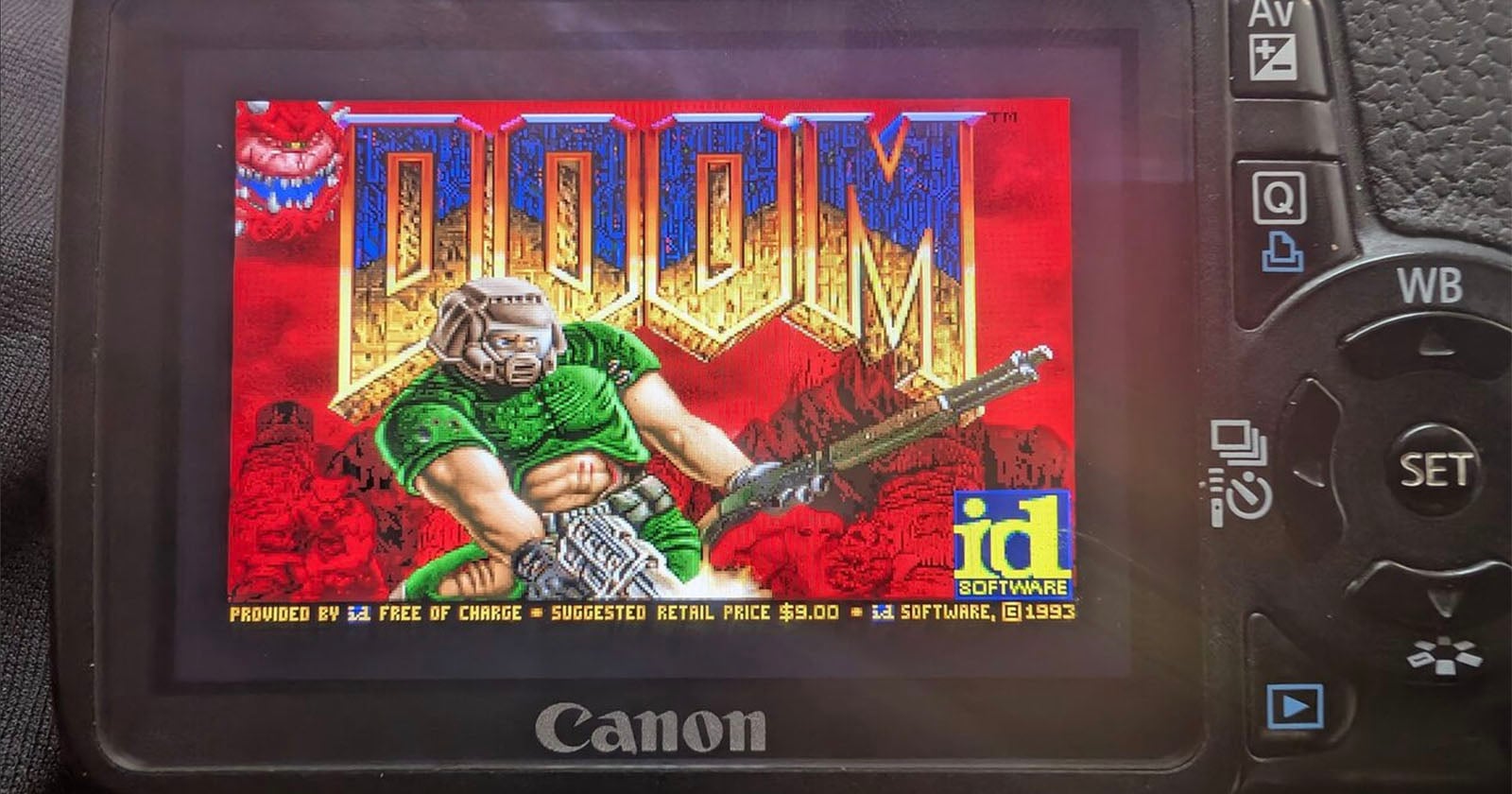
The legendary 1993 first-person shooter Doom has once again defied conventional hardware limitations, this time finding an improbable new home on the Canon EOS 550D DSLR camera. This remarkable technical feat, achieved through a custom module built for the open-source Magic Lantern firmware, allows users to navigate the iconic UAC facility and battle demons directly on their camera’s display, further cementing Doom’s reputation for unparalleled portability across an astonishing array of devices.
The Enduring Legacy of Doom and its Unconventional Hosts
Since its groundbreaking release in December 1993 by id Software, Doom has not only revolutionized the gaming industry by popularizing the first-person shooter genre but also spawned a unique cultural phenomenon: the continuous quest to run the game on the most unexpected hardware. Developed by John Carmack, John Romero, Adrian Carmack, Kevin Cloud, and Tom Hall, Doom was a technological marvel for its time, featuring pseudo-3D graphics, multiplayer deathmatch, and a shareware distribution model that propelled it into millions of homes worldwide. Its efficient engine (id Tech 1) and eventual open-sourcing in 1997 made it an ideal candidate for porting, fostering an vibrant community dedicated to adapting the game to diverse platforms.
This fascination with porting Doom to unconventional devices has seen it appear on everything from smart refrigerators and ATMs to graphing calculators and even a modified pregnancy test. Each new successful port underscores the game’s robust design and the ingenuity of its enthusiasts. The Canon EOS 550D, a popular entry-level DSLR from 2010, now joins this illustrious list, demonstrating that even a decade-old photography tool possesses the underlying computational power, when properly leveraged, to run a cornerstone of video game history.
The Canon EOS 550D: A Digital Canvas for Demonic Action
The Canon EOS 550D, known as the EOS Rebel T2i in North America and EOS Kiss X4 in Japan, was released in February 2010 as a successor to the EOS 500D. At its core, it features an 18-megapixel APS-C CMOS sensor, a DIGIC 4 image processor, and a 3-inch (7.7 cm) LCD screen with a resolution of 1,040,000 dots (approximately 720×480 pixels for the actual game display area). While its primary function was high-quality still photography and Full HD (1080p) video recording, its internal architecture—comprising a capable ARM processor and sufficient RAM—provided a foundation for more adventurous applications.
Bas Lichtjaar, the developer behind this specific Doom module, meticulously adapted the game to run natively on the 550D’s hardware. The game leverages the camera’s entire 720×480-pixel display, offering a surprisingly authentic visual experience given the platform. Audio is also integrated, with Doom’s classic 8-bit sound effects playing through the 550D’s built-in, albeit rudimentary, speaker. This attention to detail, including the functionality of in-game save files and even a secret cheat code menu, ensures that the port is not merely a proof-of-concept but a fully playable version of the classic title.
Control mapping is ingeniously handled through the camera’s existing physical buttons. The four directional function buttons (D-pad) on the rear of the 550D are repurposed for movement, allowing players to navigate the labyrinthine levels. The Menu button serves to bring up the in-game menu, while the central "Set" button, typically used for confirmation, is assigned as the fire button, enabling the player, as the iconic "Doomguy," to dispatch hordes of hellish adversaries. This intuitive mapping demonstrates a thoughtful approach to user interaction, turning a photographic tool into a makeshift gaming console.
Magic Lantern: Unlocking the DSLR’s Hidden Potential
The enabling technology for this unusual port is Magic Lantern, a free, open-source firmware add-on for various Canon DSLR cameras. Launched in 2009 for the Canon EOS 5D Mark II, Magic Lantern was initially developed to enhance video capabilities, such as enabling manual audio control during movie recording. Over time, it evolved into a comprehensive suite of tools that dramatically expands the functionality of Canon DSLRs beyond their factory specifications.
Magic Lantern operates as an overlay, loading from the camera’s SD card and running concurrently with Canon’s native firmware rather than replacing it. This design philosophy significantly reduces the risk of bricking the camera, making it a relatively safe option for hobbyists and professionals alike who wish to unlock advanced features. For the Canon EOS 550D, Magic Lantern offers a plethora of enhancements that transform its capabilities:
- Expanded ISO Range: Pushing the native ISO limits from 100-12,800 to an extended range of 100-24,000, providing greater flexibility in low-light conditions.
- RAW Video Recording: A groundbreaking feature that allows the camera to record uncompressed video data, offering immense post-production flexibility previously exclusive to much higher-end cinema cameras. This feature alone revitalized many older Canon bodies for indie filmmakers.
- Advanced Exposure Tools: Including zebras for exposure warning, false color for precise exposure control, and RAW RGB histograms for accurate color balance.
- Focus Aids: Focus peaking and focus stacking capabilities, essential for critical focus in both photography and videography.
- Intervalometer: Built-in functionality for time-lapse photography without the need for external triggers.
- Custom Frame Rates and Aspect Ratios: Offering greater creative control over video production.
- Electronic Shutter Function: Providing silent shooting and reducing mechanical wear.
- Advanced Audio Controls: Including headphone monitoring, manual gain control, and external microphone support.
The significance of Magic Lantern extends beyond technical specifications; it represents a powerful testament to the open-source community’s ability to innovate and extend the lifespan of consumer electronics. Its development is driven by a global network of volunteers, reverse-engineering Canon’s proprietary systems to tap into hardware capabilities that the manufacturer often leaves dormant.
Magic Lantern itself experienced a period of reduced activity before making what the community hailed as a "glorious return" just over a year ago. This resurgence revitalized interest in older Canon DSLR bodies, prompting many photographers to dust off their devices and explore the new possibilities offered by updated Magic Lantern builds. The return of active development and community support ensures that projects like the Doom port can continue to thrive, pushing the boundaries of what these cameras can achieve.
Technical Implementation and Developer Insights
Bas Lichtjaar’s work on the Doom module for Magic Lantern is a prime example of meticulous reverse engineering and software adaptation. The module, shared on GitHub, provides detailed insights into its functionality and installation process. Lichtjaar explicitly states that the release is currently experimental and designed specifically for the Canon EOS 550D, advising caution and warning against installation on other camera models due to potential incompatibility issues. This responsible approach highlights the complexities involved in porting software to embedded systems with unique hardware configurations.
The module’s integration with Magic Lantern is seamless, allowing users who have already installed the custom firmware to simply add the Doom module to their SD card. This ease of installation, combined with Lichtjaar’s clear documentation, lowers the barrier to entry for enthusiasts wishing to experience Doom on their DSLR. The fact that the game runs natively, utilizing the camera’s display and processor without external emulation, is a testament to the efficiency of the Doom engine and the optimization efforts undertaken by Lichtjaar.
The module’s design ensures that the camera’s core photographic functions remain entirely intact. Users can switch between playing Doom and capturing images or videos without needing to reconfigure the camera, showcasing the non-intrusive nature of the Magic Lantern add-on. This dual functionality is a crucial aspect, preventing the camera from becoming a single-purpose gaming device and maintaining its utility as a professional or enthusiast’s photographic tool.
Broader Implications and the Future of Hardware Tinkering
The successful porting of Doom to a Canon DSLR holds several broader implications beyond its immediate novelty.
Firstly, it serves as a powerful demonstration of the potential residing within "obsolete" consumer electronics. In an era of rapid technological cycles, devices like the 550D are often discarded as newer models emerge. Projects like this, powered by communities like Magic Lantern, offer a compelling argument for extending the lifespan and utility of existing hardware, promoting sustainability and challenging the notion of planned obsolescence.
Secondly, it reinforces the vibrant culture of hardware modding and software tinkering. This ethos, prevalent in communities ranging from retro computing to embedded systems development, is driven by curiosity, a desire to understand how technology works, and the satisfaction of pushing boundaries. Bas Lichtjaar’s project is a clear embodiment of this spirit, inspiring others to explore the hidden capabilities of their own devices.
Thirdly, the project underscores the enduring appeal and technical robustness of Doom. Its ability to adapt to such diverse hardware platforms speaks volumes about its original design principles and the foresight of id Software in eventually open-sourcing its code. The game continues to be a benchmark for minimal system requirements and maximum portability.
Finally, for the Magic Lantern community, this Doom module is a fun yet significant showcase of the firmware’s flexibility and the power it grants users. It might not be a feature that professional photographers will use in the field, but it highlights the extensive control and customization options that Magic Lantern provides, from serious RAW video capabilities to whimsical gaming ports. It encourages new users to explore Magic Lantern’s more practical enhancements, knowing that the platform is robust enough to handle such diverse applications.
As the installation guide for the Doom module is readily available on GitHub, and the Magic Lantern builds for the Canon EOS 550D are accessible on Magic Lantern’s official website, a new generation of photographers and tech enthusiasts can engage with this unique fusion of classic gaming and digital photography. This project is a celebration of technical ingenuity, community collaboration, and the timeless appeal of a game that simply refuses to stay confined to conventional screens.