
The recent unveiling of Sony’s FE 400mm f/4.5 GM OSS and FE 600mm f/6.3 GM OSS telephoto prime lenses in September 2026 has sent ripples through the photographic community, not just for their impressive performance, but for an astonishing feat of optical engineering that renders them remarkably similar beneath the surface. While photographers might reasonably expect substantial differences between two lenses with distinct focal lengths and apertures, Sony has showcased a masterclass in efficiency, leveraging a significant portion of identical optical components to produce two high-performance G Master lenses that share more DNA than initially meets the eye. This innovative approach has implications not only for product development within Sony but also for the broader trends in photographic lens manufacturing, setting a new benchmark for strategic design and cost-effective innovation.
Unveiling the "Fraternal Twins": A Deep Dive into Shared Optics
Upon their introduction, industry observers and photographers were quick to note the aesthetic and ergonomic similarities between the FE 400mm f/4.5 GM OSS and the FE 600mm f/6.3 GM OSS. Beyond a mere superficial resemblance, initial detailed reviews, including those published by PetaPixel, highlighted an unprecedented level of commonality. Both lenses boast nearly identical physical dimensions and weights, with the 600mm variant being less than an inch longer and differing by a mere gram in weight from its 400mm counterpart – a difference so negligible it equates to the weight of a standard paper clip or a dollar bill. This physical congruence extends to their robust weather resistance, the layout of on-barrel controls, and even their minimum focusing distances, which are precisely the same. Critically, both lenses are lauded for delivering exceptionally sharp images, upholding the G Master series’ reputation for uncompromising optical quality.
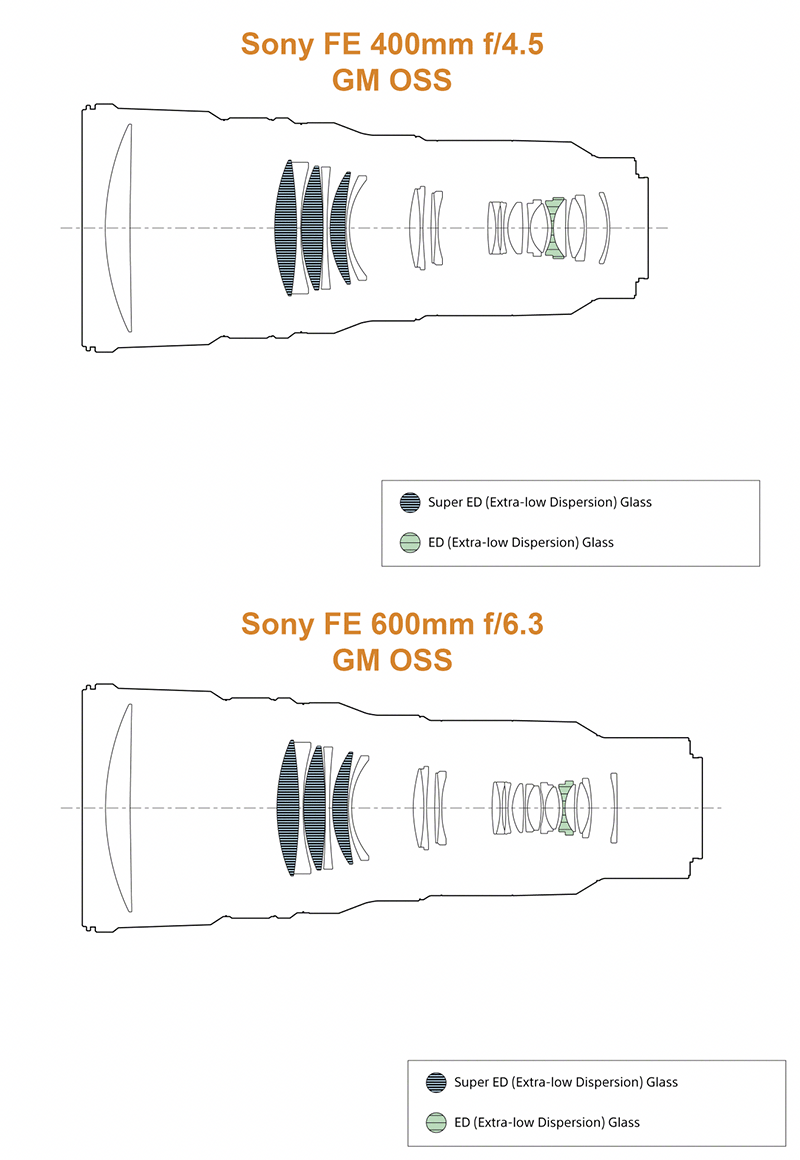
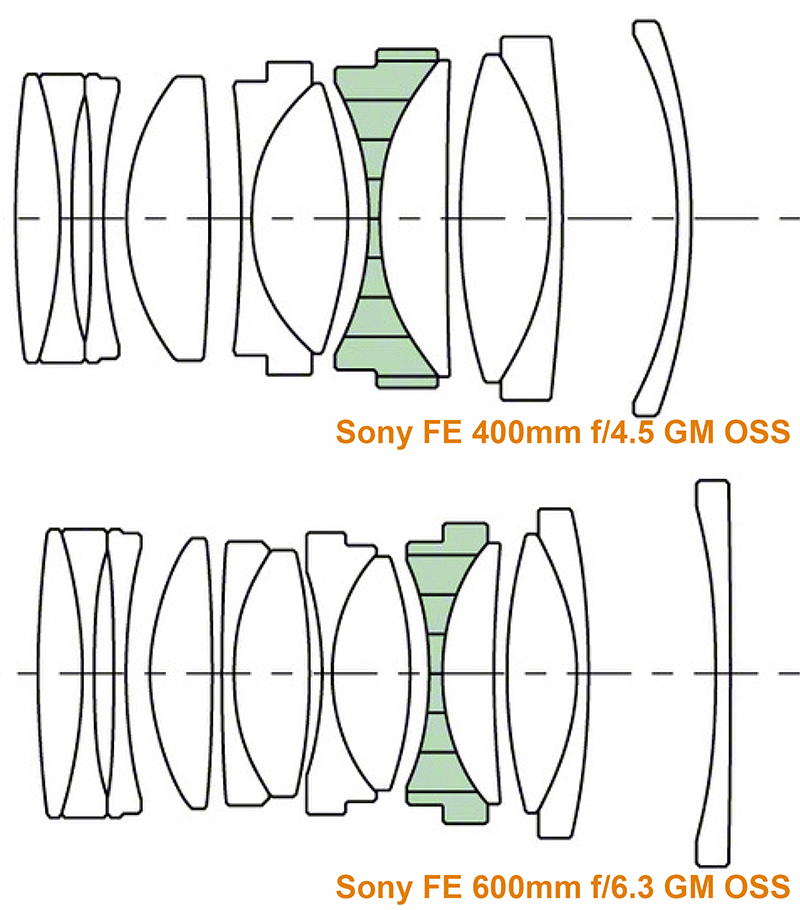
However, the true marvel lies within their internal structure. A detailed examination of the optical diagrams reveals that approximately half of the optical design for both lenses is, in fact, identical. This is not a matter of similar elements or analogous arrangements; it signifies that a substantial portion of the glass elements, from the large single front element to the critical focusing group situated near the middle of the lens barrel, are shared components. This includes a significant optical group comprising multiple Super ED (Extra-low Dispersion) glass elements. These specialized elements are crucial for effectively suppressing chromatic aberrations, a common challenge in long telephoto designs, and their shared presence ensures consistent color rendition and sharpness across both lenses.
As the optical path progresses closer to the lens mount, the designs begin to diverge. The FE 600mm f/6.3 GM OSS introduces two additional elements in an extra group, increasing its total count to 24 elements arranged in 17 groups, compared to the 400mm’s configuration. These supplementary elements are precisely what enable the increased magnification required for the longer 600mm focal length. The difference in maximum aperture—f/4.5 for the 400mm and f/6.3 for the 600mm—is a direct consequence of fundamental optical physics. Given that both lenses utilize the same physical opening size for their entrance pupil, extending the focal length necessitates a proportionally smaller aperture value (a higher f-number) to maintain the light-gathering area relative to the focal length. This mathematical relationship explains why a longer lens with a similar physical front diameter will inherently have a slower maximum aperture.

Performance and Practicality for Photographers
For professional and enthusiast photographers, especially those engaged in wildlife, sports, and action photography, the practical implications of this design strategy are significant. Both lenses feature the same advanced autofocus system, likely incorporating Sony’s latest Linear Motors, ensuring rapid, precise, and silent focusing performance. This consistency means photographers can switch between the two lenses without any learning curve regarding controls or handling, making them ideal companions for dynamic shooting scenarios.
The shared optical heritage, particularly the Super ED elements, guarantees that both lenses deliver exceptional image quality, characterized by high resolution, excellent contrast, and minimal optical aberrations. The G Master designation itself is Sony’s hallmark for its premium lens series, promising superior resolution even at the widest apertures, coupled with beautifully smooth bokeh—a critical factor for subject isolation in telephoto photography. The portability, stemming from their lightweight and compact design (relative to their focal lengths), makes them highly attractive for photographers who often trek into remote locations or spend long hours handholding their equipment. This is a considerable advantage over heavier, bulkier telephoto lenses of previous generations.

Sony’s Strategic Vision: Innovation and Efficiency in Lens Development
Sony’s approach to these two telephoto primes is a testament to astute business strategy and sophisticated engineering. Developing a single all-new lens, especially a G Master prime, involves substantial investment in research and development, intricate optical design, and complex manufacturing processes. By designing a core optical module that can be adapted for two distinct focal lengths, Sony has effectively mitigated a significant portion of the typical R&D and production costs associated with launching two separate high-end lenses. This strategy allows them to introduce two highly desirable products to the market with potentially accelerated development cycles and optimized resource allocation.
This method of "platform sharing" for optical components is a clever way to maximize return on investment for their engineering prowess. It demonstrates Sony’s commitment to innovation not just in performance but also in manufacturing efficiency. This efficiency can translate into competitive pricing, faster market availability, and a stronger, more cohesive product ecosystem for their Alpha mirrorless camera system. It solidifies Sony’s position as a leader in the mirrorless market, offering compelling options that balance performance with practical considerations like size, weight, and consistency.

Market Context and Competitive Landscape
The photographic industry is highly competitive, with major players like Canon and Nikon also investing heavily in their mirrorless telephoto offerings. Sony’s FE 400mm f/4.5 GM OSS and FE 600mm f/6.3 GM OSS enter a market where photographers increasingly demand lighter, more compact, yet uncompromisingly sharp telephoto lenses for their mirrorless systems. By presenting two lenses that are so similar in handling and performance, Sony offers a clear choice based primarily on desired focal length and maximum aperture, rather than a complex trade-off of features or build quality.
This strategy positions Sony advantageously. It appeals to photographers who might initially consider the 400mm for its slightly faster aperture and then find a seamless upgrade path to the 600mm when greater reach is required, or vice-versa. The consistency across the two lenses minimizes the psychological barrier of adopting a new piece of equipment, fostering brand loyalty and making it easier for photographers to expand their G Master collection.
The "Fraternal Twins" Phenomenon: Industry Precedents and Future Implications
While Sony’s implementation here is particularly striking due to the high degree of optical commonality in premium telephoto primes, the concept of leveraging existing designs or core modules for new products is not entirely new in the industry. Fujifilm, for instance, famously adapted its Fujinon GF 500mm f/5.6 R LM OIS WR lens, originally designed for its medium format GFX system, to its APS-C X Series cameras by simply changing the lens mount. This effectively created a 750mm equivalent telephoto prime for the X Series, demonstrating a similar principle of maximizing a single design across different camera platforms. However, Sony’s case involves creating two different focal length lenses for the same camera system from a shared optical foundation, which arguably represents an even more complex and impressive feat of internal optical adaptation.
This trend suggests a potential shift in lens design philosophy across the industry. As optical engineering becomes more sophisticated and manufacturing processes more precise, companies may increasingly look for ways to modularize lens components or develop "super-platforms" that can be adapted to yield multiple products. This could lead to faster product cycles, more consistent performance across a brand’s lineup, and potentially more accessible pricing for advanced optics due to economies of scale in R&D and production. The ability to offer a family of lenses that feel and perform similarly, despite differences in focal length or aperture, enhances the user experience and builds confidence in the brand’s engineering capabilities.
Conclusion: A Win-Win for Sony and Photographers
In conclusion, Sony’s FE 400mm f/4.5 GM OSS and FE 600mm f/6.3 GM OSS are more than just two new telephoto lenses; they represent a significant engineering and business achievement. By intelligently sharing a substantial portion of their optical design, Sony has delivered two highly capable, lightweight, and optically superb G Master lenses that offer consistent handling and performance. For photographers, this means access to premium telephoto capabilities with exceptional image quality and a streamlined user experience. For Sony, it signifies a highly efficient product development strategy that maximizes engineering investment and strengthens its market position.
While some photographers might note the approximately $1,000 price difference between the 400mm and 600mm variants, despite their significant optical commonality, it is important to acknowledge that lens pricing is influenced by a multitude of factors beyond just the direct cost of materials and assembly. These factors include the recovery of R&D for the unique elements of the 600mm, market demand, competitive positioning, and the perceived value of the extended reach. Ultimately, both lenses stand as uncompromised performers, and photographers investing in either are poised to benefit from Sony’s clever blend of optical innovation and strategic efficiency. This symbiotic relationship between advanced engineering and market strategy ensures that both Sony and its discerning customer base emerge as winners.