The landscape of professional photography, particularly within high-stakes genres like motorsport, consistently demands equipment capable of exceptional speed, precision, and optical fidelity. Over the past four years, the shift towards motorsport photography has underscored a growing imperative for specialized long lenses that can adeptly navigate the complexities of extreme speed, vast distances, and rapidly fluctuating light conditions. While versatile tools such as the Fujifilm XF100-400mm f/4.5-5.6 R LM OIS WR have proven indispensable for comprehensive trackside coverage, offering a practical early solution and maintaining its status as a default utility lens at venues like the Circuit of the Americas, the pursuit of ultimate performance necessitates a deeper commitment to specialized optics. This commitment is epitomized by the Fujifilm XF200mm f/2 OIS WR, a lens that has rapidly ascended to become a benchmark for its class across any camera system.
The Evolution of Fujifilm’s Professional Line-up: Addressing Demanding Genres
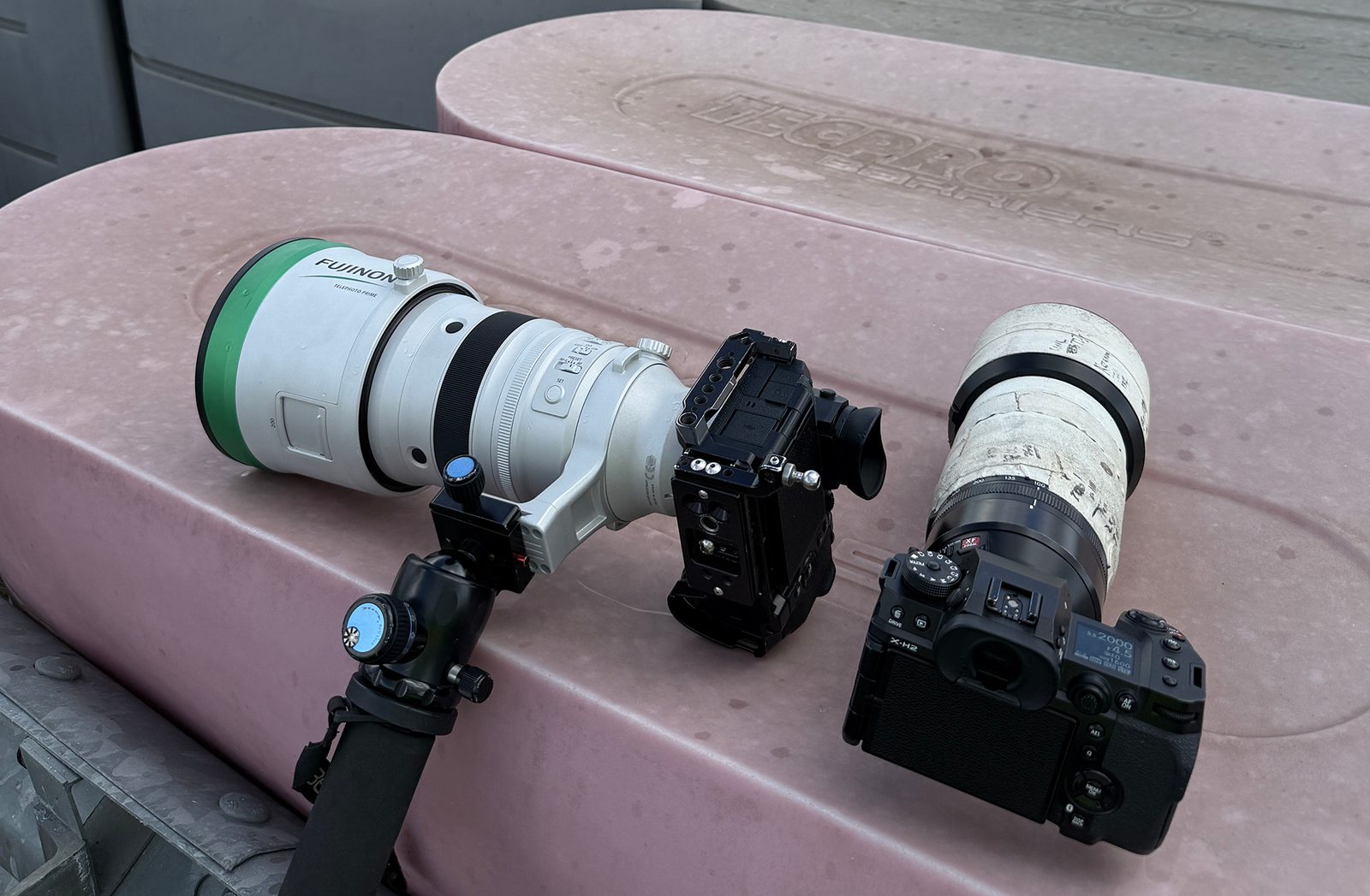
Fujifilm’s journey into the professional sports and action photography market has been marked by a strategic evolution of its X-series mirrorless system. Initially lauded for its compact form factor, retro aesthetics, and exceptional image quality, the X-series has progressively introduced bodies and lenses engineered to meet the rigorous demands of professional use. This trajectory saw the release of robust, weather-sealed zoom lenses like the XF50-140mm f/2.8 and the aforementioned XF100-400mm f/4.5-5.6, providing photographers with versatile tools for various scenarios. These lenses, offering strong optical performance and reliable autofocus, served as foundational elements in establishing Fujifilm’s credibility in professional fields where speed and durability are paramount.
The introduction of the XF200mm f/2, however, signaled a distinct and ambitious move. It represented Fujifilm’s unequivocal declaration of intent to compete at the very highest echelons of professional photography, demonstrating that its APS-C system could deliver a super-telephoto prime lens rivaling the performance typically associated with full-frame counterparts. This lens is not merely an addition to the lineup; it is a statement of capability, designed for photographers who demand absolute excellence in light gathering, subject isolation, and critical sharpness, even under the most challenging conditions. Its development reflects an understanding that while versatility is valuable, there are specific scenarios where uncompromising, specialized performance is non-negotiable.
Technical Prowess: Engineering for Extreme Performance
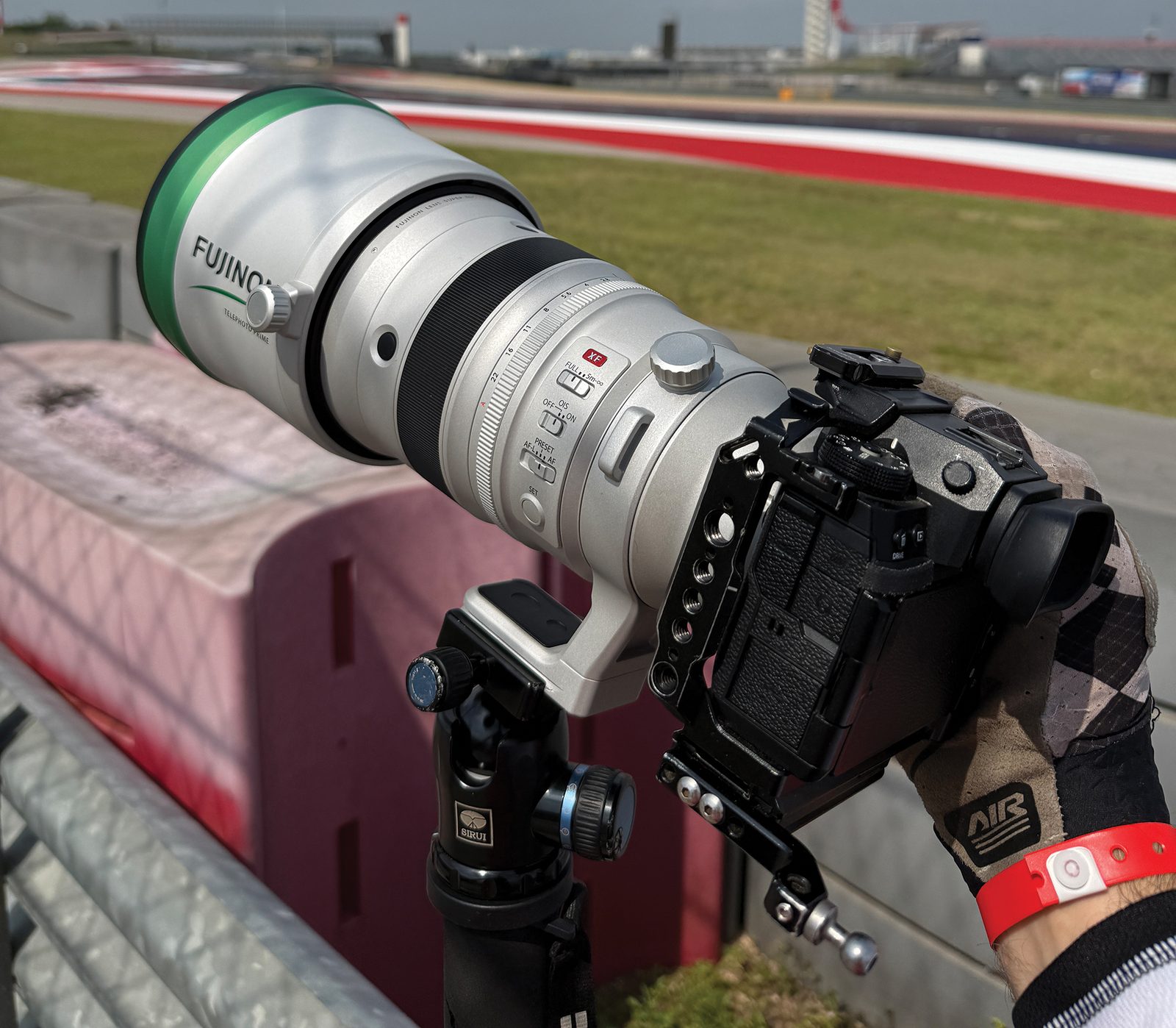
The Fujifilm XF200mm f/2 OIS WR is a testament to sophisticated optical and mechanical engineering. With an angle of view equivalent to approximately 305mm on a full-frame system, it offers a significant reach suitable for capturing distant subjects with precision. Critically, the lens is designed to integrate seamlessly with the included XF 1.4x TC WR teleconverter, extending its effective focal length to roughly 427mm full-frame equivalent. This extension comes with a minimal and expected aperture reduction to f/2.8, a trade-off that is remarkably mitigated by the teleconverter’s advanced design, which ensures no discernible degradation in optical performance or autofocus speed—a significant achievement that distinguishes this pairing in the market. This integrated approach provides photographers with expanded reach without compromising the image quality or responsiveness crucial for fast-paced events.
Physically, the lens makes an immediate and commanding statement of its professional-grade construction. It features a full-metal chassis, providing exceptional durability and a reassuringly solid feel essential for prolonged use in demanding environments. A unique design element is its matte silver coating, a practical choice implemented to minimize heat absorption. In motorsport photography, where sessions can extend for hours under direct, intense sunlight, this feature is critical. Reduced heat absorption helps maintain internal lens stability, mitigating the risk of thermal expansion that could otherwise lead to subtle image degradation and ensuring consistent optical performance throughout a shoot.
The autofocus system is driven by a twin linear motor, a sophisticated mechanism engineered for both exceptional speed and near-silent operation. This is particularly beneficial in scenarios where discreet performance is required, or where rapid subject tracking is paramount, such as following a race car hurtling down a straight at triple-digit speeds. Complementing this swift autofocus is a highly effective built-in optical image stabilization (OIS) system, rated at five stops. This stabilization is a vital asset, providing meaningful assistance for handheld shooting, especially when panning to capture motion blur or when light levels necessitate slower shutter speeds while maintaining sharpness.
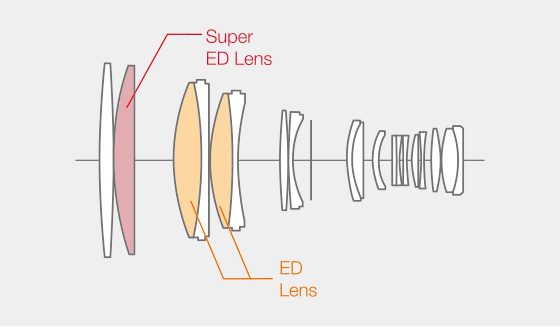
Optically, the XF200mm f/2 reflects a no-compromise design philosophy. Its complex construction comprises 19 elements arranged in 14 groups, a configuration that includes one Super ED (Extra-low Dispersion) element and two ED elements. These specialized glass types are strategically employed to rigorously control chromatic aberration, a common optical distortion in long telephoto lenses, ensuring images exhibit pristine color accuracy and exceptional clarity from edge to edge. The lens is fully weather-sealed at multiple points, safeguarding against ingress of dust and moisture—a crucial feature for trackside photography where weather can be unpredictable. A fluorine-coated front element further enhances its robustness, repelling water, dirt, and grease, simplifying maintenance in the field. The inclusion of nine rounded aperture blades is a deliberate design choice to produce smooth, aesthetically pleasing circular bokeh, enhancing subject separation and creating artistic background blur. Precision exposure control is facilitated by a one-third EV step aperture ring, offering granular adjustments critical for professional workflows. An integrated rotating tripod collar, complete with multiple strap attachment points, underscores the lens’s ergonomic design for heavy-duty use, providing stability and balance whether mounted on a monopod or carried for extended periods.
Synergy on the Track: The XF200mm f/2 and the X-H2S Combination
For professional motorsport photographers operating within the Fujifilm ecosystem, the pairing of the XF200mm f/2 with the Fujifilm X-H2S camera body represents a symbiotic relationship that elevates performance to an unprecedented level within the X Series. The X-H2S, with its stacked 26.1MP X-Trans CMOS 5 HS sensor and X-Processor 5, is purpose-built for speed, featuring blackout-free continuous shooting, an advanced AI-driven subject detection autofocus system, and impressive buffer depths. When coupled with the XF200mm f/2’s rapid twin linear motor autofocus, the resulting combination delivers an experience characterized by effortless speed, unwavering autofocus reliability, and exceptional clarity and sharpness. In the high-octane environment of a race track, where subjects move at triple-digit speeds, the ability to consistently acquire and maintain focus, capture decisive moments, and produce critically sharp images is paramount, making missed shots an unacceptable outcome.

While the XF200mm f/2 also performs commendably on the Fujifilm X-H2, the difference in autofocus acquisition and consistency on the X-H2S is noticeably superior. This distinction stems from the X-H2S’s stacked sensor design, which offers significantly faster readout speeds, and its more advanced processing capabilities, which enhance the camera’s ability to track fast-moving, erratic subjects with greater precision and fewer missed frames. For photographers whose livelihood depends on capturing fleeting moments with absolute certainty, this performance differential is a critical factor.
Artistry in Motion: Image Quality and Creative Control
Beyond its technical specifications, the XF200mm f/2 possesses a distinct photographic "personality" that discerning professionals come to appreciate. There is an initial acclimation period required for photographers accustomed to the flexibility of zoom lenses. Working with a dedicated super-telephoto prime demands a disciplined approach to identifying optimal vantage points and precise framing. However, once this rhythm is established, the photographic experience becomes profoundly rewarding, often described as addictive. Reviewing images captured with this lens frequently elicits audible reactions from photographers, a testament to its striking visual output. The separation between subject and background is exceptional, a hallmark of fast, long prime lenses. When shot wide open at f/2, the bokeh is rendered with a rich, creamy quality, creating a beautifully diffused background that accentuates the critically sharp subject. This aesthetic quality, often referred to as an "umami lens" for its unparalleled and stunning flavor, distinguishes images captured with the XF200mm f/2 from those produced by other lenses in the Fujifilm lineup.

Several thoughtful design details enhance the lens’s utility in daily professional use. The programmable autofocus buttons strategically placed on the barrel provide an additional point of stable interaction, especially beneficial when shooting handheld. These buttons can be customized to perform various functions, such as instant autofocus activation or switching AF modes, allowing photographers to maintain focus on the subject without diverting attention to camera controls. The lens hood is equally impressive: generously sized, rigidly constructed, and secured with a pressure screw. Beyond its primary function of minimizing lens flare and protecting the front element, its robust design allows for a common professional technique of cupping the edge of the hood while working with a monopod, providing additional stability and control during long panning shots.
Professional Demands: Ergonomics, Weight, and Accessory Investments
The XF200mm f/2, while a marvel of optical engineering, is a substantial piece of equipment. Weighing approximately 2,265 grams (around 5 pounds), it is manageable for handheld use in shorter bursts, but its heft becomes a significant consideration during long shooting days. After hours of handheld operation, particularly when executing speed panning techniques, the physical strain on the photographer’s shoulder and arms becomes undeniable. Consequently, while not strictly mandatory, a monopod transforms from a luxury into a welcome and often necessary companion. A monopod not only alleviates physical fatigue but also provides enhanced stability, crucial for maintaining sharpness at longer focal lengths, especially when working with slower shutter speeds to achieve creative motion blur.
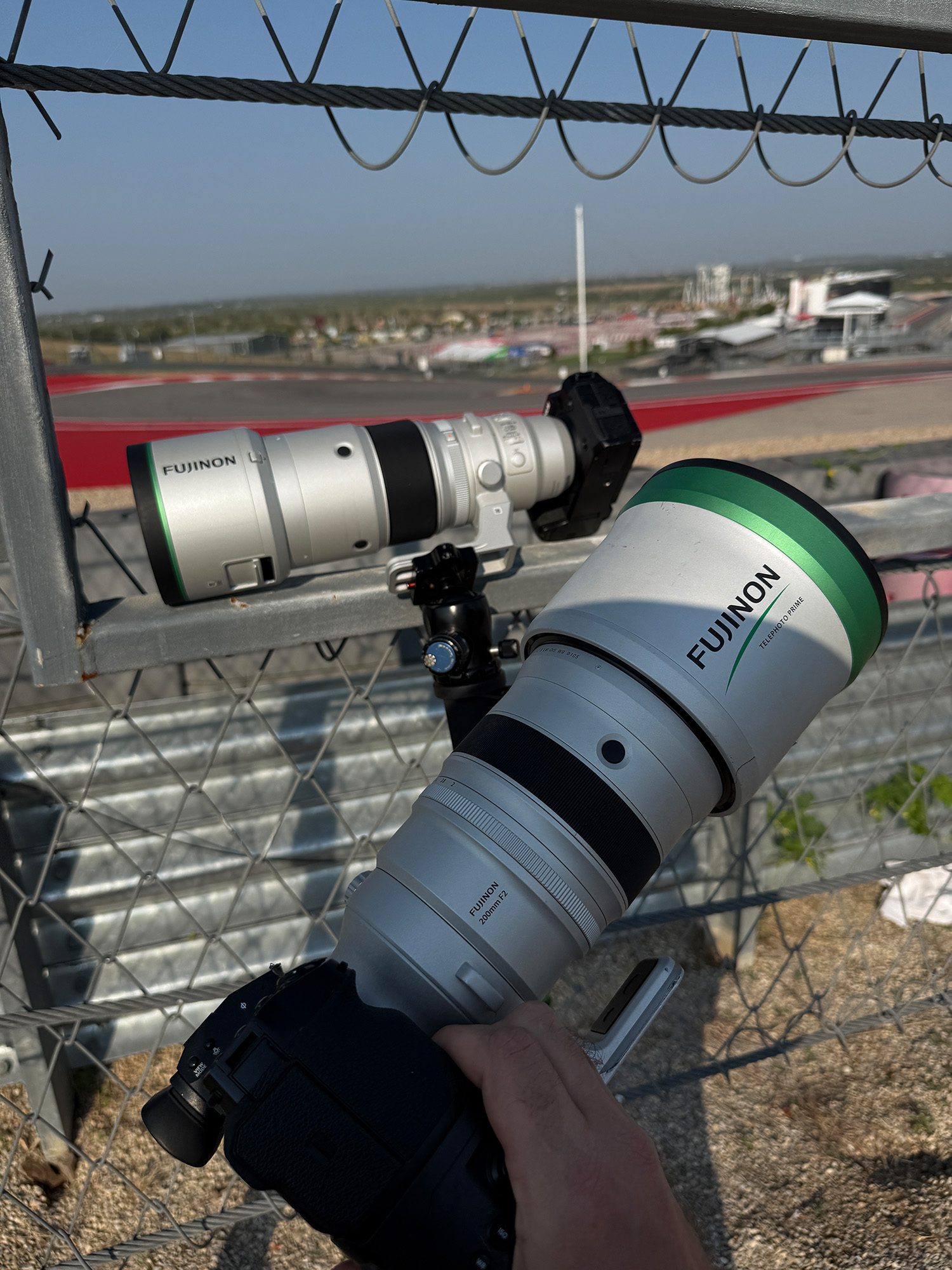
Another practical consideration, and a notable investment, is the requirement for specialized filters due to the lens’s massive front element, which accommodates 105mm filters. Given that the lens retails around $6,000, the cost of compatible high-quality filters represents a non-trivial additional expense. A typical professional kit for this lens might include a UV filter for constant front element protection against dust, scratches, and impact; a circular polarizer to manage reflections, reduce glare from track surfaces and vehicles, and enhance color saturation in bright conditions; and a high-density variable neutral density (ND) filter, potentially a 3 to 8-stop or even a 32-stop variant. The latter is particularly crucial for motorsport photographers who wish to shoot wide open at f/2 in intense daylight to maximize subject separation and bokeh, enabling creative control over depth of field even with fast shutter speeds.
Strategic Positioning: Who Benefits from This Specialized Tool?
While discussions about this lens often extend to commercial and wildlife photography, its unique attributes find a particularly potent application in motorsport. The XF200mm f/2 is not designed to be a photographer’s initial acquisition, nor is it intended as the most flexible lens in a kit. Instead, it assumes the role of a specialized instrument, often becoming the third essential lens in a professional’s bag—the one instinctively reached for when specific conditions demand its unparalleled capabilities. For scenarios requiring broad flexibility in the paddock or diverse trackside perspectives, the XF50-140mm f/2.8 or the XF100-400mm f/4.5-5.6 continues to perform the heavy lifting. However, when ambient light levels drop, when exquisite background rendering is paramount, and when absolute clarity and sharpness are the non-negotiable priorities, the XF200mm f/2 asserts itself as the undisputed heavyweight champion.

This lens serves a distinct segment of the professional market. For dedicated Fujifilm shooters in motorsports, wildlife, or even certain portrait and commercial applications where its unique aesthetic is desired, it represents the pinnacle of what the X-series system can offer. It’s an investment that signifies a commitment to achieving a particular visual signature—a blend of optical perfection, superb low-light performance, and exquisite subject isolation that is difficult to replicate with other optics.
Conclusion: A Testament to Fujifilm’s Commitment
Ultimately, the question of whether one "needs" the Fujifilm XF200mm f/2 OIS WR is distinct from whether one would "regret owning it." For professional Fujifilm photographers operating in demanding fields such as motorsport, the answer to the latter is an emphatic negative. Once integrated into a professional workflow, its performance and distinctive image quality render it indispensable. It is a lens that transcends mere utility, transforming into a creative partner that consistently delivers results that captivate. Its existence within the Fujifilm X-series ecosystem solidifies the company’s commitment to supporting professional photographers with high-performance, specialized tools, proving that the APS-C format can indeed stand shoulder-to-shoulder with full-frame systems in the most challenging and competitive photographic arenas. For those who seek the ultimate expression of Fujifilm’s optical and engineering prowess, the XF200mm f/2 is not just a lens; it is a statement of artistic and technical ambition.