The integration of the PRS-M30 parachute system, developed by Aerial Vehicle Safety Solutions (AVSS), into the DJI Matrice 30 (M30) platform represents a significant technological milestone for the commercial drone industry. This advancement fundamentally alters the operational capabilities of enterprise pilots, specifically allowing for the safe and legal navigation of unmanned aerial vehicles (UAVs) over populated areas. As urban environments become increasingly congested and the demand for real-time aerial data grows, the ability to operate "Over People" (OOP) has transitioned from a niche requirement to a critical necessity for public safety, infrastructure management, and emergency response sectors. The DJI M30, already recognized for its balance of portability and power, now gains a layer of redundant safety that meets stringent international aviation standards, effectively bridging the gap between high-performance hardware and rigorous regulatory compliance.
Technical Foundation of the PRS-M30 System
The PRS-M30 is not merely an accessory but a sophisticated safety peripheral designed to interface seamlessly with the DJI M30’s flight controller. The system is built around the ASTM F3322-18 standard, which is the international benchmark for small unmanned aircraft parachutes. This standard requires rigorous testing, including dozens of successful deployments across various failure scenarios, such as motor failure, loss of power, and manual overrides.
The hardware comprises a lightweight carbon fiber pod containing a spring-deployed parachute, an independent power supply, and an onboard flight termination system (FTS). The FTS is a crucial component; in the event of a critical failure, it immediately cuts power to the drone’s motors. This prevents the parachute lines from becoming entangled in spinning propellers, ensuring a clean deployment and a stabilized descent. The independent power source ensures that even if the drone’s primary TB30 intelligent flight batteries fail, the parachute system remains operational, capable of detecting a fall and deploying the canopy autonomously within milliseconds.
The Evolution of the DJI Matrice 30 Series
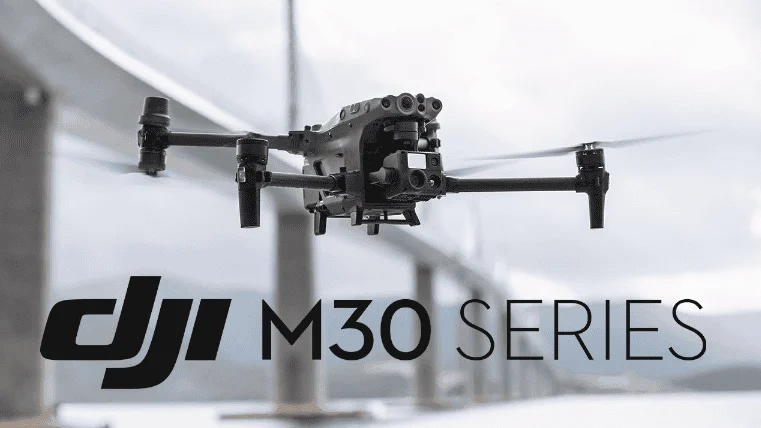
To understand the impact of this safety integration, one must look at the evolution of the DJI Matrice 30 series itself. Launched in March 2022, the M30 was designed to fill the gap between the compact Mavic 3 Enterprise and the heavy-lift Matrice 300 RTK. It introduced a foldable design that could fit into a backpack while maintaining the ruggedness required for industrial applications.
The M30 series features an IP55 ingress protection rating, allowing it to operate in heavy rain, high winds, and temperatures ranging from -20°C to 50°C. Its primary sensor payload includes a 48-megapixel 1/2-inch CMOS zoom camera, a 12-megapixel wide-angle camera, and a laser rangefinder capable of measuring distances up to 1,200 meters. The M30T variant adds a 640×512 resolution radiometric thermal camera, making it an essential tool for nighttime search and rescue or detecting hotspots in structural fires. By adding the AVSS PRS-M30, these high-end capabilities are now deployable in environments previously restricted due to safety concerns regarding the kinetic energy of a falling aircraft.
Regulatory Landscape and Compliance
For years, the Federal Aviation Administration (FAA) in the United States and the European Union Aviation Safety Agency (EASA) have maintained strict prohibitions against flying heavy drones over unprotected people. Under the FAA’s Part 107 rules, drones are categorized based on the risk they pose. Most enterprise drones fall into categories that require a specific waiver for operations over people unless they can prove a minimal risk of injury.
The combination of the DJI M30 and the PRS-M30 system provides the necessary "Means of Compliance" (MOC) to satisfy these regulators. By significantly reducing the terminal velocity of the drone during a fall, the parachute ensures that the kinetic energy transferred upon impact remains below the thresholds that cause serious injury. This allows commercial operators to apply for and receive standard waivers for complex missions in urban centers, over construction sites, and during large-scale public events.
Chronology of Development and Integration
The path to achieving flight over crowds began shortly after the M30’s global debut.
- March 2022: DJI launches the Matrice 30, emphasizing its portable industrial capabilities.
- Mid-2022: AVSS begins engineering a dedicated parachute solution specifically for the M30’s unique airframe and center of gravity.
- Late 2022: Initial testing phases involve simulated motor failures at various altitudes to calibrate the autonomous trigger sensors.
- 2023: The PRS-M30 undergoes formal ASTM F3322-18 testing. This involves 45 successful deployments, including manual and automatic triggers.
- 2024: The system becomes widely available to enterprise users, accompanied by the necessary documentation for FAA and EASA regulatory filings.
- 2025: Real-world implementation becomes standard for major public safety agencies and industrial inspection firms, marking a new era of urban UAV utility.
Strategic Applications in Public Safety
The ability to fly over crowds is a transformative capability for law enforcement and emergency services. During large public gatherings, such as parades, protests, or sporting events, ground-based perspectives are often obstructed. A drone equipped with a parachute can hover directly over the crowd to identify bottlenecks, spot potential security threats, or locate missing persons.
In the event of a medical emergency within a dense crowd, the M30 can provide "eyes on the scene" for dispatchers, allowing them to guide ground units through the most efficient routes. Because the drone is equipped with the PRS-M30, the legal and ethical barriers to maintaining a constant overhead presence are significantly lowered, as the risk of the drone itself becoming a hazard is mitigated.
Impact on Infrastructure and Industrial Inspection
Beyond public safety, the industrial sector stands to gain immensely. Inspections of bridges, high-rise buildings, and urban power grids often occur over busy streets or pedestrian walkways. Traditionally, these operations required closing down roads or sidewalks to create a "sterile" drop zone, a process that is both expensive and logistically difficult.
With the DJI M30 and its parachute system, these inspections can be conducted with minimal disruption to public movement. The drone can safely navigate the "urban canyon," capturing high-resolution thermography and zoom imagery of critical assets. If a system failure occurs, the parachute deploys, and the drone drifts slowly to the ground, accompanied by an audible alarm from the PRS-M30 unit to alert pedestrians below.
Industry Reactions and Economic Implications
Industry analysts suggest that the integration of safety systems like the PRS-M30 will lead to a surge in the commercial drone market. Insurance companies are particularly interested in these developments. Historically, insuring drone operations in urban areas carried high premiums due to the potential liability of a crash. The presence of a certified parachute recovery system provides a tangible reduction in risk, which is expected to lead to lower insurance premiums for compliant operators.
"Safety is the cornerstone of the next phase of drone integration," noted an industry consultant specializing in UAV regulations. "The DJI M30, when paired with the AVSS system, moves us away from ‘experimental’ flights and into the realm of ‘standard’ aviation operations. It gives the public and the regulators the confidence that even in a worst-case scenario, the outcome is controlled."
Analysis of Safety Redundancy and Risk Mitigation
The DJI M30 already includes several internal redundancies, such as dual batteries and a sophisticated vision system for 360-degree obstacle avoidance. However, internal redundancies cannot account for catastrophic hardware failure or total power loss. This is where the external PRS-M30 provides a "final layer" of safety.
The logic of the system is based on a "fail-safe" rather than a "fail-secure" philosophy. By focusing on reducing impact energy, the system addresses the primary concern of aviation authorities: the human cost of a drone failure. The technical data indicates that a parachute-equipped M30 descends at a rate that allows for human reaction time and significantly reduces the probability of fatal head trauma, which is the primary metric used by the FAA to evaluate Category 2 and 3 operations.
Conclusion and Future Outlook
The integration of the AVSS PRS-M30 into the DJI M30 ecosystem is more than a technical upgrade; it is a shift in the operational paradigm of the drone industry. It proves that the challenges of flying in complex, populated environments can be solved through collaborative engineering and adherence to international safety standards.
As we look toward the future, this technology paves the way for even more advanced operations, such as Beyond Visual Line of Sight (BVLOS) flights and automated dock-based missions in city centers. By prioritizing the safety of the people on the ground, DJI and AVSS have provided a blueprint for how the drone industry can continue to expand while maintaining public trust and regulatory compliance. The DJI M30 is no longer just a tool for the remote wilderness or isolated industrial sites; it is now a safe, reliable presence in the heart of the modern city.