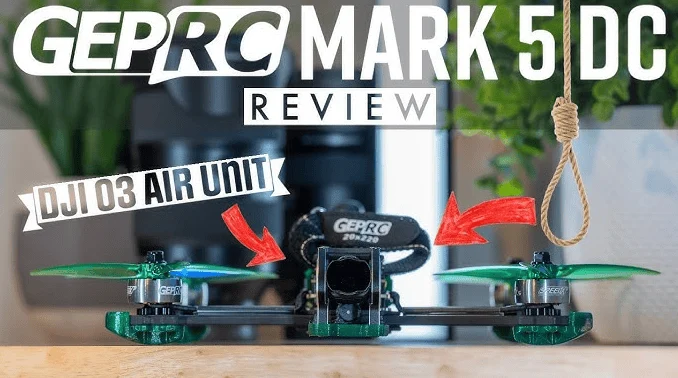
The GEPRC MARK5 DC HD O3 FPV represents a significant milestone in the convergence of high-performance freestyle maneuverability and professional-grade aerial cinematography. As the First-Person View (FPV) drone industry shifts toward high-definition digital ecosystems, this specific model has emerged as a flagship contender, integrating the sophisticated DJI O3 Air Unit into a refined "DeadCat" frame geometry. Designed to cater to both adrenaline-driven freestyle pilots and precision-oriented content creators, the MARK5 DC HD O3 serves as a testament to the rapid engineering advancements in the unmanned aerial vehicle (UAV) sector. By prioritizing structural rigidity, electronic efficiency, and visual clarity, GEPRC has developed a platform that addresses the historical trade-offs between flight performance and image quality.
The Technological Foundation of the MARK5 Series
To understand the impact of the GEPRC MARK5 DC HD O3, one must look at the trajectory of the FPV market over the last five years. Historically, pilots were forced to choose between "analog" systems, which offered low latency but poor image quality, and early digital systems that were often bulky or prone to signal dropouts. The release of the DJI O3 Air Unit changed the landscape by offering 4K onboard recording at 60 frames per second, effectively eliminating the need for an external action camera like a GoPro for many professional applications.
GEPRC, a company founded on the principles of high-end frame design and pre-tuned "Bind-and-Fly" (BNF) solutions, recognized the potential of this technology early in its development cycle. The MARK5 series was birthed from the successful MARK4 lineage, but it underwent a complete structural overhaul to accommodate the heat dissipation and mounting requirements of modern digital VTX (Video Transmitter) units. The "DC" in the name stands for "DeadCat," a specific frame configuration where the front arms are swept back and the rear arms are positioned further apart. This geometry ensures that even when using ultra-wide camera lenses, the propellers remain outside the camera’s field of view, providing a clean, cinematic canvas for editors and viewers alike.
Engineering Precision and Frame Construction
The skeletal structure of the GEPRC MARK5 DC HD O3 is crafted from high-modulus T700 carbon fiber, a material favored for its exceptional strength-to-weight ratio. The frame features a 5mm thick base plate and 2.5mm top plates, reinforced by CNC-machined 7075 aluminum alloy camera side plates. This hybrid construction is not merely aesthetic; the aluminum components act as a protective roll cage for the DJI O3 camera lens while simultaneously serving as a structural brace that reduces frame resonance.
In the world of FPV, "noise" or vibration is the enemy of flight stability. Excessive vibration can confuse the flight controller’s Gyroscope, leading to "prop wash" or mid-air oscillations. GEPRC’s engineering team addressed this by implementing a unique dampening system for the camera mount and ensuring the frame’s carbon weave is optimized for stiffness. The result is a platform that can withstand high-G maneuvers—such as power loops and snap rolls—without introducing jello or micro-vibrations into the 4K footage.
The Propulsion System: Power and Efficiency
At the heart of the MARK5’s flight dynamics are the SPEEDX2 2107.5-1960KV motors. These motors are specifically wound for 6S (six-cell) LiPo battery configurations, which has become the industry standard for 5-inch freestyle drones. The 6S system provides higher voltage and lower current draw compared to older 4S systems, resulting in cooler motor temperatures and more consistent power delivery throughout the duration of the flight.
The 1960KV rating is strategically chosen to provide a balance of "low-end torque" for recovery from dives and "top-end speed" for long-range sweeps. When paired with the GEP-F722-45A AIO (All-in-One) flight controller and a 45A BLHeli_32 ESC, the drone achieves a level of responsiveness that feels "locked-in." The F722 processor, known for its high clock speed, allows the drone to process PID (Proportional-Integral-Derivative) loops at lightning-fast intervals, enabling the pilot to feel a direct, tactile connection to the aircraft’s movements.
Digital Integration: The DJI O3 Air Unit Paradigm
The integration of the DJI O3 Air Unit is the defining feature of this model. Unlike previous generations that required a separate DVR or a heavy external camera, the O3 system handles both the low-latency video feed for the pilot’s goggles and the high-definition recording for the final production.
Key technical specifications of the O3 integration include:
- Sensor Performance: A 1/1.7-inch CMOS sensor that excels in high-dynamic-range (HDR) environments, capturing details in both deep shadows and bright highlights.
- Field of View: A 155-degree ultra-wide FOV that provides an immersive perspective, essential for "proximity flying" where the drone passes through tight gaps.
- RockSteady Technology: DJI’s proprietary electronic image stabilization (EIS) is built into the unit, allowing for buttery-smooth footage directly out of the camera without the need for post-processing software like ReelSteady or Gyroflow.
- Transmission Reliability: Utilizing O3+ transmission technology, the drone can maintain a stable 1080p/100fps video feed at distances of up to several kilometers (subject to local regulations and interference).
Strategic Market Positioning and User Demographics
The GEPRC MARK5 DC HD O3 occupies a premium segment of the market. While it is marketed as a "Bind-and-Fly" (BNF) drone—meaning it comes pre-assembled and tuned from the factory—it is not typically recommended as a "first drone" for absolute beginners. The power-to-weight ratio of a 5-inch 6S drone is immense; in the hands of an inexperienced pilot, it can be dangerous.
However, for intermediate pilots looking to upgrade from "whoop" style drones or for professional videographers who need a reliable tool for high-speed tracking shots, the MARK5 is a logical progression. It fills the gap between the heavy, slow-moving cinema drones (like the DJI Mavic series) and the ultra-light, fragile racing drones. It is the "workhorse" of the FPV world—durable enough to survive a crash in a grassy field yet sophisticated enough to produce footage that can be color-graded to match Hollywood-standard cinema cameras.
Chronology of Development and Industry Impact
The release of the MARK5 DC HD O3 in late 2022 and its subsequent iterations in 2023 and 2024 followed a timeline of rapid digital adoption. When DJI first announced the O3 Air Unit, frame manufacturers scrambled to update their designs because the new camera was wider than the previous "Vista" or "Air Unit" models. GEPRC was among the first to market with a dedicated O3 frame that did not require 3D-printed "hacks" to fit the hardware.
Since its release, the MARK5 has set a benchmark for other manufacturers like iFlight, Foxeer, and Diatone. The "DeadCat" trend, which was once a niche preference for long-range pilots, has now become a standard for cinematic freestyle because of the MARK5’s success. Industry analysts note that GEPRC’s decision to include high-quality components—such as the ELRS (ExpressLRS) receiver options—has forced competitors to stop using outdated radio protocols, effectively pushing the entire hobby toward more secure and longer-range communication standards.
Operational Guidelines for Maximum Performance
To extract the full potential of the GEPRC MARK5 DC HD O3, pilots must adhere to specific operational best practices. The drone is optimized for 6S LiPo batteries ranging from 1300mAh to 1500mAh. A 1300mAh pack offers a lighter "swing weight" for aggressive freestyle, while a 1500mAh pack provides longer flight times (approximately 5-7 minutes depending on throttle management) for cinematic missions.
Furthermore, the use of Neutral Density (ND) filters is highly recommended for professional work. Because the O3 camera has a fixed aperture, ND filters are necessary to maintain a "shutter speed" that is double the frame rate (the 180-degree shutter rule), which introduces natural motion blur into the footage. GEPRC often includes or offers compatible ND 8/16/32 filters to assist pilots in achieving this aesthetic.
Broader Implications for the Future of FPV
The success of the GEPRC MARK5 DC HD O3 FPV signals a shift in the UAV industry toward "all-in-one" digital solutions. We are moving away from the era of "Frankenstein" drones—where pilots had to solder together disparate parts from different manufacturers—and moving toward a "Prosumer" era. In this new landscape, the reliability of the hardware is just as important as the skill of the pilot.
As regulatory bodies like the FAA in the United States and EASA in Europe continue to refine drone laws, platforms like the MARK5 will likely see increased use in "closed-set" cinematography, real estate tours, and sports broadcasting. The ability to fly a 100mph camera through a window and out the other side, all while recording 4K stabilized video, provides a creative toolset that was physically impossible just a decade ago.
In conclusion, the GEPRC MARK5 DC HD O3 FPV is more than just a hobbyist toy; it is a precision-engineered instrument that reflects the current pinnacle of FPV technology. By combining the structural integrity of a freestyle frame with the visual prowess of DJI’s digital ecosystem, GEPRC has created a versatile platform that continues to influence drone design and aerial storytelling across the globe. For those seeking the ultimate balance of power, durability, and cinematic output, the MARK5 remains the definitive choice in the 5-inch digital category.