The evolution of First-Person View (FPV) drone technology has reached a significant milestone with the release of the GEPRC MARK5 DC HD O3 FPV, a quadcopter that integrates high-performance freestyle capabilities with professional-grade digital imaging. As the FPV industry transitions from analog systems to high-definition digital ecosystems, GEPRC has positioned the MARK5 series as a flagship solution for pilots who demand both durability and cinematic output. This model, specifically the "DeadCat" (DC) variant, addresses a long-standing challenge in the FPV community: achieving a wide-angle, high-resolution aerial perspective without the visual interference of propellers within the camera’s field of view. By incorporating the DJI O3 Air Unit, GEPRC has effectively bridged the gap between traditional racing drones and professional cinematography tools.
The Technological Evolution of the GEPRC MARK Series
The journey toward the GEPRC MARK5 DC HD O3 FPV began with the early iterations of the Mark series, which were primarily focused on frame rigidity and weight distribution for racing. As the market shifted toward "freestyle"—a discipline emphasizing acrobatic maneuvers and aesthetic flight—the requirements for frames changed. Pilots began demanding more space for electronics and better protection for expensive camera equipment.
The introduction of the Mark 4 brought improvements in aerodynamics, but it was the Mark 5 that truly revolutionized the lineup. The Mark 5 was designed from the ground up to support the "HD era" of FPV. When DJI released the O3 Air Unit, which features a 1/1.7-inch sensor and the ability to record 4K video at 60 frames per second (fps) internally, GEPRC updated the Mark 5 chassis to accommodate this larger, heat-intensive hardware. The "DC" or DeadCat configuration was specifically engineered to move the front motors further apart and backward, ensuring that even at the widest camera angles, the propellers remain invisible to the sensor.
Core Technical Specifications and Hardware Integration
The GEPRC MARK5 DC HD O3 FPV is not merely a frame with components; it is a meticulously tuned ecosystem of high-end hardware. At the heart of its flight performance is the GEP-F722-45A AIO flight controller. The use of an F722 processor is critical, as it provides the computational speed necessary to handle complex PID (Proportional-Integral-Derivative) loops and filtering, resulting in a "locked-in" feel that professional pilots require for precise maneuvering.
Powering the propulsion system are the SPEEDX2 2107.5-1960KV motors. These motors are optimized for 6S (six-cell) battery configurations. The 1960KV rating is widely considered the "sweet spot" for 5-inch freestyle drones, offering a balance of high-end speed and low-end torque. This allows the drone to recover quickly from "power loops" and "dives" while maintaining efficiency during steady cinematic cruises. The motors are paired with an ESC (Electronic Speed Controller) running BLHeli_32 firmware, which supports bi-directional DShot, enabling the flight controller to communicate with the motors with microsecond precision to cancel out vibrations.
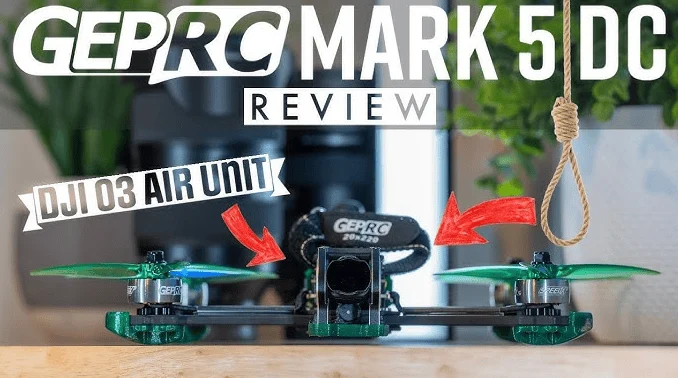
The visual component is handled by the DJI O3 Air Unit. This system has largely rendered the need for an external GoPro camera obsolete for many pilots. With a 155-degree ultra-wide field of view and the inclusion of RockSteady 2.0 digital stabilization, the MARK5 can produce stabilized, professional-quality footage directly from its primary flight camera. The camera is housed in a 7075-grade aluminum alloy cage, providing a level of physical protection that is rare in the FPV world, where crashes are an expected part of the hobby.
Structural Design and Aerodynamics
The frame of the GEPRC MARK5 DC HD O3 FPV is constructed from high-strength carbon fiber, featuring 5mm thick arms and 2.5mm top and bottom plates. The "DeadCat" geometry is the standout feature of this specific model. Unlike a traditional "True-X" frame where all motors are equidistant from the center, the DeadCat layout shifts the front arms outward. This design change slightly alters the flight physics, requiring specific software tuning to ensure the drone remains agile.
GEPRC’s engineering team implemented a shock-absorbing structure for the camera mount. FPV drones are prone to "jello"—high-frequency vibrations that appear as wavy lines in video footage. By using silicone dampeners between the camera cage and the main frame, the MARK5 isolates the DJI O3 sensor from motor-induced vibrations. Furthermore, the frame includes a dedicated cooling system for the O3 Air Unit. The Air Unit is known to generate significant heat, especially when recording in 4K. The MARK5 frame features air vents and a mounting position that maximizes airflow from the propellers to prevent thermal throttling during long flights.
Market Context and Competitive Landscape
The release of the GEPRC MARK5 DC HD O3 FPV comes at a time of intense competition in the Bind-and-Fly (BNF) market. Competitors such as iFlight with their Nazgul series and Lumenier with their QAV line have also integrated the DJI O3 system. However, industry analysts note that GEPRC has carved out a niche by focusing on "premium durability."
Industry feedback from professional FPV videographers suggests that the MARK5 is often preferred for "commercial freestyle"—jobs that require high-speed chases (such as following rally cars or mountain bikers) where a crash is possible but the footage must be saved. The inclusion of a dedicated ND (Neutral Density) filter mount on the O3 camera cage further reinforces its position as a tool for cinematographers. By using ND filters, pilots can maintain a 180-degree shutter rule (e.g., 1/120th of a second shutter speed for 60fps video), resulting in natural-looking motion blur that is a hallmark of high-end film production.
Operational Requirements and Pilot Recommendations
While the GEPRC MARK5 DC HD O3 FPV is a Bind-and-Fly drone, it is not categorized as a consumer-level "toy" drone like the DJI Mini series. It requires a sophisticated understanding of LiPo battery safety and FPV flight dynamics. The drone is optimized for 6S LiPo batteries, typically in the 1300mAh to 1500mAh range. A 1300mAh battery provides approximately 5 to 7 minutes of aggressive freestyle flight, while a 1500mAh battery can extend cinematic cruising to nearly 10 minutes, depending on the payload and weather conditions.
For software, the drone comes pre-tuned with Betaflight, the industry-standard open-source firmware. GEPRC provides custom "tunes" out of the box, which are designed to make the drone feel smooth and predictable. However, professional pilots often utilize the D-Log color profile available in the O3 system. This flat color profile preserves more dynamic range in the shadows and highlights, allowing for professional color grading in post-production software like DaVinci Resolve or Adobe Premiere Pro.
Chronology of the FPV Digital Transition
To understand the significance of the MARK5, one must look at the timeline of FPV video transmission:
- 2014-2018: The era of Analog video. Low resolution, high static, but zero latency. Recording required a heavy GoPro mounted on top.
- 2019: DJI releases the first Digital FPV System. It offers 720p HD video but still requires a GoPro for professional 4K recording.
- 2021: GEPRC releases the Mark 5 frame, designed for the original DJI HD system and Caddx Vista.
- Late 2022: DJI releases the O3 Air Unit. The FPV community realizes that the onboard camera is now good enough to replace the GoPro.
- 2023-2025: GEPRC refines the MARK5 DC (DeadCat) to perfectly house the O3 Air Unit, leading to the current flagship model which streamlines the workflow for creators.
Broader Impact on the Content Creation Industry
The implications of drones like the GEPRC MARK5 DC HD O3 FPV extend beyond the hobbyist community. Real estate marketing, automotive advertising, and even Hollywood productions are increasingly turning to 5-inch FPV drones for shots that were previously impossible. The ability to fly through narrow gaps, perform 360-degree flips while following a subject, and deliver 4K stabilized footage in a single, compact package has lowered the barrier to entry for high-production-value aerial cinematography.
Furthermore, the "DeadCat" design of the MARK5 has set a new standard for what is expected in cinematic FPV. The absence of propellers in the frame means that editors no longer have to crop into the footage, preserving the full resolution and wide-angle perspective of the sensor. This efficiency in the production pipeline is a major selling point for professional media houses.
Safety and Regulatory Considerations
As drones become more powerful, regulatory bodies such as the FAA (Federal Aviation Administration) in the United States and EASA in Europe have implemented stricter rules. The GEPRC MARK5 DC HD O3 FPV, when equipped with a 6S battery, typically exceeds the 250g weight limit, meaning it must be registered in most jurisdictions. Additionally, the O3 Air Unit supports Remote ID in certain regions, a requirement that is becoming mandatory for legal flight in controlled airspaces.
GEPRC has addressed these concerns by ensuring the drone is compatible with various GPS modules. Adding a GPS module to the MARK5 allows for "GPS Rescue" functionality—a safety feature where the drone will automatically climb and fly back toward the pilot if the radio signal is lost, providing an essential safety net for long-range flights or complex urban environments.
Conclusion: The Future of the GEPRC MARK Series
The GEPRC MARK5 DC HD O3 FPV represents the current pinnacle of pre-built FPV technology. By combining a robust, vibration-dampened frame with the most advanced digital transmission system available, GEPRC has created a versatile platform that serves both the adrenaline-seeking freestyle pilot and the detail-oriented cinematographer. As battery technology improves and flight controllers become even more intelligent, the MARK series is expected to continue its trajectory toward smaller, more efficient, and even more powerful aerial tools. For now, the MARK5 stands as a testament to how far the industry has come, transforming a once-niche hobby into a legitimate pillar of modern digital media production.