Ukraine has fundamentally reshaped the landscape of modern warfare through the rapid industrialization and deployment of First-Person View (FPV) drones. What began as a desperate measure by volunteer groups and hobbyists in the early days of the 2022 Russian invasion has transformed into a sophisticated, multi-billion-dollar domestic industry. As of early 2025, the Ukrainian government has committed more than $2.6 billion to the procurement and development of unmanned systems, with a specific focus on locally manufactured FPV units. This massive capital injection is part of a broader strategic initiative to offset the quantitative advantages of conventional Russian forces through technological asymmetry and precision-strike capabilities.
The scale of this industrial mobilization is unprecedented in the history of unmanned aerial vehicle (UAV) production. In 2024, Ukraine successfully met its goal of producing over one million drones. However, the projections for 2025 are significantly more ambitious, with the Ministry of Digital Transformation and the Ministry of Strategic Industries aiming for a total output exceeding 4.5 million FPV units. This surge represents not just an increase in volume but a qualitative leap in the integration of electronic warfare (EW) resistance, artificial intelligence (AI) for terminal guidance, and autonomous navigation.
The Strategic Shift Toward Asymmetric Attrition
The reliance on FPV drones stems from the evolving realities of the front lines, where traditional artillery shells and armored vehicles are often in short supply or vulnerable to long-range detection. An FPV drone, typically costing between $400 and $600 to manufacture, possesses the capability to disable or destroy a main battle tank costing several million dollars. This cost-to-kill ratio has forced a total re-evaluation of military doctrine globally.
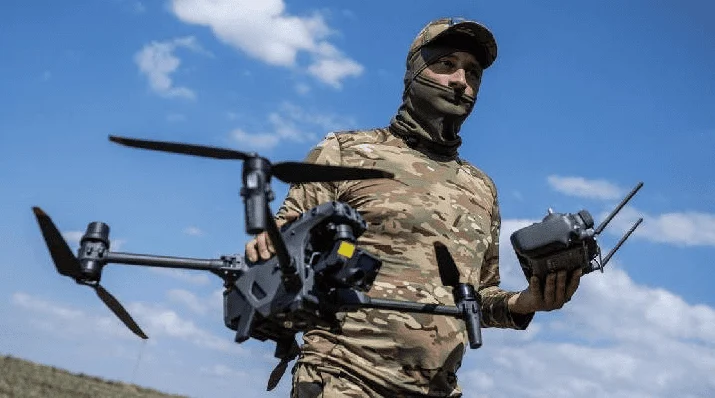
For Ukraine, the FPV drone serves three primary functions: precision strike, reconnaissance, and psychological warfare. Unlike traditional loitering munitions, FPV drones are operated by pilots wearing virtual reality-style goggles, providing a real-time, immersive view that allows for extreme maneuverability. This enables operators to fly drones into narrow openings, such as tank hatches, bunker entrances, or trench dugouts, with surgical precision. The data from February 2025 indicates that Ukrainian FPV drone strikes increased by 22% compared to the previous month, a metric that highlights the increasing density of unmanned systems in the combat zone.
Chronology of Ukrainian Drone Development
The trajectory of Ukraine’s drone industry can be divided into four distinct phases:
- The Volunteer Phase (February 2022 – Late 2022): Initially, the defense relied on off-the-shelf commercial drones, primarily for reconnaissance. Volunteer organizations began modifying racing drones to carry improvised explosive devices (IEDs).
- The Institutionalization Phase (2023): The Ukrainian government launched the "Army of Drones" initiative under the Ministry of Digital Transformation. This period saw the deregulation of the defense sector, allowing private startups to bypass traditional bureaucratic hurdles and secure state contracts.
- The Industrial Scaling Phase (2024): Production moved from small workshops to decentralized industrial facilities. Ukraine reached the milestone of 100,000 drones per month. The Brave1 defense tech cluster was established to streamline innovation and testing.
- The Technological Integration Phase (2025 and Beyond): The current focus is on the mass production of "smart" drones. This involves the integration of AI-powered computer vision that allows a drone to lock onto a target and complete its terminal dive even if the pilot’s signal is jammed by Russian electronic warfare.
Economic and Administrative Infrastructure
The growth of the FPV sector has been fueled by a unique public-private partnership model. The Brave1 platform has become a central hub for over 500 Ukrainian companies specializing in defense technology. By providing grants, testing grounds, and direct access to military feedback, the government has shortened the "lab-to-trenches" cycle to as little as a few weeks.
Financial reports indicate that the $2.6 billion allocated for 2025 is being distributed across several hundred domestic manufacturers. This decentralization is a strategic choice; by spreading production across thousands of small, inconspicuous locations rather than a few large factories, Ukraine has made its drone supply chain resilient to Russian missile and long-range drone strikes. Furthermore, the government has implemented tax exemptions for drone components, including flight controllers, motors, and camera sensors, to lower production costs and encourage local assembly.
Technical Innovations and Counter-Electronic Warfare
The primary challenge facing FPV production in 2025 is the intense electronic warfare environment. Russian forces have deployed extensive jamming systems designed to sever the link between the drone and the operator. In response, Ukrainian engineers are innovating at a rapid pace.
One of the most significant advancements is the transition to "frequency-hopping" technology and the use of non-standard radio frequencies that are harder for Russian EW systems to detect and disrupt. Additionally, the development of "wired" or fiber-optic drones—which are immune to radio interference—has entered the testing phase for specific high-intensity sectors of the front.
Artificial intelligence is also playing a critical role. By implementing "target-lock" software, a drone can identify a vehicle or a person using on-board processing. Once the pilot selects the target, the drone autonomously completes the mission, rendering jamming attempts ineffective during the most critical final seconds of the flight. This technological arms race has turned the Ukrainian battlefield into a real-world laboratory for the future of robotic warfare.
Supply Chain Realities and Global Logistics
Despite the high level of domestic assembly, the Ukrainian FPV industry remains partially dependent on international supply chains, particularly for microchips and specialized motors. A significant portion of these components is sourced from the global market, including China, which remains the primary producer of commercial drone parts.
The Ukrainian government is actively working to localize the production of these critical components to mitigate the risk of export restrictions or supply chain disruptions. Investment is currently being channeled into local manufacturing of carbon-fiber frames, flight controllers, and specialized munitions. The goal is to create a fully sovereign production cycle that can withstand long-term geopolitical shifts.
Official Responses and International Implications
President Volodymyr Zelenskyy and Mykhailo Fedorov, the Minister of Digital Transformation, have frequently emphasized that drones are the key to preserving the lives of Ukrainian soldiers. Fedorov recently stated that the goal is not just to match the enemy’s numbers but to surpass them in technological sophistication. "We are building the first-ever ‘Deep Tech’ military economy," Fedorov noted in a recent briefing, highlighting that the innovations born in Ukraine will likely define NATO’s defense strategies for the next several decades.
International observers and Western defense officials have closely monitored Ukraine’s drone success. Several NATO members have already begun incorporating lessons from the Ukrainian FPV experience into their own procurement programs. The "Drone Coalition," led by Latvia and the United Kingdom, has pledged to deliver thousands of drones to Ukraine, while also learning from the rapid iterative cycles of Ukrainian frontline feedback.
The Broader Impact on Ukrainian Society and Economy
The drone boom has had a profound impact on the Ukrainian domestic economy. The defense tech sector is now one of the few growing segments of the GDP, creating thousands of high-tech jobs for engineers, software developers, and logistics specialists. Universities across the country have launched new programs focused on unmanned systems and robotics, ensuring a steady pipeline of talent for the industry.
Beyond the military application, the skills being developed today—ranging from AI-driven computer vision to advanced telecommunications—are expected to form the backbone of Ukraine’s post-war tech economy. The country is positioning itself to become a leading global exporter of combat-proven unmanned systems once the conflict subsides.
Conclusion: A New Era of Defense
The production of FPV drones in Ukraine has evolved from a grassroots effort into a pillar of national security. With a projected output of 4.5 million units for 2025 and a multi-billion dollar budget, Ukraine is no longer just a recipient of military aid but a global leader in defense innovation.
While significant challenges remain—particularly regarding supply chain security and the relentless advancement of Russian electronic warfare—the decentralized and highly adaptive nature of the Ukrainian drone industry provides a formidable counter-measure. As the conflict continues to drive technological breakthroughs, the lessons learned on the plains of Ukraine are rewriting the rules of engagement, signaling a future where the outcome of battles is increasingly determined by the speed of a processor and the ingenuity of a coder. Through this industrial mobilization, Ukraine is not only defending its territory but is also pioneering a new paradigm of 21st-century warfare.