The Minolta CLE, released in 1981, represents a pivotal moment in the history of rangefinder photography, marking a departure from purely mechanical systems toward the integration of sophisticated electronic metering and aperture-priority automation. While often overshadowed by the prestige of the Leica M-series, the CLE—standing for "Compact Leica Electronic"—was the culmination of a decade-long technical partnership between Minolta and Leitz. Today, the system is undergoing a resurgence among street photographers and technical enthusiasts who find that its early-1980s engineering provides a level of precision and portability that rivals both modern digital workflows and vintage mechanical counterparts.
The Evolution of the Compact Rangefinder: 1973–1981
To understand the technical significance of the Minolta CLE, one must look back to the early 1970s. In 1972, Leitz and Minolta signed a formal cooperation agreement intended to share patents and manufacturing capabilities. This partnership first bore fruit with the Leica CL (and its Japanese sibling, the Leitz Minolta CL) in 1973. The CL was a compact, mechanical rangefinder that utilized a swinging arm for its CdS (Cadmium Sulfide) light meter.
However, the CL had limitations, including a relatively short effective base length for its rangefinder and a mechanical system that was difficult to service. When the CL was discontinued in 1976, Minolta began independent development on a successor. The result was the 1981 Minolta CLE. Unlike its predecessor, the CLE was not a joint venture in production; it was a Minolta-designed and manufactured body that utilized the Leica M-mount. It introduced several "firsts" for the M-mount ecosystem, most notably an electronic focal-plane shutter and an advanced through-the-lens (TTL) metering system that surpassed the capabilities of Leica’s own flagship models at the time.
Technical Analysis of the M-Rokkor 40mm f/2 Lens
Central to the CLE’s performance is the M-Rokkor 40mm f/2 lens. While a 40mm lens was also produced for the original Leica CL, the later-production Minolta variants—specifically those manufactured for the CLE—underwent significant optical refinements. Technical evaluations of these lenses reveal a sophisticated multi-coating process that distinguishes them from the earlier Leitz-badged versions.

The late-batch M-Rokkor 40mm f/2 is characterized by high local contrast and micro-contrast, which are essential for resolving detail on modern high-resolution scanners. In controlled tests, the lens exhibits two distinct rendering profiles based on the selected aperture. When used wide-open at f/2, the lens maintains a "vintage" aesthetic, with softer edge definition and a "dreamy" quality in the out-of-focus highlights. However, when stopped down to f/5.6 or f/8, the lens transforms into a "hyper-resolving" instrument.
This performance is particularly evident when paired with modern consumer-grade films such as Fujifilm 200 (internally consistent with Kodak Gold 200). The lens’s ability to drive high contrast into the shadows allows these films to punch above their weight class, delivering sharpness that challenges the perceived limitations of 200-ISO color negative stocks. The aggressive rendering of the M-Rokkor glass ensures that even under the harsh, vertical light of urban environments like Hong Kong, the imagery retains structural integrity in the mid-tones and highlights.
Comparative Metering: OTF vs. Traditional Spot Systems
The most significant engineering achievement of the Minolta CLE is its real-time "Off-the-Film" (OTF) metering system. This technology was pioneered by Olympus in their OM-2 SLR but was revolutionary when implemented in a rangefinder body.
In traditional rangefinders like the Leica M6 TTL or the M7, exposure is calculated by measuring light reflected off a white spot painted on the shutter curtain. This system effectively functions as a large spot meter, covering approximately 13% to 15% of the frame’s center. While precise, this method is susceptible to "fooling" if the central area contains a highly reflective surface (such as water or glass) or a deep shadow that does not represent the overall scene.
The Minolta CLE employs a more holistic approach. During the exposure itself, sensors located at the bottom of the camera chamber measure the light reflecting directly off the surface of the film. This allows the camera to adjust the shutter speed in real-time to account for sudden changes in illumination. Because the system averages the global scene across a sophisticated matrix pattern on the shutter curtain (and the film itself), it delivers a much higher hit rate for automatic exposures in dynamic environments. For street photographers working in rapidly changing light, this electronic automation provides a level of reliability that mechanical "center-weighted" systems often struggle to match.

Viewfinder Mechanics and Ergonomic Versatility
The Minolta CLE was designed with a 0.58x magnification viewfinder, a choice that prioritizes wide-angle photography. This magnification is particularly advantageous for photographers who wear glasses, as it allows the entire frame—including the perimeter frame lines—to be visible without excessive eye movement.
The CLE’s viewfinder features frame lines for 28mm, 40mm, and 90mm focal lengths. A notable engineering improvement over the Leica M-series is the stability of the focus patch. Users have frequently documented "white-out" or "flare" issues in the Leica M6 viewfinder when light hits the front window at a specific angle. The CLE’s optical path for the rangefinder patch is significantly more resistant to this phenomenon, ensuring a clear focusing secondary image even in backlit conditions.
However, the system is not without its idiosyncratic requirements. The focus patch on the CLE, much like the later Konica Hexar RF, requires precise eye alignment. If the photographer’s eye is slightly off-axis, the contrast of the focus patch diminishes. Furthermore, field tests indicate that at distances beyond three meters, the 40mm frame lines are conservative; the actual captured image on the film typically includes more of the scene than the frame lines suggest. This "safety margin" is a common trait of rangefinders of this era but is more pronounced in the CLE’s compact housing.
The Impact of 1980s Engineering on Modern Street Photography
The resurgence of interest in the Minolta CLE can be attributed to the "scaling" of optical quality. In the 1980s, high-end consumer cameras were often limited by the quality of commercial lab processing and small-scale printing. However, the advent of modern "lab-grade" scanning—utilizing Noritsu or Frontier scanners at high resolutions—has revealed that the optical ceiling of the M-Rokkor lenses is far higher than previously understood.
The ability of a 40-year-old Japanese "street scalpel" to produce images that remain sharp even when digitized at 60-megapixel equivalents has shifted the narrative surrounding vintage gear. No longer viewed merely as "nostalgia boxes," cameras like the CLE are being repositioned as viable professional tools for candid photography.
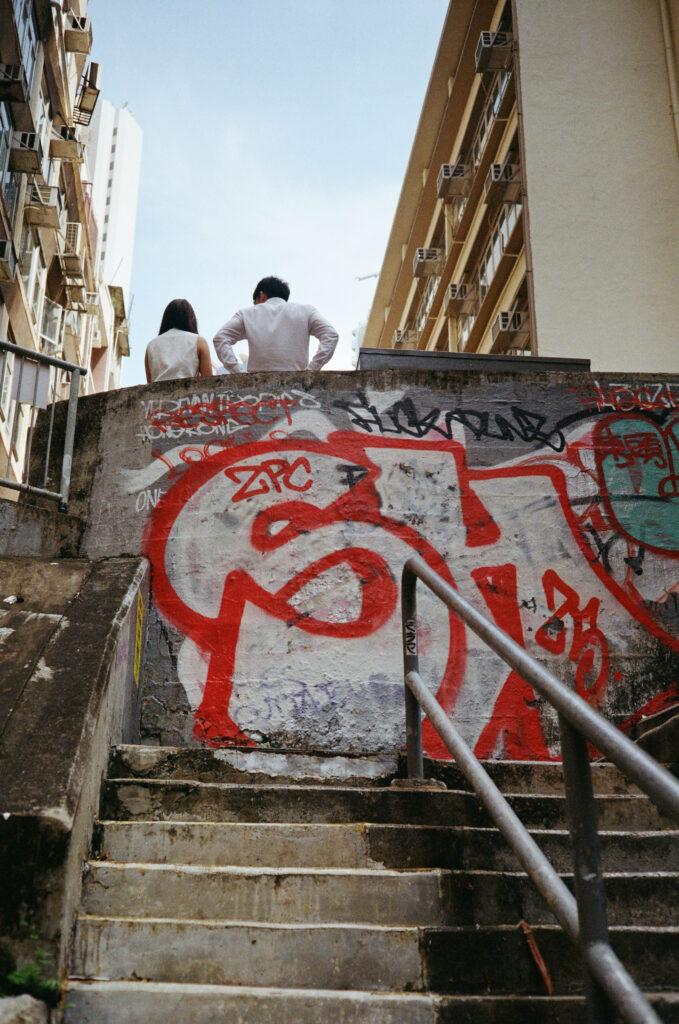
The ergonomics of the CLE also play a vital role in its modern utility. Weighing significantly less than a Leica M6 or a Konica Hexar RF, the CLE allows for longer periods of "hunting" in urban environments without physical fatigue. Its plastic-shrouded exterior, while less "luxurious" than the brass or zinc plates of its competitors, serves as a form of urban camouflage, allowing photographers to operate in crowded markets or residential stairwells without drawing the attention that a more ostentatious "status symbol" camera might.
Market Context and Chronological Significance
When the Minolta CLE was released in 1981, it was priced as a premium product, yet it faced an uphill battle against the established "Leica mythos." Despite being more technologically advanced than the Leica M4-P (its contemporary rival), it was often dismissed by purists due to its reliance on batteries and its electronic shutter.
Chronology of the CLE System:
- 1972: Leitz/Minolta partnership begins.
- 1973: Launch of the Leica CL (Mechanical).
- 1976: Leica CL discontinued; Minolta begins independent development of an electronic successor.
- 1981: Minolta CLE released with three dedicated lenses: 28mm f/2.8, 40mm f/2, and 90mm f/4.
- 1984: Production ceases as the market shifts toward Autofocus (AF) SLR technology (leading to the Minolta Maxxum 7000).
In the decades following its discontinuation, the CLE became a cult classic. In the current secondary market, the CLE often commands prices similar to or higher than its mechanical predecessor, the CL, specifically because of its 28mm frame lines and superior metering.
Conclusion: The Diagnostic Wisdom of the Rangefinder
The Minolta CLE stands as a testament to a specific era of Japanese engineering—one that prioritized functional innovation over brand heritage. By integrating OTF metering, a wide-angle optimized viewfinder, and high-performance multi-coated optics into a compact chassis, Minolta created a tool that remains highly relevant in the 21st century.

For the modern practitioner, the CLE offers a bridge between the tactile, deliberate nature of film photography and the precision required for high-resolution digital output. Its existence proves that the "logical progression" of a photographer’s journey often leads back to these overlooked masterpieces of the 1980s. The CLE is not merely a cheaper alternative to a Leica; it is a specialized instrument that, in many specific scenarios—particularly high-speed street photography—offers technical advantages that its more famous rivals cannot replicate. As film photography continues its cultural revival, the "unassuming box" from 1981 remains one of the most effective tools for capturing the complexities of the modern world.