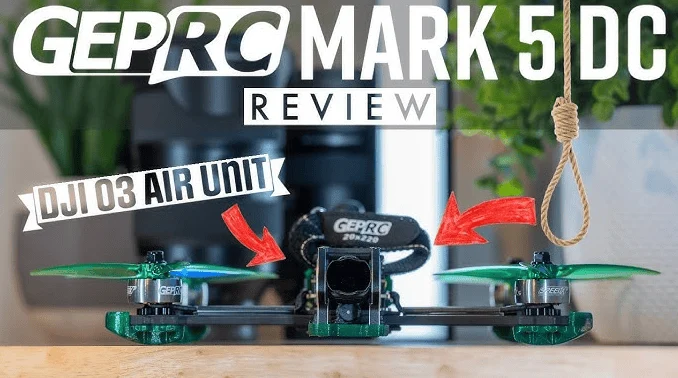
The landscape of First Person View (FPV) aviation has undergone a radical transformation over the last decade, transitioning from a niche hobby for electronics enthusiasts into a sophisticated tool for professional cinematography and competitive racing. At the forefront of this technological surge is the GEPRC MARK5 DC HD O3 FPV, a high-performance drone that represents the culmination of years of iterative design and the integration of cutting-edge digital transmission systems. This model is specifically engineered to meet the dual demands of freestyle agility and cinematic stability, leveraging the DJI O3 Air Unit to provide a visual experience that was once only possible with heavy, custom-built rigs carrying external action cameras.
The Genesis of the Mark Series and Frame Engineering
The GEPRC Mark series has long been recognized within the FPV community for its durability and thoughtful engineering. The MARK5 serves as a successor to the highly popular Mark 4, introducing significant structural improvements designed to handle the increased weight and heat output of modern digital systems. The frame is constructed from high-strength 3K carbon fiber, featuring a 225mm wheelbase that provides a stable platform for 5-inch propellers.
One of the most notable engineering feats of the MARK5 is its hybrid structure. It utilizes a combination of carbon fiber plates and 7075 aluminum alloy parts, specifically in the camera cage. This aluminum "head" serves a dual purpose: it provides superior protection for the sensitive DJI O3 camera lens and acts as a heat sink, assisting in thermal management during high-intensity flights. The use of 7075-grade aluminum is a strategic choice, as it offers a strength-to-weight ratio comparable to some steels, ensuring that the drone can withstand the high-velocity impacts common in freestyle maneuvers.
The DeadCat Configuration: A Cinematic Prerequisite
The "DC" in the model name stands for "DeadCat," a frame geometry where the front arms are swept back and the rear arms are wider apart. This configuration is a critical design choice for videographers. In traditional "True X" or "Squashed X" frames, the propellers often appear in the corners of the camera’s field of view, especially when the camera is tilted at a low angle for slow, cinematic shots.
The DeadCat layout ensures that the propellers remain entirely out of the frame, providing a "clean" 16:9 or 4:3 image directly from the onboard unit. This eliminates the need for aggressive cropping in post-production, preserving the maximum resolution and bit rate of the recorded footage. For professional content creators, this feature alone makes the MARK5 DC a primary choice for capturing immersive aerial perspectives without the visual clutter of spinning blades.
Integration of the DJI O3 Air Unit
The heart of the GEPRC MARK5 DC HD O3’s performance is the DJI O3 Air Unit. Before the advent of this system, FPV pilots were forced to choose between low-latency analog video for flight control and high-definition recording from a secondary camera like a GoPro. The O3 Air Unit bridges this gap by offering a 1/1.7-inch CMOS sensor capable of recording 4K video at 60 frames per second (fps) while simultaneously transmitting a 1080p high-definition live feed to the pilot’s goggles.
The technical specifications of the O3 unit are formidable. It supports a maximum video bitrate of 50 Mbps and features a wide 155-degree field of view. Furthermore, it incorporates DJI’s RockSteady technology, an electronic image stabilization (EIS) algorithm that smooths out high-frequency vibrations and erratic movements. This allows the MARK5 to produce "social-media-ready" footage straight from the SD card, though many professionals still opt to use the built-in gyro data with software like Gyroflow for even more precise stabilization.
Power Systems and Flight Dynamics
To propel the MARK5, GEPRC has equipped the drone with SPEEDX2 2107.5-1960KV motors. When paired with a 6S (22.2V) Lithium Polymer (LiPo) battery, these motors provide an exceptional power-to-weight ratio. The 1960KV rating is optimized for 6S voltage, offering high torque at the low end for precise proximity flying and explosive power at the high end for vertical climbs and acrobatic flips.
The internal electronics are centered around the GEP-F722-45A AIO or the F722 flight controller paired with a 45A-50A BLHeli_32 ESC (Electronic Speed Controller). The F7 processor is capable of handling complex PID (Proportional-Integral-Derivative) loops, ensuring that the drone remains locked-in even in turbulent wind conditions. The BLHeli_32 firmware allows for bi-directional DShot, which enables the flight controller to communicate with the motors in real-time to filter out noise and vibrations, resulting in a smoother flight feel and cooler motor temperatures.
Market Positioning and Industry Impact
The release of the GEPRC MARK5 DC HD O3 comes at a time when the FPV industry is shifting away from DIY kits toward "Bind-and-Fly" (BNF) solutions. Historically, pilots had to solder every component themselves, a barrier to entry that kept the hobby small. GEPRC’s ability to offer a professionally tuned, pre-assembled drone that meets competition-level standards has expanded the market significantly.
Industry analysts note that drones like the MARK5 are disrupting traditional cinematography. Previously, achieving high-speed, close-proximity shots required expensive heavy-lift drones or manned helicopters. The MARK5, costing a fraction of those systems, can fly through windows, under vehicles, and within inches of subjects, providing a level of dynamism that is increasingly demanded in Hollywood productions, music videos, and extreme sports coverage.
Operational Safety and Maintenance
Despite its performance capabilities, the MARK5 requires a disciplined approach to maintenance. The high-speed nature of FPV flight means that components are subject to immense stress. GEPRC has addressed this by making the frame modular; arms can be replaced individually by removing only a few screws, a feature that minimizes downtime after a crash.
Thermal management remains a key focus for the O3 version. Because the O3 Air Unit generates significant heat, GEPRC has integrated specialized mounts that facilitate airflow around the unit. Pilots are advised to avoid leaving the drone powered on while stationary for extended periods, as the lack of prop-wash can lead to thermal throttling of the video transmitter.
Technical Specifications Summary
- Frame: GEP-MK5D (DeadCat)
- Wheelbase: 225mm
- Top Plate: 2.5mm
- Bottom Plate: 2.5mm
- Arm Plate: 5.0mm
- FC System: GEP-F722-45A AIO (or equivalent F7 Stack)
- MCU: STM32F722
- Gyro: BMI270
- Video Link: DJI O3 Air Unit
- Motors: SPEEDX2 2107.5-1960KV (6S)
- Propellers: HQProp Ethix S5 5x4x3
- Weight: Approximately 400g (without battery)
- Recommended Battery: LiPo 6S 1300mAh-1500mAh
Expert Recommendations for Optimization
For pilots looking to extract the maximum potential from the MARK5 DC HD O3, experts recommend several software and hardware adjustments. Utilizing the "D-Cinelike" color profile on the DJI O3 camera is essential for professional workflows, as it preserves more dynamic range for color grading. Additionally, the use of Neutral Density (ND) filters is highly encouraged. By attaching an ND8 or ND16 filter, pilots can force a slower shutter speed (typically 1/120th of a second for 60fps footage), which introduces natural motion blur and makes the video appear more cinematic.
From a control standpoint, the integration of ExpressLRS (ELRS) as the radio link has become the standard for the MARK5. ELRS offers superior range and penetration compared to older 2.4GHz systems, ensuring that the pilot maintains a solid connection even when flying behind obstacles or at distances exceeding several kilometers.
Conclusion and Future Implications
The GEPRC MARK5 DC HD O3 FPV stands as a testament to the rapid maturity of the drone industry. It is no longer just a toy or a racing machine; it is a specialized instrument of digital expression. By combining the ruggedness of a freestyle frame with the high-fidelity capabilities of the DJI O3 system, GEPRC has provided a tool that empowers creators to capture the world from perspectives previously thought impossible.
As digital transmission technology continues to shrink in size and grow in power, the lessons learned from the MARK5’s design—specifically regarding thermal management and hybrid material use—will likely influence the next generation of sub-250g "micro" drones and larger professional "cinelifters." For now, the MARK5 remains a benchmark in the 5-inch category, offering a balanced ecosystem of power, durability, and visual excellence that serves both the enthusiast seeking thrills and the professional seeking the perfect shot.