The physical transformation of stadium entrances from open community gathering points into highly regulated security corridors has become a defining characteristic of 21st-century urban architecture. This shift, observed over decades by athletes and spectators alike, reflects a broader global trend toward the "fortification" of public spaces. In many metropolitan areas, the stadium—once a symbol of civic pride and unhindered athletic performance—now mirrors the structural aesthetics and operational protocols of high-security correctional facilities. This evolution is not merely cosmetic; it represents a fundamental change in how society manages large crowds, mitigates risk, and utilizes public infrastructure.
The Long-Term Transformation: A Case Study in Infrastructure Shift
The evolution of stadium environments is perhaps most visible to those who interact with these spaces daily over long periods. Observations from athletic professionals, such as track and field coaches who have utilized multi-use facilities since the early 1990s, provide a longitudinal view of this change. In 1992, many European and North American stadiums maintained a relatively porous boundary between the venue and the surrounding neighborhood. Access was often managed by simple gates or low-level fencing, and the transition from the street to the bleachers was a fluid social experience.
By 2026, the reality of the "match day" environment has drastically diverged from the "training day" environment. For athletes in disciplines such as javelin, shot put, and hammer throw—who often share facilities with professional soccer or football teams—the stadium has become a site of recurring transformation. Following high-stakes matches, these venues frequently resemble what urban sociologists describe as "temporary exclusion zones." The remnants of heavy policing, physical barriers, and the debris of crowd control measures create a landscape that feels more like a site of civil unrest than a center for physical education.
Chronology of Stadium Security Evolution (1989–2026)
The path toward the current state of stadium security can be traced through several pivotal eras of legislative and architectural change:
The Post-Disaster Era (1989–1999)
Following tragedies such as the Hillsborough disaster in 1989, the primary focus of stadium modification was safety rather than security. The subsequent Taylor Report led to the removal of perimeter fencing that had trapped fans, moving toward all-seater stadiums. During this period, the "stadium experience" was designed around visibility and fire safety, with minimal focus on preventing external threats.
The Era of Perimeter Defense (2001–2015)
The global shift in security posture following the September 11 attacks and various incidents of domestic unrest led to the introduction of "hard" perimeters. Stadiums began installing permanent bollards to prevent vehicle ramming attacks and high-tensile steel fencing. This era saw the introduction of the "inner and outer" cordon system, where ticket checks and bag searches were moved further away from the actual turnstiles.
The Rise of Digital Surveillance (2016–2023)
As technology advanced, physical barriers were supplemented by digital ones. High-definition CCTV, often equipped with facial recognition software, became standard. The "access point" was no longer just a gate but a data collection node. Spectators began to encounter biometric scanners and digital ticketing systems that tracked movement in real-time.
The Contemporary Era of Integrated Control (2024–2026)
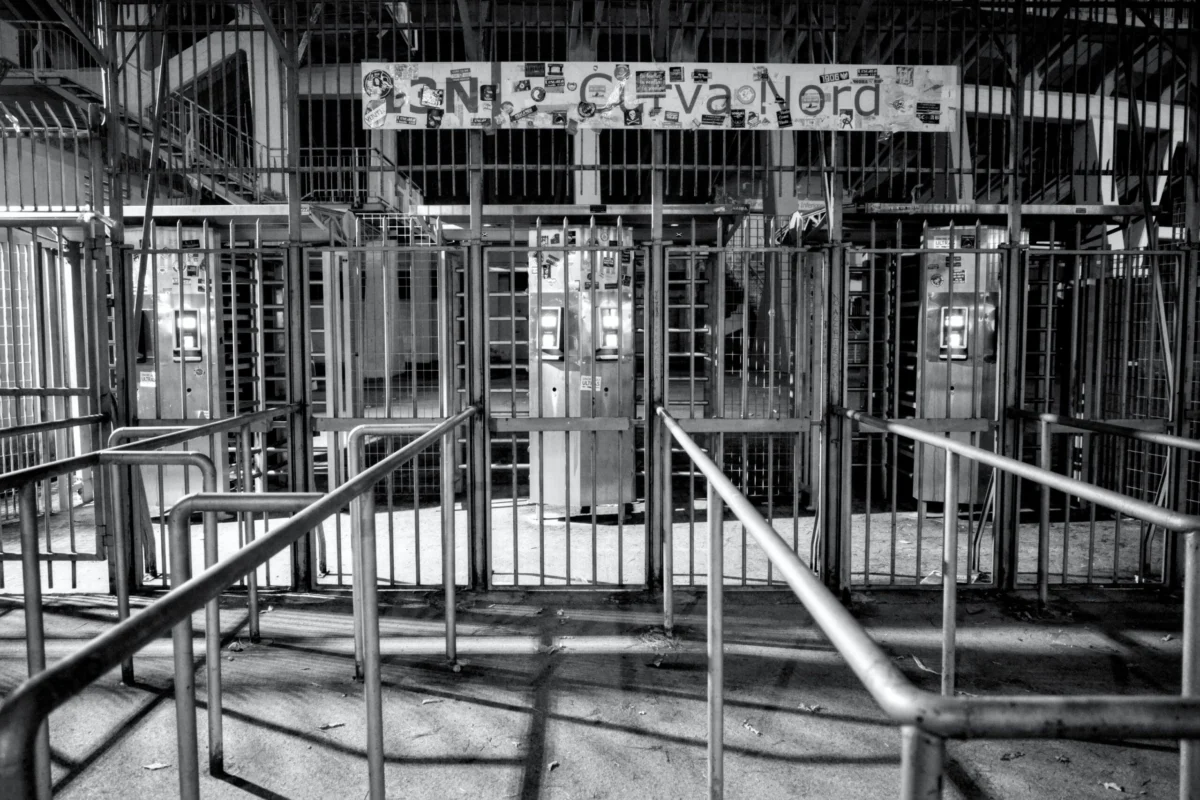
The current state of stadium architecture, as noted in recent photographic documentation using high-contrast monochrome imaging, emphasizes "total control." Modern access points are now characterized by narrow, cage-like corridors, high-frequency scanning zones, and reinforced concrete barriers. These structures are designed to isolate individuals, making them easier to manage, monitor, and, if necessary, detain.
Supporting Data: The Cost and Scale of Stadium Fortification
The shift toward high-security stadium design is supported by significant financial investment. According to global infrastructure reports, the market for stadium security technology and physical hardening reached an estimated $12.5 billion annually by 2025. This represents a 45% increase from 2018 levels.
Key statistics regarding modern stadium security include:
- Surveillance Density: Modern Tier-1 stadiums now average one camera for every 75 spectators, up from one per 500 in the late 1990s.
- Dwell Time: Due to increased security screening, the average time a spectator spends in the "access corridor" has increased from 4 minutes in 2005 to 18 minutes in 2026.
- Infrastructure Maintenance: Facilities managers report that the cost of repairing "urban riot zone" damage—including broken barriers, discarded security zip-ties, and chemical cleaning of stands—now accounts for nearly 12% of a stadium’s annual operating budget.
Stakeholder Perspectives and Official Responses
The transformation of these spaces has elicited varying responses from stakeholders, ranging from security firms to the athletes who use the facilities for non-commercial training.
Security and Law Enforcement
Official statements from stadium security directors frequently emphasize the necessity of these measures. "The goal is not to create an atmosphere of intimidation, but to ensure the safety of 50,000 people in a concentrated space," noted a lead consultant for European stadium safety standards. "The architecture of the entrance must facilitate a rapid but thorough screening process. In the modern threat environment, the ‘correctional’ aesthetic is a byproduct of efficiency and safety protocols."
The Athlete and Community Perspective
Conversely, community users of these facilities express concern over the psychological impact of "fortress architecture." For track and field athletes who arrive on Monday mornings to find their training ground littered with the remnants of Sunday’s security operations, the stadium feels less like a home for sport and more like a contested territory. The isolation of athletes within these reinforced structures can lead to a sense of detachment from the sport’s communal roots.
Architectural Analysts
Urban planners have noted that the "militarization" of the stadium entrance has a "deadening" effect on the surrounding neighborhood. When a stadium looks like a prison, it ceases to be an inviting part of the urban fabric during non-event days. This leads to a "broken windows" effect where the harshness of the architecture encourages further neglect or vandalism in the surrounding area.
Fact-Based Analysis: Implications for the Future of Public Space
The transformation of the stadium entrance is a microcosm of a larger societal trend: the prioritization of security over accessibility. While the "isolated and disciplined" nature of modern stadium access may effectively manage crowd dynamics during high-stakes matches, it carries long-term implications for the utility of these public assets.
The Multi-Use Conflict
One of the most pressing issues is the conflict between the stadium as a professional entertainment venue and the stadium as a community athletic hub. When security measures are designed solely for the "worst-case scenario" of a professional soccer match, they often hinder the daily operations of local track clubs and school programs. The "urban riot zone" atmosphere can discourage young athletes from participating in sports, as the environment feels inherently hostile.
Technological Normalization
The use of monochrome photography to document these spaces, as seen in the work of observers like Andrea Monti, highlights the stark, clinical nature of modern security. The Ricoh GR IV Monochrome, a tool often used for street photography and architectural documentation, strips away the distractions of team colors and branding, leaving only the raw, "sadly explicit" infrastructure of control. This visual evidence suggests that society has normalized a level of surveillance and restriction that would have been unthinkable in 1992.
Economic and Social Costs
The move toward "fortress stadiums" also carries an economic burden. As the cost of security infrastructure rises, those costs are passed on to the public through higher ticket prices and increased taxes for municipal stadiums. Furthermore, the social cost of losing open, inviting public spaces is harder to quantify but no less significant. When the only way to enjoy a performance is to submit to a process of "isolation and discipline," the nature of public enjoyment itself is altered.
Conclusion
As of 2026, the stadium stands as a monument to the complexities of modern urban life. It is a place of paradox: a venue for the celebration of human physical achievement that is housed within a structure of maximum constraint. The evolution from the open gates of the early 1990s to the reinforced corridors of today reflects a society that is increasingly preoccupied with risk management. While these measures may succeed in their primary goal of preventing large-scale incidents, they have undeniably changed the character of the sporting experience, turning the "access point" into a site of profound architectural and social tension. The challenge for the next decade of stadium design will be to find a way to reintegrate security with the spirit of the open, communal celebration that sport is intended to represent.