The evolution of the self-portrait serves as a critical bridge between historical fine art and contemporary digital media, functioning as a medium through which artists explore the boundaries of identity, perspective, and spatial reality. While the genre has its roots in the Renaissance and Baroque periods, the transition to digital photography has introduced new layers of technical complexity and philosophical inquiry. By examining the structural parallels between 17th-century masterpieces and modern street photography, art historians and practitioners alike are uncovering a persistent human fascination with the "subjective glance"—the moment where the observer becomes the observed. This analysis focuses on the interplay between Diego Velázquez’s 1656 masterwork Las Meninas and the contemporary use of digital film simulations to capture the "reflected space" of the modern world.
The Foundation of Perspective in Las Meninas
To understand the modern self-portrait, one must first analyze the structural complexity of Diego Velázquez’s Las Meninas (1656). Often cited as one of the most analyzed paintings in Western art history, it represents a pivotal moment in the conceptualization of point-of-view (POV). In the work, Velázquez depicts himself within the Spanish court, standing before a large canvas. However, the true genius of the composition lies in its manipulation of the spectator’s position.
Art historians, including Michel Foucault in his seminal text The Order of Things, have noted that Las Meninas creates a complex web of gazes. The viewer occupies the same physical space as the subjects being painted—King Philip IV and Queen Mariana of Spain—whose likenesses are visible only in a small mirror at the back of the room. This arrangement forces the spectator to grapple with their own identity within the scene. By placing a mirror at the vanishing point, Velázquez completes the relationship between the self and the "other," effectively turning the act of looking into a recursive loop where the subject and the spectator are one and the same.
Technical Specifications of Modern Tools: The Fujifilm X-Series
In the contemporary landscape, the tools of the self-portrait have shifted from oil and canvas to sophisticated digital sensors. A prominent example of this technical shift is the Fujifilm X100F, a camera that has gained a cult following among street photographers and artists for its ability to replicate the aesthetic of analog film. Released in 2017, the X100F features a 24.3-megapixel X-Trans CMOS III sensor and a fixed 23mm f/2 lens, providing a field of view roughly equivalent to 35mm in full-frame terms.
A critical component of modern digital self-portraiture is the use of "film recipes" or simulations. The Acros + Y recipe, modeled after Fujifilm’s own Neopan 100 Acros film, utilizes a yellow filter simulation to enhance contrast and texture in monochrome images. This technical choice is not merely aesthetic; it serves to strip away the distractions of color, focusing the viewer’s attention on light, shadow, and the geometry of the reflected space. Data from industry analysts suggests that the resurgence of monochrome photography in the digital age is driven by a desire for "intentionality" and a connection to the historical roots of the medium.
The Case Study of Reflected Space
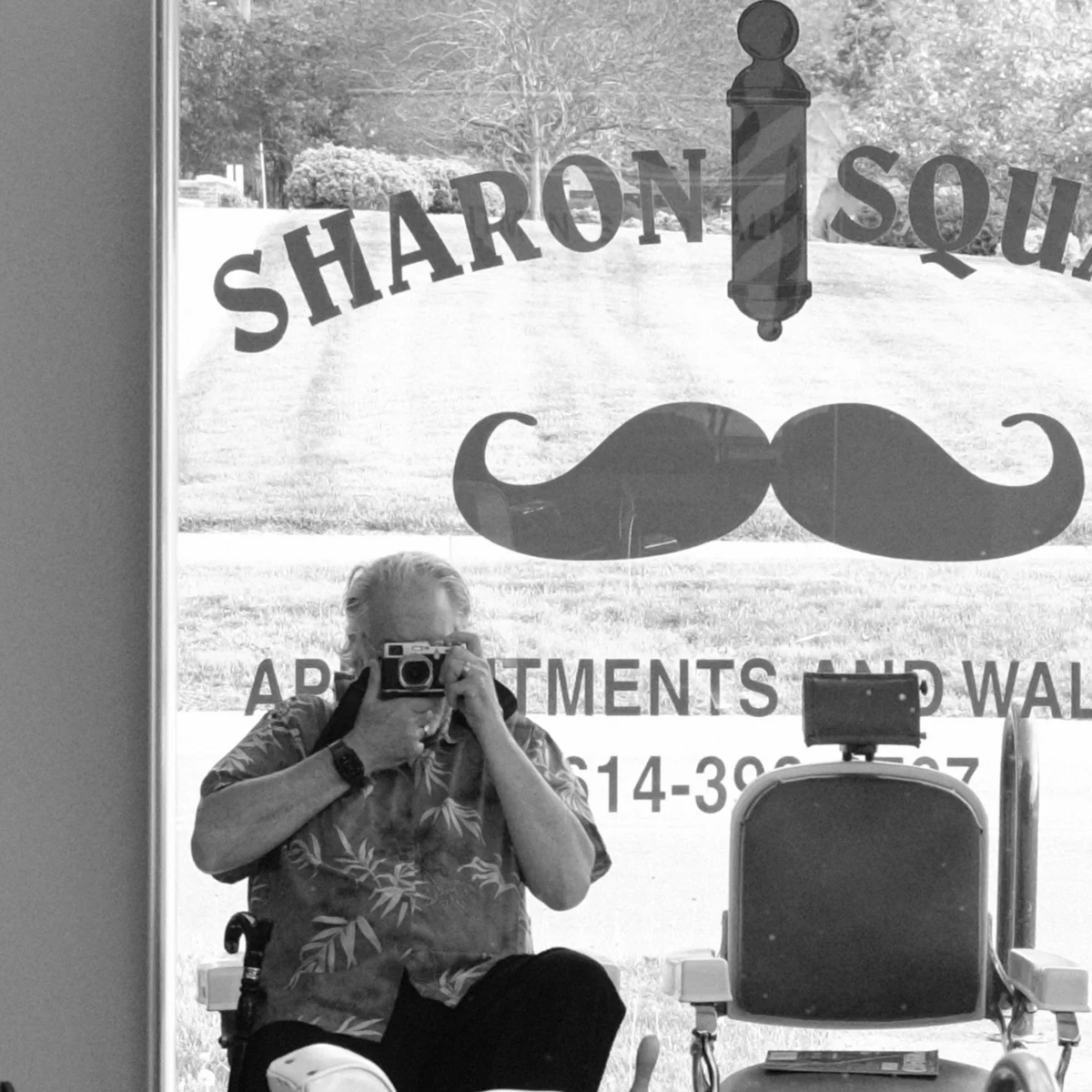
A recent photographic exercise conducted by artist Michael Kaplan serves as a practical application of these classical theories. While utilizing a Fujifilm X100F in a traditional barbershop setting, Kaplan captured a self-portrait that inadvertently mirrored the spatial challenges posed by Velázquez. The environment of a barbershop, characterized by parallel mirrors and vintage styling chairs, provides a unique laboratory for exploring optical reflections.
The photograph in question captures the artist’s reflection in a styling mirror, but the significance lies in the background elements—specifically a large plate-glass window. Upon reviewing the digital output, it was observed that the "reflected space" rendered by the camera had inverted the exterior environment, making the text on the barbershop window readable from the interior perspective. This inversion creates a surreal spatial paradox: the viewer appears to be outside the building looking in, yet the physical presence of the photographer is clearly anchored within the interior.

This phenomenon highlights the "surprising and fascinating" nature of photographic arts. While the camera is often viewed as a tool for objective documentation, the inclusion of mirrors and reflections transforms the image into a subjective exploration of POV. The readable sign in the reflection suggests a location that contradicts the photographer’s physical reality, challenging the viewer’s understanding of where the artist stands in relation to the world.
Chronology of the Self-Portrait Tradition
The development of the self-portrait can be tracked through several key eras, each contributing to the modern digital approach:
- The Renaissance (1450–1600): Artists like Albrecht Dürer began to use the self-portrait as a means of elevating the status of the artist from a mere craftsman to an intellectual.
- The Baroque Era (1600–1750): Velázquez and Rembrandt introduced psychological depth and complex lighting (tenebrism), using mirrors to experiment with perspective.
- The Rise of Photography (1839): Robert Cornelius took the first known photographic self-portrait (a "daguerreotype"), initiating the era of the mechanical gaze.
- The Digital Revolution (2000s–Present): The advent of high-resolution sensors and social media shifted the self-portrait from a rare artistic endeavor to a ubiquitous social tool (the "selfie"), while professional photographers continued to use the medium for deeper philosophical inquiry.
Philosophical Implications and Subjectivity
From the perspective of film theory, the self-portrait is the archetypal "mirror" that completes the relationship between self and identity. The concept of the "gaze" is central here; it is the purely subjective possession of the glance that becomes revelatory. In cinema, POV shots are used to immerse the audience in a character’s internal world. In photography, the self-portrait achieves a similar effect by collapsing the distance between the creator and the subject.
Psychological analysis of the self-portrait often references Jacques Lacan’s "Mirror Stage," the developmental phase where an individual recognizes their reflection as an integrated whole. For the photographer, the act of capturing one’s reflection is a re-enactment of this recognition. It is a moment of self-actualization that is both documented and distorted by the lens.
Broader Impact on the Photographic Arts
The continued relevance of the self-portrait in professional photography has significant implications for the industry. As artificial intelligence and automated imaging become more prevalent, the human element—the "eye" of the photographer—remains the primary differentiator of value. The ability to recognize a "curious and surreal" composition in an everyday setting like a barbershop is a uniquely human capability that relies on an understanding of art history and spatial physics.
Furthermore, the trend toward "analog-style" digital photography indicates a broader cultural shift. Consumers and artists are increasingly seeking out tools that offer a tactile, intentional experience. The popularity of Fujifilm’s X-series and its monochrome simulations suggests that the "final image" is no longer just about resolution; it is about the narrative and the emotional resonance of the perspective captured.
Conclusion and Future Outlook
The relationship between the artist and the reflection remains a fertile ground for exploration. As demonstrated by the comparison between Las Meninas and modern street photography, the core questions of identity and perspective have remained remarkably consistent over nearly four centuries. Whether through the medium of oil paint or a 24-megapixel sensor, the goal remains the same: to challenge the spectator to process space and to grapple with an understanding of identity.
As technology continues to advance, the "reflected space" will likely become even more complex. However, the fundamental thrill of the photographic arts—the anticipation of the final image and the surprise of a captured perspective—ensures that the self-portrait will remain a vital part of the human experience. The work of practitioners like Kaplan serves as a reminder that every time a camera is picked up, there is an opportunity to see the world, and oneself, in an entirely new light.