Located off the northwest tip of West Papua’s Bird’s Head Peninsula, Raja Ampat stands as an almost unbelievable spectacle of jungle-covered islands, rich coral reefs, and a staggering array of marine wildlife. Long celebrated as the ultimate dive destination, its reputation as a mecca for underwater photography is globally recognized, drawing enthusiasts and professionals alike to capture its unparalleled beauty.

Geographic and Ecological Significance

Known affectionately as ‘The Last Paradise’, Raja Ampat is an archipelago comprising over 1,500 islands, cays, and shoals, clustered around four main islands: Waigeo, Batanta, Salawati, and Misool. This intricate geography is more than just picturesque; it is the cornerstone of its ecological dominance. Situated squarely in the heart of the Coral Triangle, the global center of marine biodiversity, Raja Ampat boasts an astonishing concentration of life. Scientific surveys confirm that this vibrant utopia harbors over 75% of the world’s known coral species, an extraordinary figure that underpins the health and complexity of its ecosystems. This includes an impressive repertoire of over 1,000 species of fish, 540 different strains of coral, and 700 types of mollusks. Beyond these statistics, the waters teem with charismatic megafauna such as reef sharks, schooling manta rays, the elusive wobbegong shark, dugongs, and even saltwater crocodiles in certain mangrove areas, promising an experience that truly blows the mind.

Evolution as a Premier Destination and Conservation Efforts

Raja Ampat’s journey to becoming a globally renowned dive destination is intertwined with increasing scientific recognition of its biodiversity and dedicated conservation efforts. For decades, local communities have maintained traditional fishing practices that inherently contributed to marine health. However, it was in the early 2000s that international attention, spurred by scientific expeditions, began to highlight its critical ecological value. This led to the establishment of extensive Marine Protected Areas (MPAs) across the region, a monumental step in safeguarding its pristine environment.

These MPAs are crucial, covering vast stretches of ocean and enforcing strict regulations against destructive fishing practices. A notable success story is the Misool region, where concerted efforts by local communities and organizations like the Misool Foundation have led to a measurable improvement in biodiversity. Through active patrolling, community empowerment, and sustainable tourism models, areas that once faced threats from illegal fishing now demonstrate a remarkable rebound in fish stocks and coral health. This unique model of conservation, blending scientific rigor with local stewardship, has become a benchmark for marine protection globally. The Indonesian government, through its Ministry of Marine Affairs and Fisheries, actively supports these initiatives, recognizing Raja Ampat as a national treasure and a cornerstone of its marine conservation strategy.

Navigating the Journey: Planning an Expedition

Reaching this remote yet rewarding destination requires careful planning, a testament to its pristine, untouched nature. For international travelers, the journey typically involves multiple flights, often connecting through major Indonesian hubs like Jakarta or Makassar, followed by a domestic flight to Sorong (Dominique Edward Osok Airport, SOQ) in West Papua. From Sorong, the final leg to Waisai, the capital of Raja Ampat regency, usually entails a two-hour public ferry ride. Once in Waisai, travelers have several options for exploring the archipelago:

- Day trips: Staying in Waisai or a nearby homestay and taking daily speedboats to various dive sites.
- Liveaboards: This is often the preferred choice for serious divers and photographers. Liveaboard vessels offer comprehensive itineraries, allowing access to the most remote and biodiverse sites across the vast region, including the coveted Misool area, without the need for daily transfers. These trips typically range from 7 to 14 days, maximizing time spent underwater.
- Island Homestays/Resorts: For those preferring a more static experience, numerous eco-friendly homestays and dive resorts are scattered throughout the islands, offering access to stunning house reefs and local culture.
Given the expansive nature of Raja Ampat and the desire to explore its diverse ecosystems, liveaboards are highly recommended for photographers, as they facilitate covering significant ground and accessing the most renowned sites. Selecting an itinerary that includes Misool is particularly advantageous, as it offers some of the most vibrant and protected reefs. Post-liveaboard, spending a few days at an island homestay provides an opportunity to decompress, enjoy the pristine house reefs at a leisurely pace, and integrate with local communities.

Mastering the Underwater Frame: Photographic Opportunities

Raja Ampat presents an unparalleled canvas for underwater photographers, catering to a wide spectrum of photographic styles. The sheer diversity means photographers must often make strategic decisions about their gear before each dive.

- Wide-Angle Photography: The majestic reef systems, flourishing with unimaginable size and color, provide perfect backdrops for wide-angle shots. Photographers frequently capture schooling batfish, barracuda, snappers, lionfish, and angelfish, often against vibrant coral walls. Encounters with larger marine life such as manta rays, reef sharks (including the endemic wobbegong), and sea turtles are common. A 16-35mm wide-angle lens is generally recommended for these expansive reefscapes and large animal encounters. Opportunities for Close Focus Wide Angle (CFWA) shots are also abundant, allowing photographers to highlight specific reef sections or animals while retaining a sense of their environment.
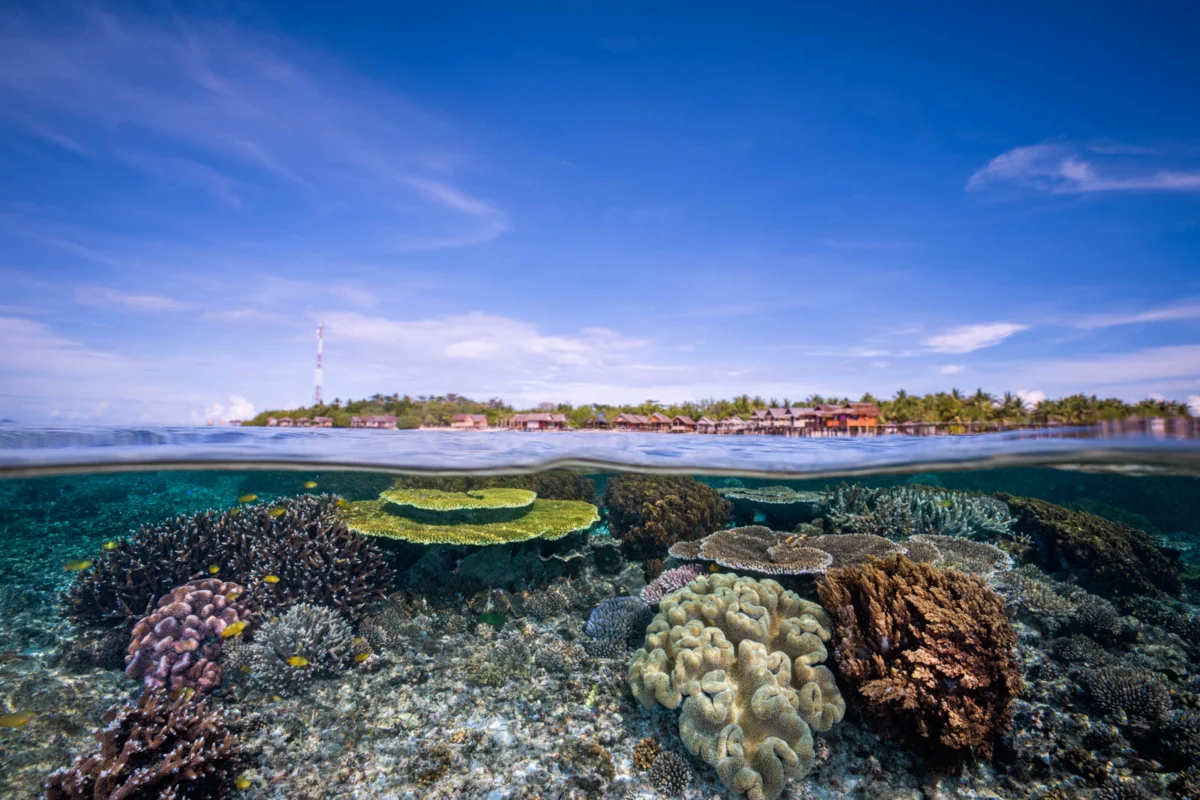
- Split Shots (Over-Under): The dramatic limestone karsts, crystal-clear shallow lagoons, and vibrant house reefs make Raja Ampat an ideal location for stunning split shots, capturing both the underwater and above-water worlds in a single frame. The breathtaking sunrises and sunsets further enhance these photographic possibilities, painting the sky and water with rich hues. Choosing a homestay with a pristine house reef offers 24-hour access to an almost choreographed coral backdrop, maximizing opportunities for perfect split shots.
- Macro Photography: For many, the major draw to Raja Ampat gravitates towards the weird and wonderful macro critters hidden within the cracks and crevices of these breathtaking reef systems. This "critter hunting" requires patience and specialized equipment. A mid-range macro lens, such as a 60mm, is a good starting point, but an essential addition is a longer macro lens (90mm or 120mm) for shy or extremely tiny subjects. An external diopter is highly recommended for capturing the minutest details of pygmy seahorses, mantis shrimps, leaf scorpionfish, various frogfish species, cephalopods, ghost pipefish, eels, and blennies. Dive guides are instrumental in locating these masters of camouflage; therefore, a pre-dive briefing is crucial to select the appropriate setup for the expected marine life.
Challenges Beneath the Surface

While offering immense photographic rewards, Raja Ampat also presents unique challenges, primarily stemming from the very conditions that foster its rich biodiversity.

- Visibility: The nutrient-rich waters, while supporting prolific marine life, can sometimes result in less-than-desirable visibility compared to other tropical destinations. This means capturing crisp wide-angle images requires meticulous attention to strobe positioning to minimize backscatter. Experienced photographers learn to work with these conditions, often focusing on subjects closer to the lens or waiting for clearer moments.
- Strong Currents: The region’s intricate system of strong currents, particularly through the Dampier Strait, is the main contributing factor to the masses of marine life. However, these currents can be a significant burden when handling heavy underwater photography equipment. Divers must be prepared for dives where merely holding on for dear life, seeking shelter behind boulders, becomes the primary activity. Dive guides will often warn of "strong currents," and in such instances, leaving the camera behind might be a prudent decision to ensure diver safety and avoid equipment damage. It is paramount that cameras are securely attached to the diver at all times, and comprehensive camera insurance is highly advisable. Understanding current patterns and planning dives accordingly is a critical skill for photographers in Raja Ampat.
Premier Dive Sites for Photographers

Several dive sites consistently stand out for their exceptional photographic opportunities:

- Melissa’s Garden (Fam Islands): A coral enthusiast’s dream, this wide-angle site plunges divers into mountains of plate corals stretching as far as the eye can see. The elegance and refined beauty of its topography, teeming with schooling batfish, barracuda, and snappers, set the stage for iconic wide-angle reefscape shots.
- Batu Rufus (Fam Islands): A hidden gem, Batu Rufus features a crystal-clear emerald lagoon enclosed by towering limestone formations. While its outer slopes offer chances for manta and shark sightings, the true photographic magic unfolds in the shallow lagoon. Divers enter through a large swim-through adorned with towering coral fans, emerging into a natural pool with startling visibility. Here, hours can be spent capturing flourishing reef systems in 5 meters of water, ideal for natural light photography and stunning split shots against the dramatic limestone backdrop. Freediving with a camera is an excellent option here.
- Cape Kri (Dampier Strait): Perhaps the most well-known site, Cape Kri famously held the world record for the highest number of fish species spotted on a single dive. Its prolific marine life ensures overwhelming choices for photographers. With sloping reefs dropping to 40 meters and strong intersecting currents, it offers fantastic wide-angle opportunities with schooling pelagics, turtles, and mantas. Simultaneously, Cape Kri is a macro photographer’s delight, saturated with exotic tiny critters. The abundance of Muricella gorgonians makes it a prime spot for pygmy seahorse encounters, alongside octopus, flatworms, nudibranchs, and various shrimp species. Photographers often plan multiple dives here, dedicating one to wide-angle and another to macro.
- Manta Ridge (Mansuar and Airborei Islands): A hotspot for schooling manta rays, this site is a truly dynamic experience. While sightings can sometimes be unpredictable, favorable conditions can lead to incredible moments where mantas glide in from every direction, offering unparalleled wide-angle opportunities. Divers must, however, be acutely aware of the incredibly strong and potentially dangerous down currents prevalent here, prioritizing safety above all else.
- Citrus Ridge (Gam Islands): Celebrated as one of the most colorful reef systems in the region, Citrus Ridge is a T-shaped dive that invites wide-angle experimentation. Beyond its vibrant reefscapes, this site is a biodiversity hotspot for macro life. Photographers can immerse themselves in "underwater detective work," scouring every rock and crevice for wobbegongs, various sharks, turtles, and an incredible array of macro subjects, all framed by a stunning coral backdrop.
Sustaining "The Last Paradise": Implications and Future Outlook

Raja Ampat’s status as a global biodiversity hotspot brings with it significant responsibilities and implications. The burgeoning tourism industry, particularly dive tourism, provides crucial economic benefits to local communities, offering sustainable livelihoods that incentivize marine conservation. However, this growth also necessitates careful management to prevent adverse environmental impacts. Local authorities and conservation groups are continuously working to implement and enforce sustainable tourism practices, including strict waste management, mooring buoy systems to protect reefs from anchor damage, and educational programs for both tourists and locals.

Despite robust local conservation, Raja Ampat remains vulnerable to broader environmental threats such as climate change, which causes coral bleaching, and illegal, unreported, and unregulated (IUU) fishing that can deplete fish stocks beyond its protected zones. The future of "The Last Paradise" hinges on a delicate balance: continuing to attract responsible tourism that funds conservation, strengthening marine protection measures, and fostering global awareness of its irreplaceable ecological value. The photographic possibilities in Raja Ampat are endless, inviting eager ocean lovers to become immersed in its perfectly manicured reefs, abundance of ocean creatures, and infinite archipelago structures. But beyond the lens, visitors are called to be stewards, respecting the strong ocean currents and fragile underwater ecosystems, ensuring this last remaining paradise endures for generations to come.