The stark beauty of Norway’s winter coastline, often shrouded in the dim light of the polar night, recently played host to a spectacle of raw, untamed power as a pod of orcas engaged in a breathtaking feeding frenzy. For weeks, wildlife photographers and researchers had been tracking these magnificent marine mammals, a pursuit that often tests patience and resilience amidst challenging environmental conditions. The effort, however, culminated in a moment of extraordinary visual and visceral impact, capturing the essence of these apex predators in their natural, often unforgiving, habitat. The event underscores the unique behaviors of Norwegian orca populations and highlights the dedication required to document these elusive creatures.
The Arduous Pursuit: Weeks of Anticipation
The journey to witness this particular display began weeks prior, with an intensive effort to locate and observe orca pods in the fjords of Norway. This region is renowned for its wintering populations of orcas, drawn by the abundance of herring that migrate into these sheltered waters. However, the success of such expeditions is far from guaranteed. The prevailing conditions during this period are notoriously difficult. Daylight hours are severely limited, with the sun often failing to rise above the horizon, casting a perpetual twilight or outright darkness for much of the day. Coupled with frigid temperatures and frequently turbulent seas, these factors present significant logistical and operational hurdles for any team attempting to document marine wildlife.
Researchers and photographers often describe these weeks as a test of endurance. Many days are spent navigating through rough waters, with only fleeting glimpses of the distinctive black dorsal fins slicing through the dark, choppy surface. The visual contrast against the typically grey or slate-colored sky can be striking, yet the overall atmosphere is one of muted intensity, a stark reminder of the raw power of nature and the resilience of its inhabitants. The scarcity of sightings during this prolonged period only amplifies the anticipation for any significant event.
A Sudden Awakening: The Feeding Frenzy Unfolds
The turning point occurred one particular morning, as a distant pod of orcas was being observed. Initially, the scene appeared subdued. While the presence of several large male orcas was noted, the pod seemed to be moving with a degree of quietude. This observation is significant, as it contrasts with the more frequently observed behaviors of orcas in other regions, such as British Columbia, where breaching and aerial displays are a common occurrence. Norwegian orcas, while equally powerful, are typically less inclined towards such acrobatic performances.
However, without any prior indication, a dramatic shift in behavior was triggered. Even from a distance, it became evident that something extraordinary was happening. The orcas were not merely moving; they were exhibiting signs of intense excitement and engagement. This sudden animation indicated a feeding frenzy, a critical period of intense activity focused on securing prey. The observation team’s senses immediately heightened, their focus sharpening with the sudden surge of adrenaline.
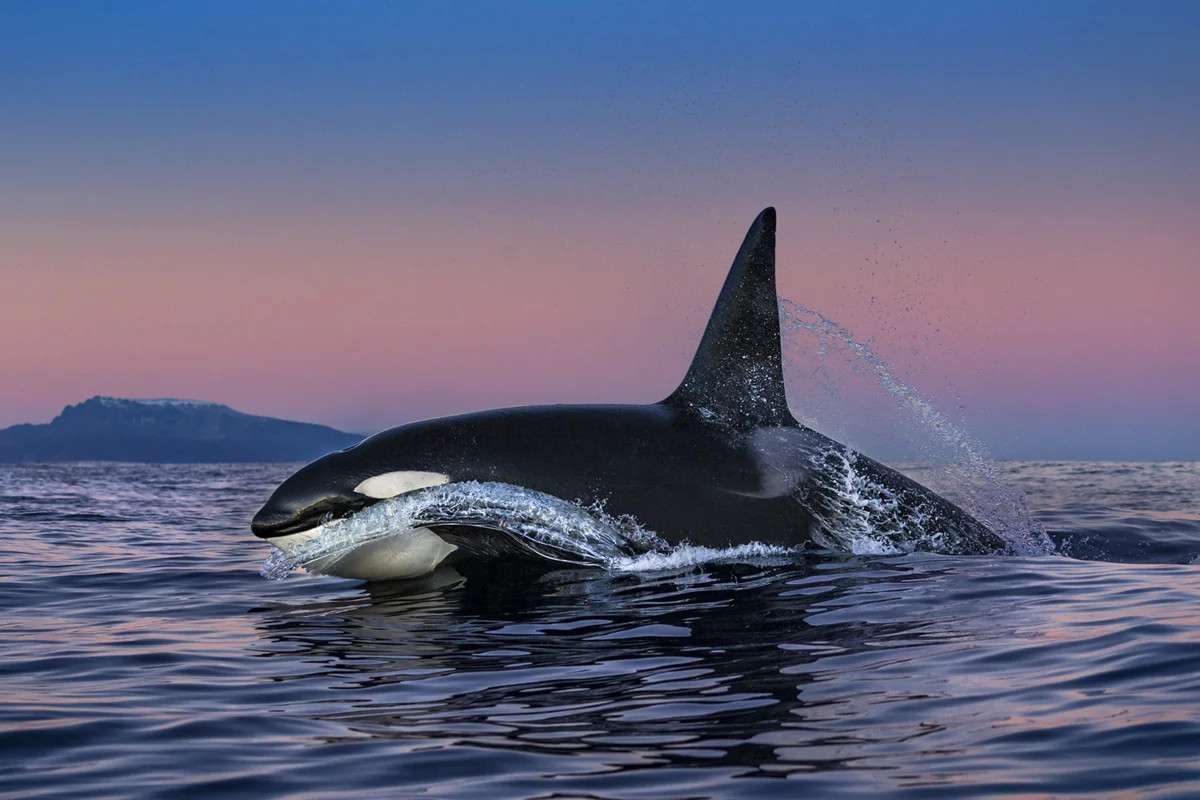
The research vessel, maintaining a careful distance to avoid disturbing the pod, accelerated to approximately 20 knots. This speed was crucial for matching the pace of the orcas, allowing for sustained observation of their dynamic movements. The conditions, for a rare change, were remarkably calm, and the water’s surface provided an optimal environment for photography. It was during this opportune moment that a particularly large male orca began to porpoise with astonishing speed and vigor. The intensity of its leaps sent explosive plumes of water streaming from its body, creating a spectacle of raw, unbridled energy.

The Art of Capturing the Ephemeral
Photographing such a dynamic event under the specific conditions of a Norwegian winter presents a significant technical challenge. The low light levels characteristic of this region necessitate a delicate balance between shutter speed and aperture settings. The photographer must select a shutter speed fast enough to freeze the rapid motion of the orcas, preventing motion blur, while simultaneously allowing enough light to enter the lens to achieve a well-exposed image. This often requires a difficult and rapid calculation, especially when dealing with subjects moving at such high speeds.
On this particular occasion, the lighting conditions were just sufficient to make the endeavor possible. The sky had transformed into a canvas of soft pinks and oranges, creating a dramatic backdrop against the towering, snow-capped mountains that formed a natural horizon. Against this ethereal light, the immense form of the orca became a focal point of breathtaking power. This particular male, estimated to weigh around 12,000 pounds and measure approximately 25 feet in length, possessed a dorsal fin that stood nearly six feet tall and pectoral fins comparable in size to car hoods. Its porpoising was so powerful that it created a visual challenge for the photographer, making it difficult to frame the entire subject within the viewfinder while capturing the explosive motion.
The technicalities of using single-lens reflex (SLR) cameras in such fast-paced situations added another layer of complexity. The act of taking a photograph – the mirror lifting, the shutter opening and closing – temporarily blinds the photographer, creating a brief period of uncertainty about whether the shot has been successfully captured. Shooting at ten frames per second meant ten moments of blindness every second. This process left the photographer with little immediate feedback on the quality of the image being produced.
The Moment of Revelation: A Perfect Capture
Following the intense activity, which passed in what felt like a fleeting instant, the photographer was able to retreat to the rear of the boat. The relief and anticipation of having potentially captured the desired imagery were palpable. In previous situations, with such challenging low-light conditions and the extreme speed of the subject, there would have been significant concern about the sharpness and clarity of the final images.
However, this occasion proved to be exceptional. The boat’s driver, identified as a friend named Goran, had expertly maneuvered the vessel, achieving perfect pacing with the orca pod. This synergy between the wildlife’s behavior, the environmental conditions, and the observational platform’s capabilities converged to create an ideal scenario. As the photographer reviewed the captured images on the camera’s LCD screen, the result was immediately apparent. The entire scene had been successfully preserved.
The detail captured was extraordinary: the water droplets splashing from the orca’s eye, cascading down its powerful body, the interplay of light and shadow, the rich hues of the sky, and the overall mood of the moment were all present in stunning clarity. The photographer’s initial doubt about being able to achieve sharp focus on the orca’s eye, let alone the entire frame, dissolved upon inspection. Each scroll through the images revealed a perfect capture, devoid of the anticipated errors that signal a failed attempt.
Nature’s Gifts: Preserving a Fleeting Moment
These instances are described as profound gifts from nature, opportunities to translate the raw beauty and power of the natural world into a tangible medium. In such moments of clarity and epiphany, there is a deep realization that a perfect, ephemeral moment has been preserved – a "bottle of light and time" that will endure beyond the fleeting seconds it took to create.

The successful documentation of such events holds significant value beyond the aesthetic. Orcas in Norway are part of a complex marine ecosystem. Their presence and feeding behaviors are indicators of the health of the fish populations, particularly herring, which are crucial to the regional economy and the wider food web. Understanding their migratory patterns, hunting strategies, and social structures provides vital data for conservation efforts.
Supporting Data and Context
Orcas, scientifically known as Orcinus orca, are the largest members of the dolphin family. They are highly intelligent, social animals with complex hunting techniques that often vary by population and region. The Icelandic and Norwegian waters are known for their large populations of transient orcas that follow the annual migration of herring. Studies have indicated that these populations are genetically distinct and exhibit unique foraging strategies. For instance, the practice of "herding" and "wave washing" has been documented, where orcas work together to disorient and incapacoupe their prey.
The specific event described, occurring in the dark winter months, aligns with the typical feeding season for these Norwegian orcas. The herring population in the Norwegian fjords can be substantial, with estimates suggesting millions of tons of herring migrating annually, providing a rich food source for predators like orcas and humpback whales. The challenge of photographing these events is exacerbated by the low angle of the sun, which can lead to significant glare and the need for specialized techniques to manage light conditions.
Broader Impact and Implications
The ability to capture such vivid imagery of orcas in their natural habitat has far-reaching implications. For scientific research, high-quality photographs and videos provide invaluable data for population studies, behavioral analysis, and understanding ecological dynamics. They can help researchers track individual animals, identify social structures, and observe hunting success rates.
From a conservation perspective, these powerful images serve as potent advocacy tools. They raise public awareness about the magnificence of these animals and the importance of protecting their marine environments. By showcasing the beauty and wildness of orcas, such as those in Norway, organizations and individuals can garner support for initiatives aimed at reducing threats such as pollution, overfishing, and habitat degradation. The photographs serve as a stark reminder of what is at stake if these vital ecosystems are not preserved.
Furthermore, the experience itself, as described by the photographer, highlights the profound connection that can be forged with the natural world. The dedication, patience, and technical skill required to document such moments underscore the commitment of those who work to share these natural wonders with the public. The resulting images become not just photographs, but testaments to the enduring power and beauty of life in the ocean, offering a glimpse into a world that remains largely wild and untamed. The "gifts of nature" are thus shared, fostering a deeper appreciation for the planet’s biodiversity and the urgent need for its stewardship.