The frigid waters off the coast of Norway, a realm often shrouded in the muted light of Arctic winters, recently played host to a spectacle of raw power and breathtaking beauty as a pod of orcas, or killer whales, engaged in an extraordinary feeding frenzy. This event, captured by the lens of renowned wildlife photographer Paul Nicklen, offers a rare glimpse into the dynamic lives of these apex predators in a challenging environment. While orcas in other regions, such as British Columbia, are known for their acrobatic displays, Norwegian orcas typically exhibit a more reserved demeanor, making this particular exhibition of energetic porpoising and synchronized feeding an exceptionally noteworthy occurrence.
The Elusive Majesty of Norwegian Orcas
For weeks, Nicklen and his team had been navigating the often-treacherous Norwegian fjords, their efforts to locate orca pods frequently met with the stark reality of the polar winter. Days were characterized by a profound darkness, with the sun’s ascent barely painting a fleeting pink glow on the horizon at what would typically be considered midday. The prevailing conditions were consistently harsh: low light, biting cold, and rough seas. The sight of a black orca fin slicing through the choppy, dark waters was a familiar, yet often fleeting, reward for their persistent pursuit.
“There are few things more humbling in this world than to witness a 12,000-pound dolphin explode out of the water,” Nicklen recounted, underscoring the sheer scale and power of these marine mammals. These moments, he emphasized, are "so exquisite that it is near impossible not to become immersed in them," a testament to their rarity and profound impact.
A Dawn Patrol Unfolds: The Trigger of the Feeding Frenzy
The turning point arrived on a particular morning, as the team was tracking a distant group of orcas. Initially, the pod appeared to be in a state of quietude, with the presence of several large males the only discernible feature. This observation aligned with established knowledge about Norwegian orcas, which are generally less inclined to breach or perform aerial acrobatics compared to their counterparts in British Columbia.
However, without any prior indication, a sudden and dramatic shift occurred. Something ignited the pod, transforming their passive presence into a display of intense activity. Although still at a distance, it was evident that a significant event had transpired, sparking a profound excitement within the group. The orcas had entered a feeding frenzy.

This dramatic transformation immediately galvanized Nicklen and his crew. "We came alive, our senses suddenly alert and active, as if flicked on by a switch," he described. The boat accelerated, meticulously maintaining a strategic distance from the frenzied pod. They proceeded at approximately 20 knots, matching the pace of this "unrivaled athletic spectacle." The conditions, for once, proved favorable. The sea had calmed, and the water’s surface was cooperative, allowing for optimal observation and photography.
A Symphony of Motion: Capturing the Unseen
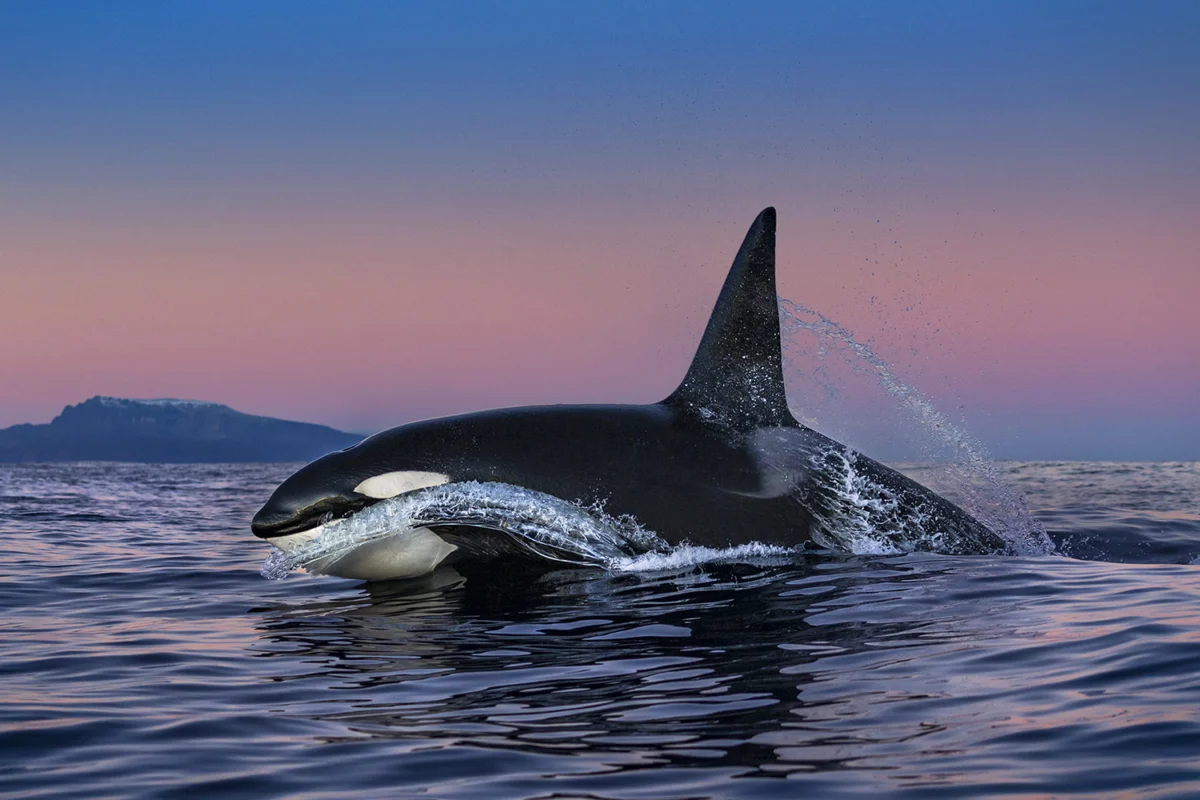
As the orcas’ synchronized movements intensified, one particularly massive male, estimated to weigh around 12,000 pounds and measure 25 feet in length, began to porpoise with astonishing speed and ferocity. Each powerful leap sent cascades of water streaming from its body, creating an almost explosive effect. The visual impact was immense: a six-foot-tall dorsal fin and pectoral fins akin in size to car hoods, cutting through the water with unparalleled grace and power.
The low light conditions inherent to this Arctic environment presented a significant photographic challenge. Nicklen had to make a rapid, calculated decision regarding his camera’s shutter speed. The objective was to freeze the dynamic action in time, preventing the blur that would inevitably result from such rapid movement. Fortunately, the prevailing light, a soft pink hue tinged with orange against a backdrop of towering, snow-capped mountains, was just sufficient to achieve this.
The technical demands of wildlife photography in such conditions are immense. Using single-lens reflex cameras, Nicklen often found it difficult to confirm a successful shot in real-time. Shooting at ten frames per second meant that for a fraction of a second after each burst, he was effectively blind as the camera’s mirror and shutter mechanisms engaged. "Essentially, I had no clue if I had captured the shot or not," he admitted.
The Moment of Epiphany: A Perfect Capture
Despite the technical hurdles and the fleeting nature of the event, a sense of calm confidence settled over Nicklen. "It was one of those occasions when, after it is over – a split second that passes by in the blink of an eye – I was able to sit down quietly in the back of the boat, safe in the knowledge that I likely did get the shot." He reflected on past experiences where the low light and explosive speed had jeopardized the sharpness of his images, leading to concerns about the quality of the captured moment.
The success of this particular photographic endeavor was also attributed to the expert seamanship of his friend, Goran, who was piloting the boat that day. His ability to maintain the perfect pacing and distance was crucial.

Upon reviewing the images on his camera’s LCD screen, Nicklen experienced a profound sense of satisfaction. "I immediately saw that the whole package was there. It was beautiful," he described. The detail was exquisite: water droplets splashing off the orca’s eye, tracing a path down its sleek body, all bathed in the ethereal light and mood of the Arctic twilight. "The light, the mood, the color . . . perfect."
Initially, Nicklen had harbored doubts about the possibility of capturing a sharp image of the orca’s eye, given the challenging circumstances. However, upon zooming in, he was astonished to find not only the eye but the entire image rendered with remarkable clarity and sharpness. He meticulously scrolled through the sequence, anticipating a flaw that would signify a missed opportunity, but none emerged.
Implications and the Enduring Power of Nature Photography
This extraordinary encounter underscores the remarkable resilience and adaptability of marine life in even the most demanding environments. Orcas, as apex predators, play a critical role in maintaining the ecological balance of their habitats. The feeding frenzy observed in Norway is indicative of a healthy prey population, likely herring, which are known to aggregate in large numbers in these waters during the winter months.
The behavior observed also contributes to our understanding of regional variations in orca behavior. While the breaching habits of Orcas in British Columbia are well-documented, the more subtle, yet equally powerful, displays seen in Norway offer a different perspective on their intelligence and predatory prowess. The rarity of such energetic displays by Norwegian orcas makes this photographic documentation particularly valuable to the scientific community and the broader public.
The broader implications of this event extend to conservation efforts. Images like those captured by Nicklen serve as powerful tools for raising awareness about the importance of protecting these magnificent creatures and their habitats. The challenges faced by wildlife photographers in documenting such events highlight the dedication required to bring these stories to light, often requiring significant investment in time, resources, and expertise.
Nicklen’s description of the captured images as "gifts of nature" that transform the beauty of the natural world into a tangible form speaks to the profound connection between humanity and the wild. These captured moments, frozen in time and light, serve as enduring reminders of the planet’s extraordinary biodiversity and the urgent need for its preservation. The successful documentation of this rare event not only enriches our visual understanding of orca behavior but also reinforces the critical role of dedicated conservation photography in fostering a deeper appreciation for the natural world. The ongoing efforts to study and protect these iconic marine mammals remain paramount, ensuring that future generations can continue to marvel at their power and majesty.