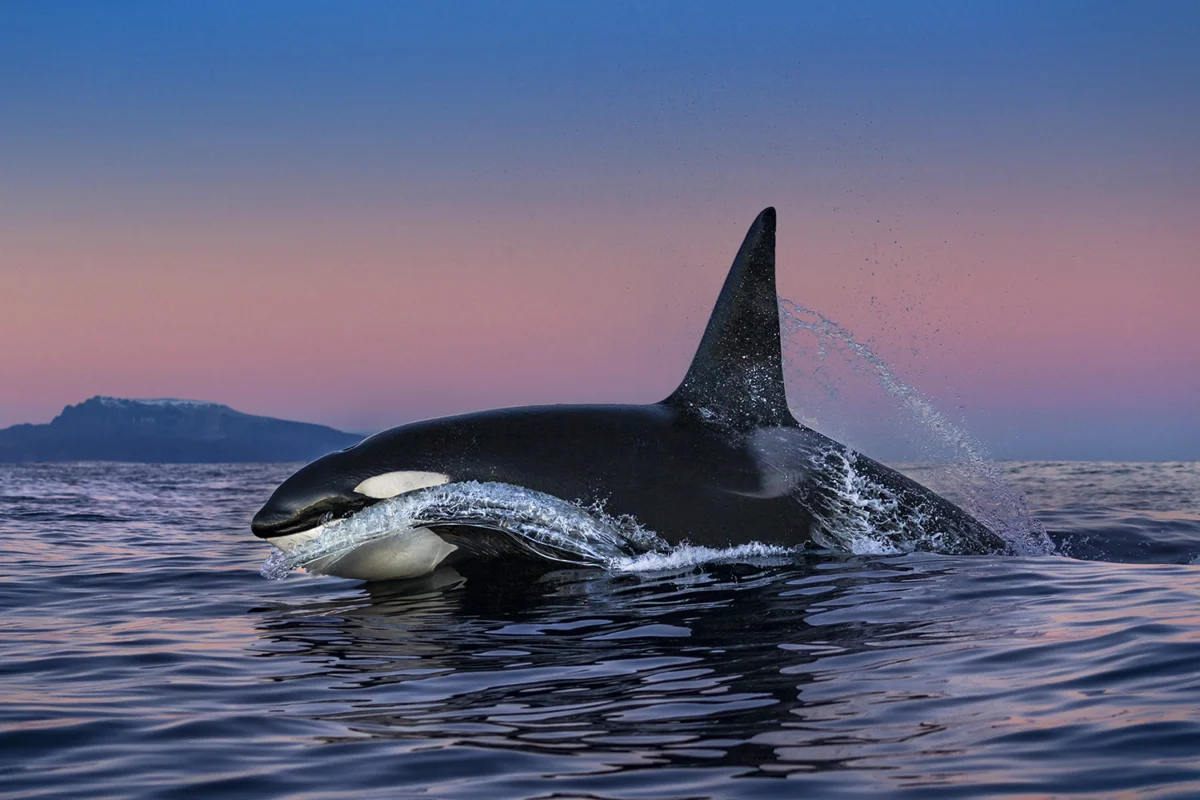
The raw power and ethereal beauty of the ocean’s apex predators were on full display off the coast of Norway, as a pod of orcas, known for their more reserved nature in these northern waters, erupted into a breathtaking feeding frenzy. Renowned wildlife photographer Paul Nicklen documented a particularly electrifying moment: a massive male orca, estimated to weigh 12,000 pounds and measure 25 feet in length, launching itself clear out of the water in a display of unparalleled athleticism. This event, captured under challenging conditions of low light and rough seas, represents a rare and treasured glimpse into the dynamic lives of these marine mammals, a moment that Nicklen described as a "perfect little bottle of light and time that will live on forever."
A Grueling Pursuit Yields Extraordinary Rewards
The expedition, which spanned several weeks, was characterized by the persistent pursuit of orca pods. These encounters were often punctuated by the harsh realities of Arctic winters in Norway. Days were marked by prolonged periods of darkness, with the sun barely cresting the horizon, casting a fleeting pink glow that served as the day’s "high noon." For much of the remaining time, visibility was limited, and the sea conditions were frequently turbulent. The stark black dorsal fins of the orcas, when they appeared, were often seen slicing through dark, choppy waters, a testament to the challenging environment in which the photographer and his team operated.
This prolonged period of observation, while often yielding limited visual rewards, underscored the dedication required in wildlife photography. Unlike their counterparts in British Columbia, where orcas are frequently observed breaching and engaging in aerial acrobatics, Norwegian orcas are typically less inclined to leap from the water. Their usual behaviors include more subtle displays, such as "spyhopping," where they rise vertically out of the water to observe their surroundings. This fundamental difference in observed behavior made the subsequent event all the more remarkable.
The Turning Point: A Dawn Patrol Awakens
The breakthrough moment occurred on a particular morning, described by Nicklen as part of a "dawn patrol." While following a distant pod, the initial observation suggested a period of relative quietude. The presence of several large male orcas was noted, but no immediate signs of extraordinary activity were apparent. However, this tranquility was shattered without warning.
"Then, one morning, as we were following a pod of orcas, something wonderful happened," Nicklen recounts. The pod, initially observed at a distance, began to exhibit signs of heightened activity. "It was clear that something was happening—had happened. Something that excited them. They were in a feeding frenzy."
This sudden shift in behavior instantly galvanized the observers. The photographer and his team experienced an immediate surge of alertness, their senses sharpening as if a switch had been activated. The boat’s speed was increased to approximately 20 knots, a deliberate effort to maintain a consistent distance from the pod and to match the pace of this "unrivaled athletic spectacle." The conditions, for a rare change, had also become favorable. The sea had calmed, and the water was cooperative, providing an ideal canvas for the unfolding drama.

Capturing the Uncapturable: A Masterclass in Low-Light Photography
As the orcas’ frenzied activity intensified, the photographer faced the dual challenge of capturing the sheer speed and power of the animals while contending with the prevailing low-light conditions. The sky, in a fortunate turn of events, had transformed into a canvas of soft pinks and oranges, with towering mountains providing a dramatic natural backdrop along the horizon. This ambient light, though subtle, was crucial.
The central figure in the spectacle was the immense male orca. Nicklen meticulously describes its physical attributes: "12,000 pounds, 25 feet long, with a six-foot-tall dorsal fin and pectoral fins the size of a car hood." This colossal creature was engaged in a series of powerful leaps, a behavior known as porpoising, executed with such "furious speed and power" that water seemed to stream off its body with each ascent.
The technical demands of capturing such a moment were immense. Nicklen highlights the intricate calculation required to set the camera’s shutter speed. The objective was to achieve a speed fast enough to freeze the action, preventing motion blur, while simultaneously allowing enough light to enter the sensor. "You want a shutter speed that is fast enough to freeze a snapshot in time, otherwise the action will be blurred. Luckily, on this occasion, there was just enough light."
The use of single-lens reflex (SLR) cameras presented an additional layer of difficulty. The mechanical operation of these cameras, involving the lifting of a mirror and the rise of a shutter, meant that for a fraction of a second during each shot, the photographer was effectively "blind," unable to see the image being captured. "I was shooting at ten frames a second, which means that ten times every second I was blind because the mirror has to lift, the shutter has to rise, and the image is exposed. Essentially, I had no clue if I had captured the shot or not."
A Moment of Epiphany and Perfect Execution
The intensity of the orca’s leaps meant that keeping the entire frame in view through the camera’s viewfinder was a significant challenge. The sheer scale of the animal’s movement often exceeded the field of vision. "It was hard to put the camera to my eye without losing sight of the whole image."
The success of the photographic endeavor was also attributed to the skilled navigation of the boat. Nicklen credits his companion, Goran, for his precise maneuvering: "Somehow my friend Goran, who was driving the boat that day, had paced us perfectly. Everything came together." This seamless coordination between the photographer’s timing and the boat’s positioning was instrumental in achieving the desired shot.
Following the explosive sequence, which Nicklen describes as lasting "a split second that passes by in the blink of an eye," there was a period of anxious anticipation. The photographer retreated to the back of the boat, waiting to review the captured images. The inherent uncertainties of low-light, high-speed photography led to initial doubts about the sharpness and clarity of the shots. "In the past, I would have worried that this shot was not going to be sharp, with all this low, moody light and such an explosion of speed."

However, upon reviewing the images on the camera’s LCD screen, Nicklen was met with an overwhelming sense of satisfaction. The entire composition, from the dynamic water splashing off the orca’s body to the subtle interplay of light and color, was perfectly rendered. "I immediately saw that the whole package was there. It was beautiful. The water splashing off the eye of the orca, running down its body – the light, the mood, the color . . . perfect."
The sharpness of the orca’s eye, a detail he initially doubted he could capture, was particularly striking. He meticulously scrolled through the images, searching for any flaw that might indicate a missed opportunity, but found none. "I saw that the eye was sharp. The whole image was sharp. I scrolled down and up, up and down, just waiting for that mistake that told me I had failed somehow. It never came."
The Enduring Significance of Natural Wonders
This extraordinary encounter serves as a powerful reminder of the profound beauty and raw power that the natural world holds. Nicklen frames these moments as "gifts of nature," transforming the wild into tangible art through the lens of a camera. The captured image, in his words, becomes a "perfect little bottle of light and time that will live on forever."
The implications of such documentation extend beyond the aesthetic. Studies on orca behavior, particularly in varying environments, contribute vital data to marine biology and conservation efforts. Understanding the feeding habits and social dynamics of these intelligent creatures is crucial for assessing their health and the overall well-being of their marine ecosystems. For instance, research published by organizations like the Norwegian Orca Survey consistently highlights the importance of observing these animals in their natural habitats to understand migratory patterns, dietary shifts, and responses to environmental changes, including the impact of climate change on prey availability.
The specific context of Norwegian orcas, often associated with herring runs, means that their feeding frenzies are directly linked to seasonal resource abundance. The observed behavior in Nicklen’s photograph likely signifies a successful hunt, a critical event for the energy expenditure of these large marine mammals. The successful capture of such a moment by a photographer like Nicklen not only raises public awareness but also provides valuable visual evidence that can be used by scientists and conservationists to advocate for protective measures.
Furthermore, the stark contrast drawn between Norwegian and British Columbian orca behaviors underscores the nuanced adaptations of this species across different geographical regions and prey types. While BC orcas have been extensively studied for their unique ecotypes and complex social structures, the visual documentation of less common behaviors in Norwegian populations adds another layer to our understanding of orca diversity.
The challenges faced in capturing this image – the low light, the rough seas, the brief window of opportunity – are emblematic of the broader challenges in marine research and conservation. The dedication of individuals like Paul Nicklen, who invest time, resources, and expertise in documenting these fleeting moments, is invaluable. Their work not only inspires awe but also serves as a critical component in the ongoing effort to understand, appreciate, and protect the world’s oceans and their inhabitants. The "Dawn Patrol" photograph, therefore, is more than just a stunning image; it is a testament to patience, skill, and the enduring allure of the wild.