The traditional creative process has long venerated the "blank canvas" as the ultimate symbol of artistic integrity and original thought. However, in the high-velocity environment of modern commercial marketing, the blank canvas has increasingly become a liability, representing significant costs in time, labor, and capital. As digital platforms proliferate, marketing teams are facing an unprecedented demand for content volume, leading to a strategic shift away from manual asset creation toward a hybrid model of AI-enhanced stock media. This evolution is not merely a technological convenience but a fundamental restructuring of how visual communication is produced, tested, and deployed on a global scale.
The Content Velocity Crisis and the Cost of Starting from Zero
In the current advertising landscape, a single campaign concept no longer results in a handful of static assets. To be effective across the modern fragmented media ecosystem, a central idea must be translated into dozens, or even hundreds, of variations. This includes hero images for desktop websites, mobile-optimized banners, vertical video for social media stories, programmatic display ads, email headers, and localized content for diverse geographic markets.
Industry data suggests that the demand for creative content has increased by over 300% in the last five years, while creative budgets and timelines have remained largely stagnant. When a design team starts from a blank canvas, they commit to a lengthy chain of production: sourcing talent, scheduling shoots, managing lighting and art direction, and navigating complex approval cycles. Even when using traditional stock photography, the process remains rigid. If a selected image does not perfectly fit a specific aspect ratio or lacks sufficient "negative space" for copy, designers are forced to spend hours on manual "cloning" and "healing" to extend backgrounds or adjust compositions. These repetitive production tasks, while necessary, offer diminishing returns on creative value and contribute to burnout among design professionals.
The Strategic Pivot: From Generation to Augmentation
While generative AI—tools that create images entirely from text prompts—has dominated headlines, professional creative departments are finding more practical utility in AI-assisted augmentation of existing assets. This "hybrid" approach uses professionally produced stock media as a foundational layer, which is then modified using AI tools to meet specific campaign requirements.
The advantage of this model lies in the inherent quality of the source material. Professional stock photography, such as the vast libraries maintained by Shutterstock, provides a baseline of technical excellence: intentional lighting, high-resolution sensors, authentic human emotion, and legally cleared subjects. By applying AI tools like generative fill, outpainting, and smart resizing to these high-quality foundations, teams can bypass the "uncanny valley" often associated with fully synthetic AI imagery while gaining the flexibility of digital generation.

Chronology of the Stock Media Evolution
The transition to AI-enhanced workflows represents the third major era in the history of commercial imagery:
- The Physical Era (1920s–1990s): Stock agencies managed physical archives of transparencies and prints. Licensing was slow, expensive, and reserved for high-budget print media.
- The Digital Era (2000s–2020): Platforms like Shutterstock revolutionized the industry by digitizing millions of assets, making them searchable via keywords and accessible via instant download. This era democratized professional imagery but left the burden of editing and adaptation on the user.
- The AI-Enhanced Era (2021–Present): The integration of machine learning models directly into stock libraries. Users no longer just "find" an image; they "direct" it. Tools now allow for the instant expansion of backgrounds, the removal of objects, and the variation of lighting within a pre-existing professional frame.
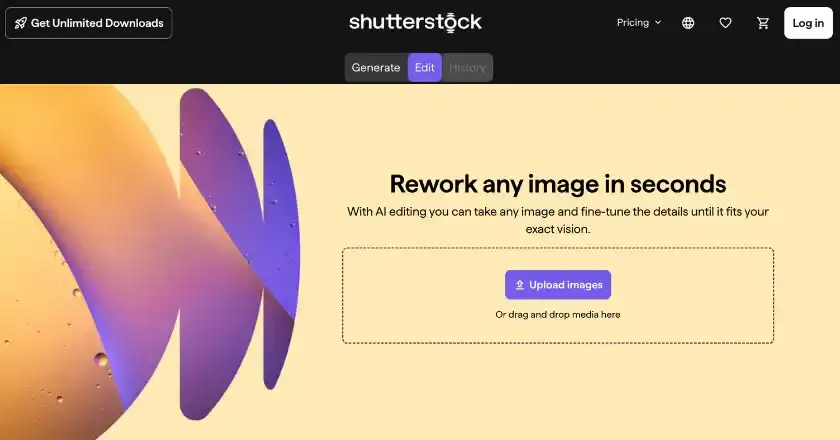
In 2023, Shutterstock solidified this transition by expanding its partnership with OpenAI and NVIDIA, integrating generative capabilities directly into its library of over 700 million images. This allows users to take a licensed, ethically sourced image and use AI to "outpaint" it for a 9:16 Instagram Story or "generatively fill" a section to move a subject from the center to the left, creating space for marketing copy.
Supporting Data: Efficiency Gains in the Creative Workflow
Quantitative analysis of AI-integrated workflows reveals significant improvements in production metrics. According to internal industry benchmarks, the use of AI-assisted editing tools can reduce the time spent on "versioning"—the process of adapting one asset into multiple formats—by as much as 60% to 80%.

| Task Category | Traditional Manual Workflow | AI-Enhanced Stock Workflow |
|---|---|---|
| Background Extension | 45–90 minutes | 30–60 seconds |
| Object Removal/Replacement | 30–60 minutes | 2 minutes |
| Aspect Ratio Adaptation | 20–40 minutes | Instant (Generative) |
| Multi-Market Localization | 4–8 hours per set | < 1 hour per set |
These efficiencies allow creative teams to shift their focus from "production" to "performance." With the cost of creating a variation reduced, brands can afford to engage in rigorous A/B testing. Instead of guessing which image will resonate with a specific demographic, performance marketers can deploy five different AI-adjusted variations of a professional asset and let real-time engagement data dictate the campaign’s direction.
The Role of Human Creative Direction
The rise of AI-enhanced media has sparked a debate regarding the potential displacement of human creatives. However, industry leaders argue that the technology is shifting human involvement "upstream." In this new paradigm, the designer’s role evolves from a "maker" of pixels to a "director" of systems.
"AI does not have taste, and it does not understand brand strategy," noted one industry analyst during a recent creative technology summit. "A human must still decide which image aligns with the brand’s voice, which composition feels authentic to the audience, and which emotional cues will drive a conversion. The AI simply removes the friction between the idea and the output."

By automating the "grunt work" of resizing, retouching, and background manipulation, AI allows art directors to manage larger, more complex campaigns without a linear increase in headcount. This is particularly vital for global organizations that must maintain visual consistency across dozens of regional offices while allowing for local cultural nuances.
Addressing Legal and Ethical Frameworks
A critical component of the move toward AI-enhanced stock media is the "provenance" of the data. Fully generative AI models trained on scraped internet data have faced significant legal challenges regarding copyright infringement. Professional stock agencies have countered this by developing "Contributor Funds" and ensuring their AI models are trained only on licensed, high-quality content.
This creates a "safe harbor" for enterprise brands. When a marketing team uses an AI-enhanced image from a reputable library like Shutterstock, they receive the same indemnification and legal protections that have always applied to traditional stock media. This legal certainty is a prerequisite for major corporations that cannot risk the intellectual property disputes associated with "open" AI models.
Broader Impact and Industry Implications
The long-term impact of AI-enhanced stock media extends beyond simple time-saving. It represents a democratization of high-end production value. Small-to-medium enterprises (SMEs) can now produce visual content that rivals the quality of global conglomerates, as the "production gap" closed by AI reduces the need for massive internal design departments.
Furthermore, the "Modular Production" model—where one professional asset serves as the seed for an entire ecosystem of content—is becoming the standard. This modularity supports the growing trend of personalization in digital advertising. As AI tools become more sophisticated, we can expect "dynamic creative optimization" (DCO) to reach a point where stock images are modified in real-time to suit the specific preferences, weather conditions, or browsing habits of individual users.
Conclusion: The End of the Manual Era
The "blank canvas" will always remain a sacred space for fine art, but in the world of commercial production, it is being replaced by a more efficient, data-driven starting point. AI-enhanced stock media provides the perfect synthesis of human intent and machine speed. By starting with professional source material and using AI to bridge the gap to the final output, creative teams are finally gaining the tools necessary to keep pace with the digital world’s insatiable demand for content. The future of creativity is not about doing less; it is about doing more of what matters, leaving the repetitive mechanics of production to the algorithms.