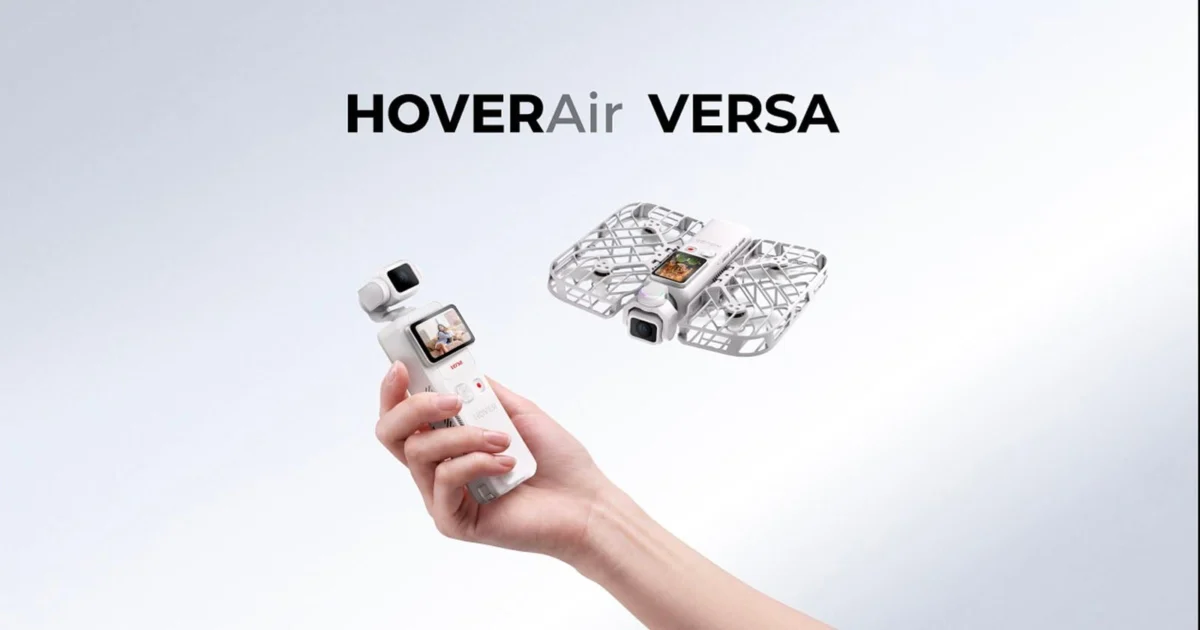
The HoverAir Versa, an innovative hybrid device that blurs the lines between a handheld gimbal camera and a compact drone, has reportedly had its aerial capabilities restricted for sale to U.S. consumers. Unveiled in July 2026 and marketed as the "world’s first flying pocket camera," the Versa’s unique design, which allows users to attach wings to transform it into an autonomous aerial camera, appears to have run afoul of an expansive Federal Communications Commission (FCC) ban enacted in December 2025 targeting drones and critical drone components manufactured in foreign countries. This development underscores the intensifying regulatory landscape for drone technology, particularly concerning national security implications and the push for domestic manufacturing.
The HoverAir Versa: A Hybrid Innovation Grounded by Policy
The HoverAir Versa garnered significant attention upon its announcement in July 2026 for its dual functionality. In its default configuration, the device resembles popular stabilized handheld cameras such as the DJI Osmo Pocket 4 or the Insta360 Luna. It features a three-axis gimbal camera, a compact built-in screen, and intuitive controls, making it ideal for vlogging, travel photography, and capturing smooth, stable footage. However, its standout feature, and ultimately its point of regulatory contention, is its ability to transform into a flying camera. By snapping on detachable wings, the Versa morphs into a dedicated aerial platform designed to automatically follow users, offering dynamic perspectives previously exclusive to more complex drones. This "flying pocket camera" concept aimed to democratize aerial videography, making it accessible and portable for everyday content creators.
However, the "flying" aspect is precisely what has triggered the U.S. restrictions. Information gleaned from the company’s IndieGoGo campaign comments indicates that HoverAir has adjusted its shipping plans for U.S. customers. The "Flight Kit," which includes the crucial wing components that enable the Versa to fly, is currently unavailable for purchase by those with U.S.-based internet connections. The company’s statement on the platform notes, "Due to a few remaining logistics updates with the Flight Kit, we’re currently only shipping our PocketOnly and PocketCombo combos to the US. We’ll keep everyone updated on full availability." This carefully worded message points to a clear, albeit unstated, regulatory hurdle specific to the aerial functionality of the device in the U.S. market.
The FCC’s Broadening ‘Covered List’ Mandate
The regulatory foundation for this restriction traces back to a significant decision made by the FCC in December 2025. At that time, the Commission announced a pivotal expansion of its "Covered List," an inventory of communications equipment and services deemed to pose an unacceptable risk to U.S. national security. This expansion followed a thorough review by an Executive Branch interagency body, convened by the White House, which concluded that drones and critical drone components produced in certain foreign countries presented "unacceptable risks to the national security of the United States and to the safety and security of U.S. persons." Consequently, the FCC received instructions to add these items to its Covered List, effectively barring their sale and operation within the U.S. telecommunications network infrastructure.
FCC Chairman Brendan Carr was a vocal proponent of this measure, stating at the time, "I welcome this Executive Branch national security determination, and I am pleased that the FCC has now added foreign drones and related components, which pose an unacceptable national security risk, to the FCC’s Covered List. Following President Trump’s leadership, the FCC will work closely with U.S. drone makers to unleash American drone dominance." This statement not only highlights the national security rationale but also explicitly links the policy to a broader strategy of fostering domestic drone manufacturing and leadership. The rule’s immediate practical effect is that any new drone, or device capable of drone functionality, produced outside the U.S. by entities deemed a national security risk, would be prohibited from being sold domestically.
A Chronology of Restrictions and Innovation
The timeline of events leading to the HoverAir Versa’s partial ban illustrates the rapid intersection of technological innovation and evolving geopolitical policy:
- December 2025: The Federal Communications Commission (FCC) announces the expansion of its "Covered List" to include drones and critical drone components manufactured in foreign countries deemed to pose national security risks. This decision, driven by an Executive Branch interagency review, sets the regulatory precedent for future foreign drone products.
- July 2026: HoverAir officially announces the Versa, touting it as the "world’s first flying pocket camera." The device is showcased for its unique ability to function as both a handheld gimbal and a compact, autonomous drone, generating considerable excitement in the consumer tech market.
- August 2026: Reports begin to surface, primarily through comments on HoverAir’s IndieGoGo crowdfunding campaign, indicating that the "Flight Kit" — the components necessary to enable the Versa’s drone functionality — is not being shipped to U.S. customers. HoverAir issues a statement citing "logistics updates" for the restriction, confirming the unavailability of the flying version for the U.S. market. At the time of publication, U.S.-based users attempting to back the project cannot select options that include the drone portion of the camera.
This swift sequence demonstrates how quickly regulatory frameworks, particularly those driven by national security concerns, can impact the availability of innovative consumer electronics, even those with hybrid functionalities.

Official Stance and Broader Industry Reactions
The FCC’s stance, as articulated by Chairman Carr, emphasizes a dual objective: mitigating national security risks associated with foreign-made drones and simultaneously promoting U.S. leadership in drone technology. The "unacceptable risks" cited typically pertain to potential data exfiltration, surveillance capabilities, and the possibility of foreign entities exploiting drones for intelligence gathering or infrastructure disruption. While the FCC’s action is distinct from the ongoing legal battles faced by drone giant DJI, which has been designated by the U.S. Department of Defense as a "Chinese military company," both scenarios reflect a concerted effort by the U.S. government to address perceived threats from foreign technology, particularly from China.
HoverAir’s official communication regarding the U.S. shipping restrictions remains circumspect, referring to "logistics updates." This cautious language is common for companies navigating complex international trade and regulatory environments, especially when national security is invoked. Directly acknowledging a ban could carry significant reputational and legal implications.
From a broader industry perspective, U.S. drone manufacturers are likely to view these restrictions favorably, as they reduce competition from foreign rivals and potentially open up market share. Organizations representing domestic drone interests, such as the Drone Manufacturers Alliance (DMA) or similar advocacy groups, have often lobbied for policies that prioritize U.S.-made drones, citing both economic and national security benefits. Conversely, consumer advocacy groups and international tech organizations might express concerns about reduced consumer choice, stifled innovation, and the potential for market fragmentation. The ban could also set a precedent for other hybrid devices that incorporate drone-like capabilities, forcing manufacturers to consider regional regulatory compliance from the earliest stages of product development.
The Rationale: National Security Concerns and Data Sovereignty
The core of the FCC’s decision, and by extension the restriction on the HoverAir Versa’s flight capabilities in the U.S., lies in escalating national security concerns. The U.S. government has increasingly focused on the vulnerabilities presented by foreign-made technology, particularly from nations identified as strategic adversaries. Drones, with their ability to collect high-resolution imagery, video, and potentially other sensor data, are seen as critical assets with dual-use potential – serving both commercial and military intelligence purposes.
The "unacceptable risks" cited by the Executive Branch interagency body encompass several dimensions:
- Data Security and Privacy: Concerns that data collected by foreign-made drones could be accessed, stored, or transmitted to foreign governments, potentially compromising sensitive information of U.S. citizens, businesses, or government agencies.
- Supply Chain Integrity: The risk that critical drone components manufactured abroad could contain hidden vulnerabilities, backdoors, or malicious hardware/software, posing a threat to U.S. cybersecurity.
- Surveillance and Espionage: The potential for foreign governments to leverage commercially available drones for intelligence gathering or surveillance activities within U.S. borders.
- Critical Infrastructure: The hypothetical risk of foreign-controlled drones being used to disrupt or damage critical infrastructure.
These concerns are not unique to drones; they mirror broader U.S. tech policies seen in actions against companies like Huawei in telecommunications, TikTok in social media, and other entities perceived as extensions of foreign state influence. The U.S. government’s strategy is increasingly to decouple from technology supply chains originating from countries deemed high-risk, thereby reducing reliance and enhancing national security.
The Precedent: DJI and the Geopolitical Chessboard
While the HoverAir Versa situation is a direct consequence of the FCC’s expanded Covered List, it exists within a larger geopolitical context shaped by ongoing tensions between the U.S. and China, particularly concerning technological dominance. DJI, the world’s leading drone manufacturer, has been at the epicenter of these tensions for years. In 2020, the U.S. Department of Commerce added DJI to its Entity List, restricting American companies from exporting technology to it. More recently, in August 2026, DJI landed a partial win in its legal fight against the U.S. Department of Defense’s designation of it as a "Chinese military company," a label that carries significant implications for its U.S. operations.
It is crucial to differentiate the HoverAir Versa’s situation from DJI’s. DJI’s challenges stem from various executive orders and designations specifically targeting companies with alleged ties to the Chinese military or government surveillance apparatus. The HoverAir Versa’s restriction, conversely, appears to be a broader application of the FCC’s December 2025 rule, which applies to any new foreign-made drone or critical drone component deemed a national security risk, regardless of specific military ties. This indicates a wider net being cast, impacting a broader spectrum of international drone manufacturers attempting to enter the U.S. market. Both instances, however, clearly reflect a robust and expanding U.S. policy aimed at controlling the proliferation of foreign drone technology within its borders.

Impact on Innovation and the Consumer Market
The ban on the HoverAir Versa’s flight capabilities in the U.S. has multifaceted implications for innovation and the consumer market. For consumers, it means a potentially promising and innovative product will not be fully available. The Versa’s hybrid nature represented a novel approach to capturing both ground-level and aerial footage with a single device, offering convenience and versatility. Its restricted availability limits consumer choice and access to cutting-edge technology.
For international manufacturers like HoverAir, these evolving regulations create significant hurdles. Designing and launching a product for a global market becomes increasingly complex and costly when faced with fragmented regulatory landscapes. Companies must either develop region-specific versions of their products, navigate complex exemption processes, or forgo access to major markets like the U.S. altogether. This can stifle innovation by disincentivizing manufacturers from investing in features or technologies that might fall afoul of such bans.
However, the policy also aims to spur domestic innovation. By restricting foreign competitors, the U.S. government hopes to create a more favorable environment for American drone companies to thrive. This could lead to increased investment in U.S.-based research and development, potentially fostering new technologies and strengthening the domestic supply chain. Yet, it also raises questions about whether U.S. companies can rapidly fill the void and offer comparable or superior products without the benefit of global competition driving rapid advancement.
Boosting Domestic Production: A Strategic Imperative
The explicit goal articulated by FCC Chairman Carr — to "unleash American drone dominance" — underscores a strategic imperative to boost domestic drone production. This is part of a broader U.S. industrial policy aimed at reshoring manufacturing and reducing reliance on foreign supply chains in critical technology sectors. The drone industry, with its applications ranging from defense and surveillance to logistics, agriculture, and entertainment, is considered strategically vital.
Initiatives like the American Security Drone Act (ASDA), though not directly cited in the FCC’s December 2025 announcement, align with this sentiment. ASDA, for instance, aims to restrict federal agencies from purchasing drones from countries like China and to promote the use of domestically produced drones. The FCC’s Covered List expansion serves as a significant regulatory tool to further this objective, effectively creating a protected market for U.S.-made drones. The long-term success of this strategy hinges on the ability of U.S. manufacturers to scale production, innovate rapidly, and offer competitive products to both commercial and consumer markets. Without robust domestic alternatives, such bans could inadvertently limit technological progress or raise costs for consumers and businesses.
Looking Ahead: Challenges and the Future of Drone Technology
The HoverAir Versa incident is a clear signal that the regulatory environment for drones in the U.S. will continue to be shaped by national security considerations. As drone technology becomes more sophisticated and ubiquitous, and as geopolitical tensions persist, similar restrictions are likely to be imposed on other foreign-made drone products or hybrid devices.
The challenges for the future of drone technology are manifold:
- Global Harmonization vs. Fragmentation: The divergence in regulatory approaches between major economic blocs could lead to a fragmented global market, making it harder for companies to achieve economies of scale and hindering cross-border innovation.
- Defining ‘Drone’ in a Hybrid World: As devices like the HoverAir Versa emerge, the very definition of what constitutes a "drone" for regulatory purposes will become increasingly complex. Is a device that can fly, but isn’t primarily a drone, subject to the same rules?
- Technological Adaptation: Manufacturers will need to adapt their design and supply chain strategies to comply with diverse national regulations, potentially leading to regionalized product lines or an increased focus on domestic manufacturing within key markets.
- Consumer Impact: Consumers might face higher prices for compliant products or reduced access to innovative features if regulatory burdens become too restrictive for manufacturers.
Ultimately, the HoverAir Versa’s partial grounding in the U.S. is more than just a product setback; it’s a prominent indicator of a new era where technological innovation is increasingly scrutinized through the lens of national security and geopolitical strategy, fundamentally reshaping the landscape for global tech companies and consumers alike.