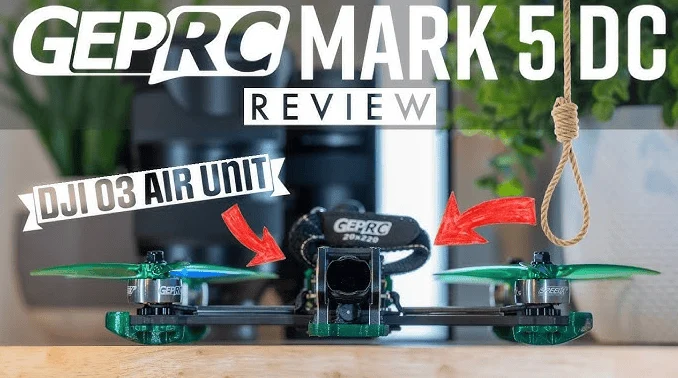
The landscape of First Person View (FPV) aviation has undergone a radical transformation over the last decade, transitioning from a niche hobby characterized by complex DIY soldering projects to a sophisticated industry capable of delivering professional-grade cinematic tools. At the forefront of this evolution is the GEPRC MARK5 DC HD O3 FPV, a drone that has rapidly established itself as a benchmark for performance, durability, and visual fidelity. This aircraft is not merely a recreational toy but a precision instrument designed to meet the rigorous demands of both high-intensity freestyle pilots and professional aerial cinematographers. By integrating the cutting-edge DJI O3 Air Unit into a refined "DeadCat" frame architecture, GEPRC has addressed one of the most persistent challenges in FPV flight: the ability to capture high-definition, prop-free footage without sacrificing the agility required for complex maneuvers.
The Genesis and Evolution of the MARK Series
To understand the significance of the MARK5 DC HD O3, one must examine the chronology of GEPRC’s engineering trajectory. The MARK series has long been recognized within the FPV community for its structural integrity and "Bind-and-Fly" (BNF) reliability. The predecessor, the MARK4, was a staple for many pilots, yet it existed in an era where digital video transmission was still in its infancy and external action cameras, such as the GoPro Hero series, were mandatory for high-quality recording.
The launch of the MARK5 represented a generational leap. It was designed from the ground up to accommodate the shift toward high-performance digital systems. The "DC" in the model name refers to the "DeadCat" frame configuration. Unlike traditional "X" or "Squashed X" frames where the propellers are positioned symmetrically around the center, the DeadCat layout pushes the front arms outward and backward. This specific geometry ensures that the propellers remain outside the camera’s field of view (FOV), even when using ultra-wide-angle lenses. For the modern content creator, this eliminates the need for post-production cropping, preserving every pixel of the 4K sensor.
Technical Engineering and Material Science
The structural foundation of the GEPRC MARK5 DC HD O3 is its 5-inch carbon fiber frame. The use of high-strength 7075-T6 aluminum alloy components in the camera cage provides a "roll cage" effect, protecting the sensitive DJI O3 camera from the high-impact forces common in freestyle flight. Industry data suggests that 5-inch drones are the "Goldilocks" size for the FPV industry, offering the ideal power-to-weight ratio for both outdoor exploration and precision proximity flying.
The frame’s side plates are not just aesthetic; they serve as a heat sink and a mounting point for the flight controller stack. The MARK5 utilizes a sophisticated GEP-F722-45A AIO (All-in-One) or a separate stack depending on the specific sub-version, but the core remains the F722 flight controller. This processor provides the computational overhead necessary to run the latest Betaflight firmware features, such as bidirectional DShot and RPM filtering, which are critical for eliminating "washout" during aggressive cornering.
The Impact of DJI O3 Air Unit Integration
The integration of the DJI O3 Air Unit is perhaps the most significant technological milestone for this model. Before the O3, pilots often had to choose between a lightweight drone with poor video quality or a heavy drone carrying an expensive external camera. The O3 Air Unit bridges this gap by offering a 1/1.17-inch CMOS sensor capable of recording 4K video at 60 frames per second (fps).
The O3 system also introduces "RockSteady 2.0" and "HorizonSteady" digital image stabilization directly into the drone’s onboard processing. This is a crucial development for professional videographers who require smooth, gimbal-like footage from a platform that can move at speeds exceeding 100 kilometers per hour. Furthermore, the 155-degree ultra-wide FOV allows for an immersive perspective that mimics the human eye’s peripheral vision, making the flight experience more intuitive for the pilot using FPV goggles.
From a technical standpoint, the O3 unit generates significant heat. GEPRC engineers addressed this by designing a dedicated cooling structure within the MARK5 frame. This ensures that the video transmitter (VTX) does not throttle its power output during long sessions on the ground or in high-temperature environments, maintaining a stable 1080p 100fps low-latency video feed to the pilot.
Propulsion Systems and Flight Dynamics
Performance in the FPV world is measured by responsiveness, and the MARK5 DC HD O3 utilizes the SPEEDX2 2107.5 motors, typically paired with a 1960KV rating for 6S battery configurations. The shift from 4S (14.8V) to 6S (22.2V) power systems has become the industry standard for 5-inch drones. 6S systems offer higher voltage and lower current draw for the same power output, which results in less "battery sag" during full-throttle bursts and a more linear control feel.
These motors are paired with Gemfan 5136 propellers, a choice that reflects a balance between "grip" in the air and top-end speed. Analysis of the flight dynamics reveals that the MARK5 exhibits minimal prop wash—the turbulence created when a drone flies through its own disturbed air. This stability is a direct result of the frame’s stiffness and the factory-tuned PID (Proportional-Integral-Derivative) controllers provided by GEPRC, which allow the drone to feel "locked in" immediately out of the box.
Market Implications and Professional Adoption
The release of the GEPRC MARK5 DC HD O3 has had a ripple effect across the drone industry. Analysts observe that the "Bind-and-Fly" market is encroaching on the territory once held exclusively by custom-built drones. For production houses and independent filmmakers, the ability to purchase a pre-tuned, high-performance machine saves dozens of hours in assembly and troubleshooting.
Furthermore, the drone’s durability has made it a favorite for "bando" flying—exploring abandoned buildings—where collisions with concrete are frequent. The availability of spare parts, such as individual carbon fiber arms and 3D-printed TPU (Thermoplastic Polyurethane) mounts, ensures that the MARK5 remains a sustainable investment rather than a disposable commodity.
Regulatory Context and Pilot Responsibility
As the capabilities of drones like the MARK5 increase, so does the scrutiny from aviation authorities such as the Federal Aviation Administration (FAA) in the United States and EASA in Europe. Because the MARK5 DC HD O3 weighs significantly more than the 250-gram threshold (typically around 400-500 grams without a battery), it falls under more stringent regulations.
In many jurisdictions, pilots are now required to utilize Remote ID (RID) modules and maintain a visual line of sight or fly with a dedicated spotter. The GEPRC MARK5 is designed with enough internal space to accommodate these regulatory hardware additions, reflecting a forward-thinking approach to compliance in an increasingly regulated airspace.
Comparative Analysis: MARK5 vs. Competitors
When compared to its primary competitors, such as the iFlight Nazgul Evoque or the AOS 5, the MARK5 DC HD O3 distinguishes itself through its aesthetic refinement and the specific "DeadCat" geometry. While the Nazgul series is often praised for its "crushing" power, some pilots find the GEPRC’s flight feel to be more "fluid" and suited for cinematic transitions.
The AOS 5, designed by renowned engineer Chris Rosser, focuses heavily on vibration resonance frequency management. While the AOS 5 might offer a slight edge in technical gyro-data cleanliness, the GEPRC MARK5 offers a more comprehensive "all-in-one" package that includes high-quality 3D-printed parts and a more robust camera protection system, making it more accessible to the broader market.
Best Practices for Operational Excellence
To maximize the lifespan and performance of the MARK5 DC HD O3, industry experts recommend several operational protocols:
- Power Management: Utilizing high-discharge 6S LiPo batteries (1300mAh to 1500mAh) with a C-rating of 100C or higher is essential. This prevents voltage drops that can lead to premature "Land Now" warnings or loss of control during acrobatic maneuvers.
- Color Grading: For cinematic projects, pilots should record in the D-Cinelike color profile. This provides a flatter image with higher dynamic range, allowing for professional color grading in post-production software like DaVinci Resolve or Adobe Premiere Pro.
- Lens Filtration: The use of Neutral Density (ND) filters is highly recommended. By reducing the amount of light hitting the sensor, pilots can lock their shutter speed to double the frame rate (the 180-degree shutter rule), resulting in a natural motion blur that is a hallmark of high-end cinema.
- Firmware Updates: Regularly updating both the DJI O3 Air Unit and the Betaflight flight controller is necessary to access new features like improved stabilization algorithms or enhanced OSD (On-Screen Display) elements.
Conclusion: The Future of Aerial Content Creation
The GEPRC MARK5 DC HD O3 FPV stands as a testament to the rapid maturation of the drone industry. By successfully merging high-speed freestyle capabilities with elite-level digital imaging, it has democratized high-end aerial cinematography. No longer is a Hollywood budget required to capture immersive, high-speed chase sequences or breathtaking mountain dives.
As sensor technology continues to shrink and battery energy density improves, we can expect the descendants of the MARK5 to push the boundaries even further. However, for the current era, the MARK5 DC HD O3 remains a definitive choice for those who refuse to compromise between the thrill of the flight and the quality of the image. It is a bridge between the raw, mechanical world of racing drones and the polished, visual world of professional film, cementing GEPRC’s reputation as a leader in the global UAV market.