Southwestern Alaska’s rugged coastline and verdant river valleys become a stage for one of nature’s most compelling dramas each year as brown bears emerge from their mountain refuges. This annual emergence coincides with the monumental salmon run, a crucial ecological event where an estimated 30 million salmon embark on a perilous journey upstream to their ancestral spawning grounds. This migration, stretching across five months from late May through mid-October, provides a critical and abundant food source for the bears, enabling them to build essential fat reserves for the lean winter months. The phenomenon is not merely a visual spectacle; it is a cornerstone of the region’s ecosystem, supporting a complex web of life.
The Salmon’s Journey and the Bears’ Feast
The salmon run is a staggered affair, with different species arriving in sequence. The sockeye salmon are the vanguard, followed by pink salmon, then coho, chum, and finally, the largest and most prized, the chinook salmon. For the brown bears, this influx of protein-rich fish marks a period of intense feeding. During the fall, a physiological state known as hyperphagia takes hold, driving the bears to consume vast quantities of calories, often hundreds of thousands per day, to prepare for hibernation. This intense feeding period is vital for their survival, with females needing to accumulate enough fat to sustain themselves and their cubs through the winter, and males needing to replenish energy lost during mating season.
A Hierarchy of Feeding Grounds
Within this feeding frenzy, a distinct social hierarchy governs access to prime fishing locations. The most powerful members of the bear population, the alpha males, often weighing up to 1,500 pounds (680 kg), are typically the first to claim the most advantageous spots along the riverbanks and in the strongest currents. Their immense size and strength allow them to stand their ground against the powerful river flow, ambushing fish as they surge past. This dominance ensures they secure the most calorically dense meals, a significant advantage in the race to build winter fat reserves.
Younger, more agile bears, often referred to as subordinates, employ different strategies. They tend to be quicker and more opportunistic, often foraging in shallower waters or areas with less competition. Their agility allows them to snatch fish that might elude the more stationary, larger bears. This dynamic creates a complex interplay of power and strategy, where each bear species and age group finds a niche within the abundant ecosystem.
Maternal Vigilance: The Ultimate Challenge
Perhaps the most poignant aspect of the salmon run is the role of mother bears and their cubs. For these mothers, the riverbanks are both a vital feeding ground and a zone of heightened risk. They must be perpetually vigilant, not only to secure sustenance for themselves and their offspring but also to protect their young from a multitude of dangers. Young cubs, especially those only five to six months old, are particularly vulnerable. While they may have begun to supplement their diet with protein-rich grasses, they remain heavily reliant on their mothers for protection and nourishment.
The act of bringing cubs to the river’s edge, a necessity for feeding, presents one of the most perilous situations a mother bear will face. The presence of other bears, particularly large, aggressive males, introduces a significant threat.
The Dark Reality of Infanticide
A grim reality of the wild, and particularly evident during the salmon run, is the phenomenon of infanticide. Male bears, especially dominant ones, have been observed to kill cubs, sometimes even their own offspring. While the precise motivations remain a subject of ongoing scientific research and debate, prevailing theories point to a combination of factors. These include the reduction of competition for scarce food resources, sexual selection—where killing cubs can bring females back into estrus sooner—and, in some instances, cubs may even be consumed as a food source.
For a mother bear, this threat is paramount. Her primary responsibility becomes the unwavering protection of her young. This maternal instinct drives her to be exceptionally aware of her surroundings, constantly assessing potential threats and strategizing to keep her cubs safe. The image of a mother bear shielding her young from a perceived danger, while simultaneously trying to procure food, is a testament to the fierce, protective nature that defines animal survival.
A Photographer’s Encounter: A Moment of Acceptance
In late August, at the peak of the salmon run, photographer Paul Nicklen found himself on a secluded stretch of Alaskan riverbank. The air was filled with the sounds of splashing salmon, yet the overall atmosphere was one of profound quiet. A few large bears were engaged in fishing upstream, their focus solely on the bounty of the river.

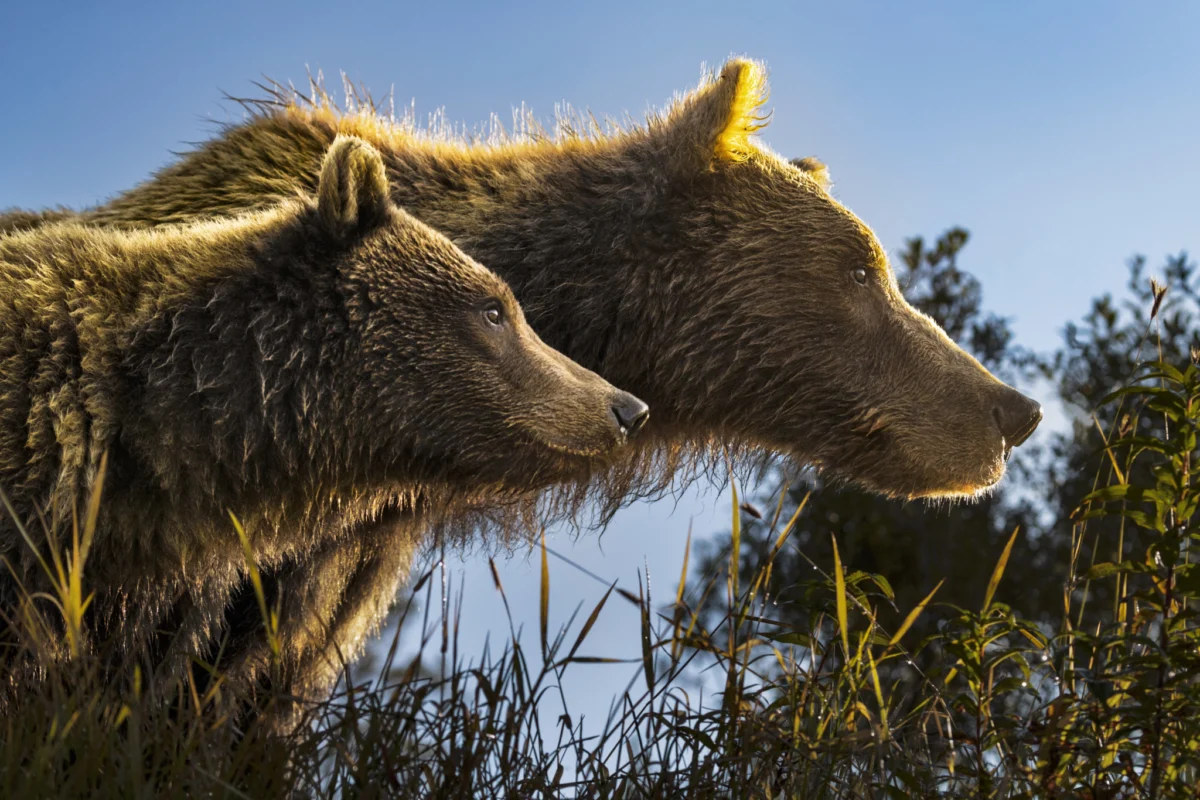
Suddenly, Nicklen sensed movement in the underbrush nearby. Emerging from the foliage were a mother brown bear and her cub, the cub appearing no older than eight months. In such encounters, maintaining a non-threatening presence is paramount. Nicklen instinctively slowed his breathing, avoided direct eye contact, and adopted a posture of humility, a silent acknowledgment of his intrusion into their natural world.
Navigating the Wild with Respect and Calm
Nicklen, equipped only with a wide-angle lens, recognized the delicate nature of the situation. He observed the mother bear, her ears alert, her attention fixed on a large male bear fishing further upstream. She appeared to disregard his presence, her instincts entirely focused on the potential threat posed by the dominant male. This heightened awareness demonstrated her sophisticated understanding of her environment and the social dynamics at play.
Nicklen emphasizes the importance of moving with extreme deliberation and gentleness in such encounters. He likens the required movement to the practice of Tai Chi, advocating for slow, fluid, and measured motions, even when urgency might dictate otherwise. This approach, he believes, is crucial for de-escalating potential conflict and fostering a sense of calm.
Capturing an Unforgettable Image
With meticulous care, Nicklen raised his camera, determined not to disturb the fragile peace of the moment. He managed to capture two photographs before the opportunity passed. He later reflected that he had little expectation of having captured anything truly remarkable, given the rapid nature of the shots. However, one of those images, he discovered, became one of the most personally satisfying photographs he had ever taken.
This particular image, he explained, encapsulates a profound moment of acceptance. "There is nothing like being in a situation where an animal like this accepts you into its presence and dictates the rules," Nicklen stated. The mother bear and her cub, he felt, recognized his presence but perceived him as non-threatening. The true danger, in their eyes, was the larger male upstream. Nicklen’s presence was a matter of chance, a fortuitous intersection of timing and circumstance, allowing him to document this intimate tableau just as the day’s light began to fade.
The Ecological Significance and Broader Implications
The annual salmon run in Alaska is far more than a wildlife spectacle; it is a critical ecological event with far-reaching implications. The health of the salmon populations directly influences the biodiversity and stability of the entire Alaskan ecosystem. The bears, as apex predators, play a vital role in regulating salmon numbers, while also dispersing nutrients throughout the landscape as they consume and transport their catch.
The challenges faced by mother bears and their cubs during this period highlight the inherent struggles for survival in the wild. The threat of infanticide, while brutal, is a natural aspect of the complex social dynamics within bear populations. Understanding these behaviors, through careful observation and scientific study, is crucial for appreciating the intricate balance of nature.
Furthermore, the reliance of these iconic species on healthy salmon runs underscores the importance of conservation efforts. Protecting the pristine waters and vital habitats that support the salmon’s migratory routes is essential for ensuring the long-term survival of both the fish and the wildlife that depend upon them. The image captured by Nicklen serves as a powerful reminder of the delicate relationships within the natural world and the profound beauty that can be found in moments of quiet observation and mutual respect.
The ocean waters that Nicklen works to protect are a testament to the interconnectedness of ecosystems. The salmon, a keystone species in this region, link the marine environment to the terrestrial one, facilitating the transfer of energy and nutrients that sustain a vast array of life. The continuation of these natural cycles depends on the preservation of these wild spaces and the respect afforded to the creatures that inhabit them.