The annual salmon run in southwestern Alaska is a breathtaking spectacle, a vital ecological event that draws apex predators like the brown bear from their mountain retreats. This natural phenomenon, spanning five months from late May to mid-October, witnesses an astonishing 30 million salmon battling upstream to their ancestral spawning grounds. This immense influx of protein-rich prey transforms the region into a critical feeding arena for the Ursus arctos, offering them the essential caloric intake needed to survive the harsh Alaskan winter. The process is not merely about sustenance; it’s a complex dance of survival, hierarchy, and the unwavering instinct of maternal protection, as observed in the interactions between bears and their cubs during this crucial period.
The Grand Migration: A Feast for the Wild
The salmon run is not a monolithic event but a staggered progression of different species, each with its own timing and ecological niche. The sockeye salmon are the vanguard, initiating the upstream journey, followed by pink, coho, chum, and finally, the largest and most sought-after species, the chinook salmon. This multi-species migration ensures a continuous food source for the bears, maximizing their opportunity to accumulate the necessary fat reserves. During this period, bears enter a state of hyperphagia, a voracious feeding frenzy where they consume hundreds of thousands of calories daily. This physiological drive is paramount for their survival, as they must endure months of hibernation with no access to food.
The sheer abundance of salmon creates a dynamic feeding environment, where social hierarchies among the brown bears become acutely evident. Dominant alpha males, some weighing upwards of 1,500 pounds (680 kg), assert their authority by claiming the most advantageous fishing spots along the rivers. Their immense size and strength allow them to stand firm against powerful currents, efficiently intercepting salmon as they navigate the challenging aquatic terrain. These alpha males are the first to capitalize on the bounty, their physical prowess enabling them to secure prime feeding locations and a disproportionate share of the available resources.
In contrast, younger and less dominant bears, including subordinate males and females, often adopt more agile and opportunistic strategies. They may retreat to the edges of the river, utilizing tall grasses for cover and ambushing fish that stray from the main currents. This demonstrates a keen understanding of their place within the social structure, a strategy that prioritizes survival through cunning and avoidance rather than direct confrontation with larger, more aggressive individuals.
Maternal Instincts: A Vigilant Defense
The most poignant and perhaps most vulnerable participants in this annual drama are the mother bears and their cubs. For these mothers, the salmon run is an exercise in constant vigilance and strategic resource management. Their primary objective is to provide for their offspring while simultaneously safeguarding them from the myriad dangers of the wild. This dual responsibility places an immense burden on the mother bears, demanding an unwavering focus and an acute awareness of their surroundings.
Young cubs, often only five to six months old, are particularly defenseless. They are entirely reliant on their mothers for sustenance, protection, and guidance. The riverbanks, while offering access to food, also present the highest risk. It is here that mother bears must navigate the delicate balance between feeding their cubs and shielding them from potential threats. This includes not only the environmental hazards but also the predatory nature of other bears.
One of the most formidable challenges faced by mother bears is infanticide, a grim reality in the natural world. Male bears, particularly the dominant alpha males, have been observed killing cubs, sometimes even their own offspring. While the precise reasons for this behavior remain a subject of scientific inquiry, prevailing theories suggest a complex interplay of factors. These include the elimination of competition for scarce food resources, evolutionary pressures related to sexual selection, and, in some instances, the cubs themselves becoming a food source. Regardless of the underlying motivations, the threat is very real and profoundly impacts a mother bear’s every decision. Her sole focus becomes the protection of her young, a fierce, primal drive to shield them from harm.
A Moment of Serene Encounter
During an early evening in late August, at the peak of the salmon run, a profound moment of wildlife observation unfolded. Standing on a tranquil stretch of Alaskan riverbank, with the sounds of splashing salmon providing a natural soundtrack, the observer detected subtle movement in the underbrush nearby. The scene was otherwise quiet, imbued with an eerie gentleness, a stark contrast to the energetic feeding occurring upstream by a handful of larger bears.

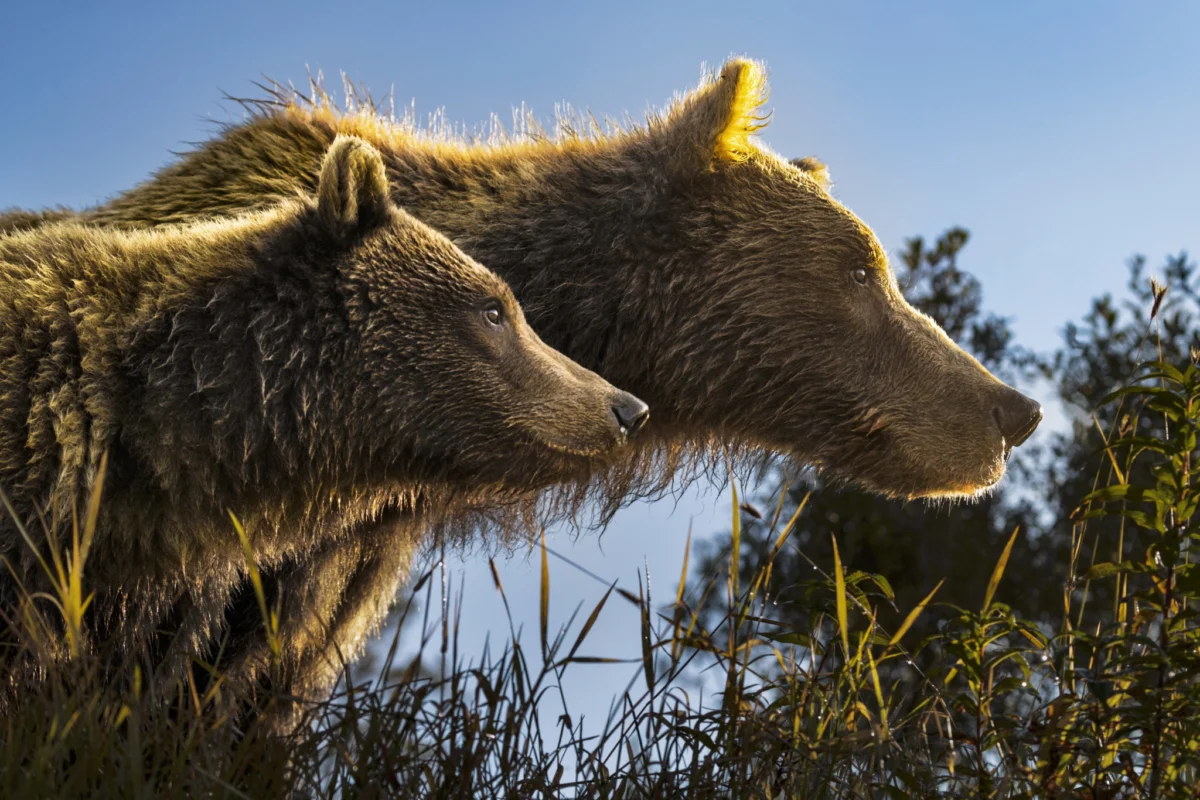
The encounter began with a rustling sound, hinting at the presence of something substantial. Emerging from the dense vegetation, about eight feet away, were a mother brown bear and her cub. The cub, estimated to be no more than eight months old, cautiously poked its head out, its youthful curiosity evident. The observer, recognizing the sensitive nature of the situation, immediately adopted a posture of non-aggression. Breathing slowed, direct eye contact was avoided, and body language conveyed humility and respect for the animals’ space, almost as if seeking permission for their presence.
In such close proximity, without specialized telephoto lenses, the observer relied on a wide-angle lens, emphasizing the immersive nature of the encounter. The mother bear, ears alert and eyes scanning her surroundings, stepped fully into the open. Her attention, however, was not directed at the human observer. Instead, her gaze was fixed on a large male bear actively fishing upstream. The male appeared oblivious to her presence, and indeed, to the observer as well. Yet, the mother bear remained intensely focused, observing, listening, and seemingly learning from the larger bear’s feeding patterns and position.
The Art of Observation: Respect and Patience
Moments like these underscore the profound importance of patience and respectful observation in wildlife photography and research. The observer’s account highlights a methodology akin to a meditative practice. "Everything slows down in moments like that," the observer noted, describing the need to calm nerves, steady hands, and move with extreme deliberation. This approach is often taught to field assistants, emphasizing that even in urgent situations, movements should be smooth, slow, and deliberate, reminiscent of the fluid grace of Tai Chi. This mindful interaction is crucial for minimizing disturbance and fostering a sense of non-threat to the wildlife.
With painstaking slowness, the camera was raised. The paramount concern was to avoid any sudden movement that could startle the bears or break the delicate spell of the encounter. Two quick captures were made, with no immediate certainty of their success. However, one of these images later emerged as a deeply satisfying capture, embodying the perfection of that fleeting moment.
The essence of such encounters lies in the animals’ acceptance of the observer into their presence, allowing them to dictate the terms of interaction. The mother and cub were aware of the observer’s presence, yet they perceived no threat. The true perceived danger emanated from the larger male bear upstream. The observer was merely an incidental witness, a fortunate participant in a chance intersection of luck, timing, and circumstance, capturing a poignant scene as the day’s last light faded.
Ecological Significance and Broader Implications
The salmon run is more than just a feeding frenzy; it is a cornerstone of the Alaskan ecosystem. The annual migration of millions of salmon is a critical nutrient transfer event, bringing vital marine resources inland and supporting a cascade of life, from bears and eagles to vegetation along the riverbanks. The health of the salmon populations is intrinsically linked to the health of the entire ecosystem, making their protection a matter of significant ecological importance.
The ocean waters that serve as the primary habitat for these salmon are themselves under increasing pressure from climate change, overfishing, and pollution. The continued vitality of the salmon runs, and consequently the survival of species like the brown bear that depend on them, hinges on effective conservation strategies and sustainable management of both marine and freshwater environments.
The observed dynamics of bear behavior, including the fierce protection exhibited by mother bears and the social hierarchy among males, offer valuable insights into the complex ecological relationships that govern these wild spaces. Understanding these interactions is crucial for developing informed conservation plans that account for the needs of all species within the ecosystem. The continued observation and documentation of these natural processes, as exemplified by the photographer’s account, play a vital role in raising awareness and fostering a deeper appreciation for the intricate web of life that characterizes the Alaskan wilderness. The preservation of these wild landscapes and their iconic inhabitants requires ongoing commitment to scientific research, responsible stewardship, and a recognition of the profound beauty and ecological significance of events like the annual salmon run.