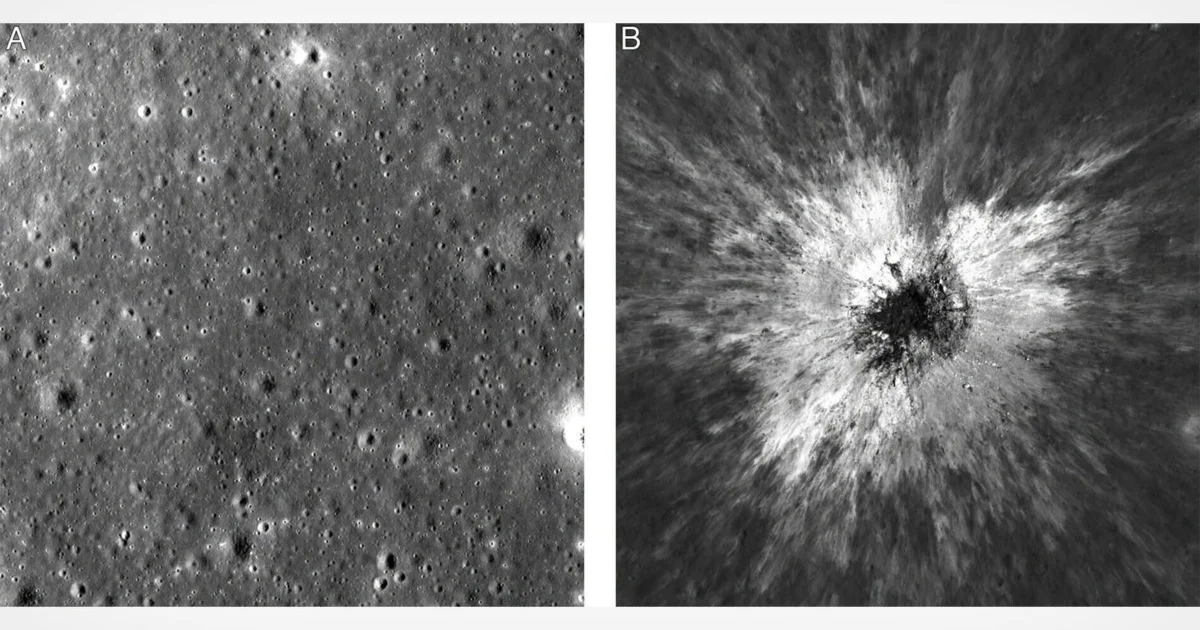
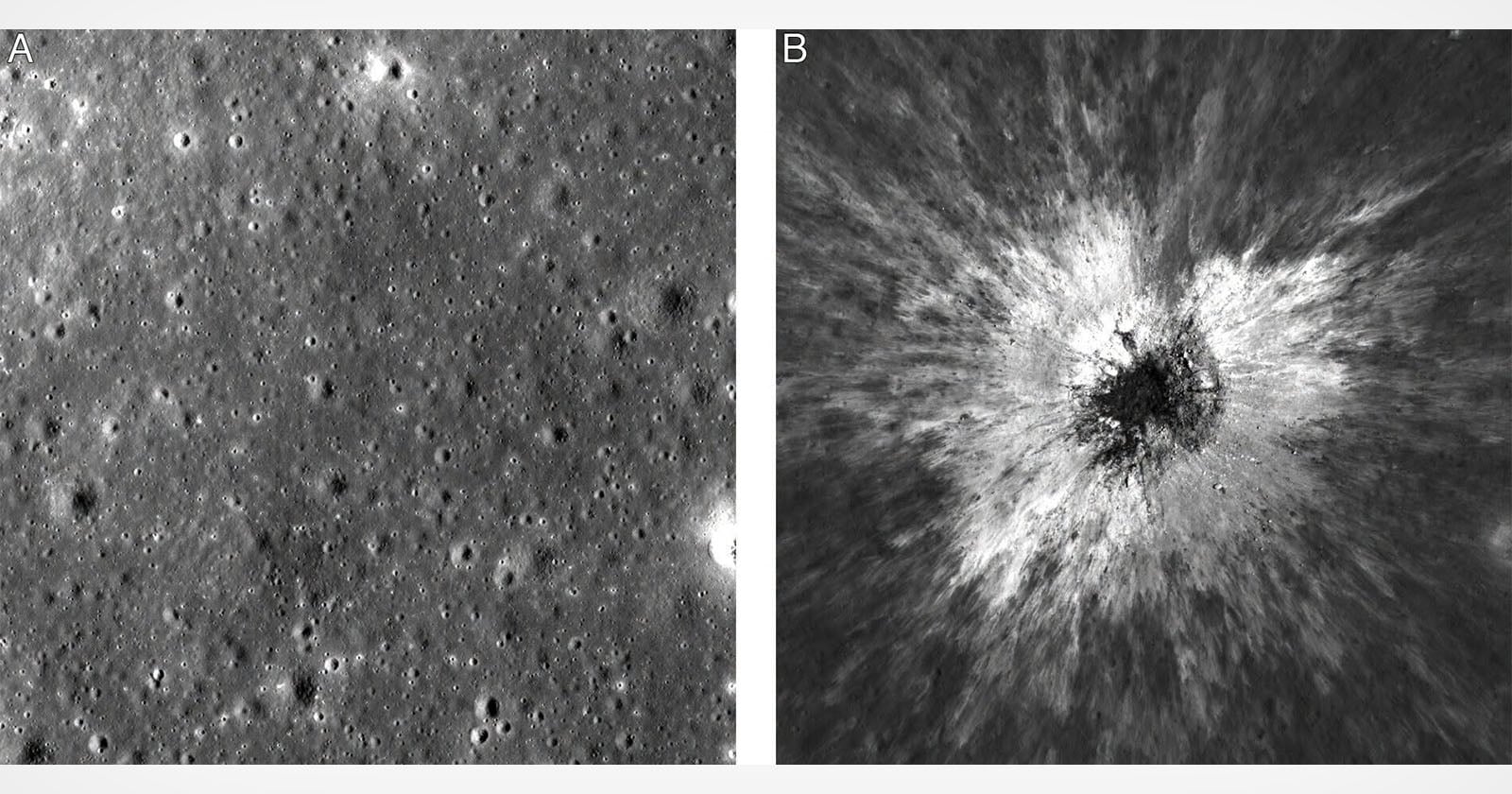
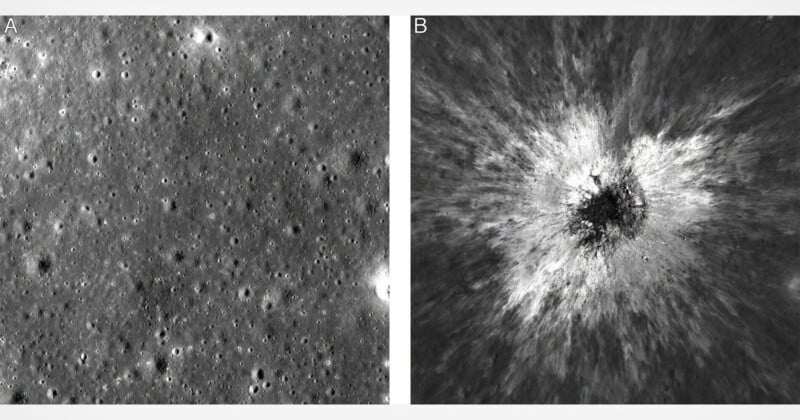
NASA scientists have unveiled remarkable before-and-after photographs of a newly formed lunar crater, offering an unparalleled, detailed perspective on the profound geological changes that occur when a substantial celestial object collides with the Moon’s surface. This extraordinary discovery, documented in two separate studies published in the esteemed journal Science Advances, represents a statistically rare observational event, likened by researchers to a "once-in-a-lifetime" opportunity for planetary science.
The Genesis of McGetchin: A Rare Lunar Event
The newly identified crater, officially named McGetchin crater in honor of Thomas McGetchin, a distinguished former director of Houston’s Lunar and Planetary Institute, is a monumental feature measuring approximately 728 feet (222 meters) in diameter and reaching an impressive depth of roughly 141 feet (43 meters). This makes it the largest newly formed impact crater unequivocally identified and observed by NASA’s Lunar Reconnaissance Orbiter (LRO) since its launch. Experts estimate that an impact event capable of generating a lunar feature of this magnitude occurs, on average, only once every century.
The catastrophic impact itself transpired sometime between April 11 and May 22, 2024. The celestial projectile responsible for McGetchin crater is believed to have been a fragment of an asteroid or comet, potentially several stories in height, hurtling through space at immense velocity before its cataclysmic encounter with the Moon. Despite its considerable size and the energetic nature of the collision, the event occurred on the Moon’s near side, yet it was not detected in real-time by terrestrial telescopes or space-based observatories. This underscores the vastness of space and the challenges inherent in continuously monitoring every potential impactor, even those relatively close to Earth. The very fact that such a significant event went unnoticed until post-impact analysis highlights the critical role of dedicated lunar missions like LRO.
The Lunar Reconnaissance Orbiter: Sentinel of the Moon
The Lunar Reconnaissance Orbiter (LRO) has been a cornerstone of lunar exploration since its launch in June 2009. Designed to spend at least one year mapping the Moon’s surface, LRO has far exceeded its primary mission, continuing to provide invaluable data for over a decade. Its suite of seven powerful instruments has revolutionized our understanding of Earth’s closest celestial neighbor. Among its key instruments are the Lunar Orbiter Laser Altimeter (LOLA), which precisely maps lunar topography; the Diviner Lunar Radiometer Experiment, which studies surface temperatures; and, most pertinently for this discovery, the Lunar Reconnaissance Orbiter Camera (LROC).
LROC comprises two Narrow Angle Cameras (NACs) and one Wide Angle Camera (WAC). The NACs are high-resolution imagers capable of resolving features as small as 0.5 meters (about 20 inches) from LRO’s typical orbital altitude of 50 kilometers. This exceptional resolution allows scientists to observe fine details on the lunar surface, from the tracks of Apollo astronauts to subtle changes caused by recent impacts. The WAC, on the other hand, provides broader contextual views, albeit at lower resolution. LRO’s mission objectives include identifying safe landing sites for future human and robotic missions, locating potential resources, studying the lunar radiation environment, and, critically, observing changes on the lunar surface. It is this last objective that directly led to the discovery of McGetchin crater. The orbiter’s systematic and repeated imaging of the lunar surface over many years has created an invaluable archive, enabling "before and after" comparisons that are impossible for most other planetary bodies.
A Fortuitous Discovery: Tracing the Crater’s Unveiling
The journey to identifying McGetchin crater was a testament to both diligent scientific work and a touch of serendipity. The initial hint of the new crater emerged in May 2024 during a routine data-quality check conducted by LRO researcher Robert Wagner. While examining lunar maps generated from LRO data, Wagner’s keen eye caught an anomaly: an unusually bright area surrounded by a distinct dark halo. This pattern, characteristic of freshly disturbed lunar surface material, immediately signaled a recent event. "I just stopped, dropped everything, and started looking into what that spot was," Wagner recounted in a NASA blog post, illustrating the immediate recognition of a significant finding.
However, the confirmation of a new crater of this scale was not instantaneous. The initial wide-angle LRO images, while suggestive, were not definitively recognized as evidence of a massive new impact until August 2025. This delay highlights the sheer volume of data collected by the LRO spacecraft, requiring extensive processing and analysis by dedicated teams of researchers. It was during a comprehensive examination of this vast dataset that scientists were able to isolate and identify the specific feature. Subsequent targeted observations by LRO’s high-resolution Narrow Angle Cameras provided the crucial detailed imagery needed to confirm the discovery and precisely characterize the crater. The official confirmation of McGetchin crater and its scientific significance was made public earlier this year, following rigorous peer review and publication of the findings. The meticulous process, spanning nearly two years from initial detection to full confirmation, underscores the scientific rigor involved in lunar discovery.
Unpacking the Impact: The Science of Crater Formation
Impact cratering is the dominant geological process shaping the surfaces of most solid bodies in the solar system, including the Moon, Mercury, and many moons of Jupiter and Saturn. The formation of McGetchin crater provides a rare, direct observation of this fundamental process. When a high-velocity projectile strikes a planetary surface, a series of complex physical events unfolds.
The process begins with the compression phase, where the kinetic energy of the impactor is rapidly converted into shockwave energy. This shockwave propagates through the target material, compressing and deforming it. Following this is the excavation phase, where the compressed material rebounds, ejecting vast quantities of rock and dust outwards from the impact site, forming the characteristic bowl shape of the crater. The ejected material, known as ejecta, blankets the surrounding terrain, often forming bright, radial rays that extend for many crater diameters, as seen strikingly around McGetchin. The dark halo observed around McGetchin crater is likely formed by the excavation of darker, possibly subsurface, basaltic material or by the shock heating and darkening of existing surface regolith.
Finally, the modification phase sees the crater walls slump and gravity reshape the initial transient cavity into a more stable form. For craters of McGetchin’s size, which is considered a simple crater, the morphology is typically a smooth, bowl-shaped depression. Larger impacts can lead to more complex structures like central peaks or terraced walls, but McGetchin appears to fit the simpler classification, albeit on the larger end of that spectrum.
The sheer scale of the disturbance caused by the McGetchin impact is remarkable. Beyond the crater itself, the event propelled dust and fragmented rock across an area spanning more than 60 miles (nearly 100 kilometers) of the lunar surface. This vast ejecta blanket is significantly larger than the crater, demonstrating the immense energy released during such a hypervelocity collision. The McGetchin crater is also roughly three times wider than the previous record-holder for a newly formed crater identified by LRO, further emphasizing the unique magnitude of this observation.
Why McGetchin Matters: Scientific Significance
The discovery and detailed observation of McGetchin crater hold profound implications for several branches of planetary science:
-
Calibration for Cratering Rates: The Moon’s surface is a historical archive of impacts, and studying cratering rates is crucial for dating planetary surfaces across the solar system. While scientists use models to estimate how frequently impacts of various sizes occur, direct, "before-and-after" observations like McGetchin are invaluable. They allow researchers to calibrate and refine these models, making them more accurate. This helps to better understand the impact history of the inner solar system, including Earth.
-
Lunar Surface Evolution and Regolith Formation: Most lunar craters are billions of years old, weathered and modified by subsequent impacts, solar wind, and micrometeorite bombardment. McGetchin, being pristine, offers a fresh look at the immediate aftermath of a large impact. Scientists can study the composition of the ejecta, the distribution of materials, and the formation of fresh regolith (the layer of loose, fragmented rock and dust that covers the lunar surface) without the confounding effects of long-term space weathering. This provides critical insights into how the lunar surface is continually renewed and modified.
-
Material Properties and Subsurface Probing: The crater’s location is particularly intriguing. It lies near the boundary between the Moon’s darker basalt-covered plains (maria) and its brighter, anorthositic highlands. This geological context is significant because it allows researchers to study how the same impact process affects different types of lunar terrain. The ejecta from McGetchin likely contains material excavated from both these distinct geological units, offering a natural cross-section of the lunar subsurface at this specific location. This could provide clues about the composition and stratigraphy of the lunar crust, which are otherwise difficult to ascertain remotely.
-
"Ground Truth" for Remote Sensing: The before-and-after imagery provides an unparalleled "ground truth" dataset for validating and improving remote sensing techniques. Scientists can compare the observed changes with predictions from impact models and refine their interpretation of other, older craters where such pre-impact data is unavailable. This enhances the ability of orbital missions to infer subsurface compositions and impact energies from surface observations alone.
The Broader Implications: From Asteroid Tracking to Human Exploration
The insights gleaned from McGetchin crater extend beyond fundamental lunar science, touching upon critical areas like planetary defense and the future of human exploration.
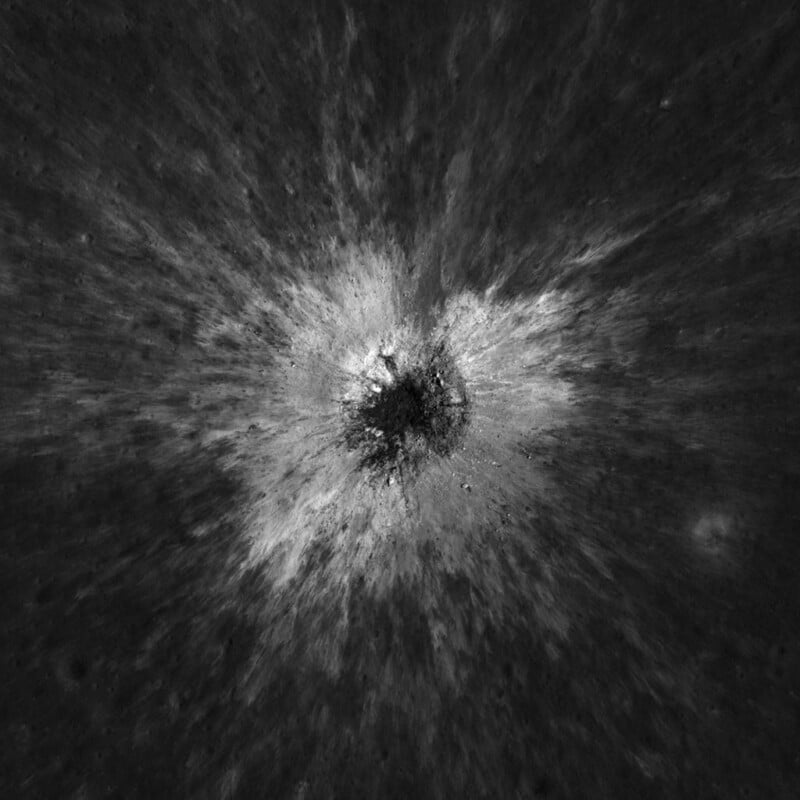
The fact that an object large enough to create a 700-foot-wide crater on the Moon went undetected by Earth-based observatories prior to impact serves as a stark reminder of the challenges in planetary defense. While the Moon acts as a convenient, albeit unobserving, target practice for understanding impacts, it also highlights the need for continuous and improved monitoring of Near-Earth Objects (NEOs). An object of similar size striking Earth would have devastating regional consequences, emphasizing the importance of international efforts to catalog and track potential impactors.
For future lunar missions, McGetchin crater presents a compelling scientific target. The unique circumstances of its formation—its freshness, known impact time, and geological setting—make it an ideal candidate for in situ investigation. As Tyler Powell, lead author of one of the Science Advances studies, explained to Space.com, "Observations from the surface would be really valuable because they would allow us to correlate what we see and map from orbit with small-scale changes to surface texture, the distribution of ejected material, and other properties that can only be studied in detail from the surface." A robotic rover or a crewed mission could provide unprecedented data, including:
- Detailed Geochemical Analysis: Analyzing the composition of the fresh ejecta could reveal the precise chemical makeup of the lunar crust at various depths, offering insights into the Moon’s internal structure and evolution.
- Seismic Studies: Placing seismometers near the crater could detect lingering seismic activity from the impact or reveal properties of the shallow subsurface.
- Regolith Characterization: Direct examination of the newly formed regolith, its grain size, porosity, and thermal properties, would inform models of lunar soil mechanics and resource utilization.
- Impact Physics Validation: In situ measurements could provide critical data to validate and refine computational models of hypervelocity impacts, improving our understanding of cratering processes across the solar system.
Such a mission would allow scientists to directly compare orbital data with ground-level observations, building a more complete picture of the impact process. This kind of "ground truth" is invaluable for interpreting data from other planetary bodies where only remote sensing is possible. The Moon, therefore, continues to serve as an accessible natural laboratory for understanding fundamental planetary processes.
It is also important to differentiate McGetchin from other recent lunar craters. Earlier this year, the LRO photographed another lunar crater, but this one was entirely man-made, created by the intentional impact of a SpaceX rocket booster. While both events resulted in craters, McGetchin represents a natural celestial phenomenon, offering insights into the Moon’s intrinsic geological evolution and the frequency of natural impacts. The SpaceX crater, while scientifically interesting for studying controlled impacts, addresses different research questions related to spacecraft disposal and artificial surface modification.
In conclusion, the discovery of McGetchin crater, meticulously documented by NASA’s Lunar Reconnaissance Orbiter, stands as a monumental achievement in planetary science. It offers an unparalleled, direct window into the dynamic processes that continually reshape planetary surfaces. As scientists continue to analyze the wealth of data from this "once-in-a-lifetime" event, the McGetchin crater will undoubtedly serve as a critical reference point for understanding lunar geology, impact mechanics, and the broader evolution of our solar system, fueling both robotic and human exploration endeavors for decades to come.