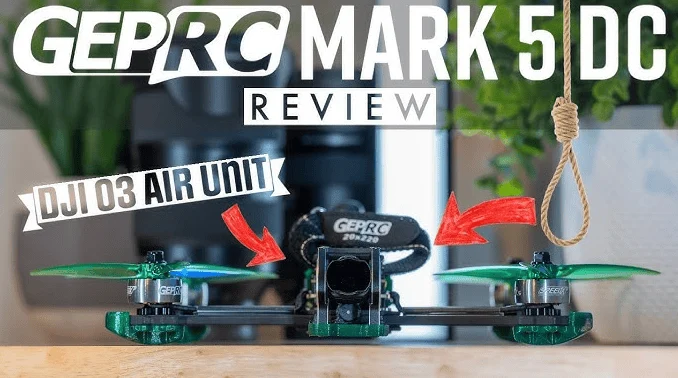
The GEPRC MARK5 DC HD O3 FPV has emerged as a pivotal development in the rapidly evolving landscape of First-Person View (FPV) drones, signaling a significant shift in how professional videographers and freestyle enthusiasts approach aerial imaging. As the FPV industry transitions from analog systems and early digital iterations toward high-bitrate, low-latency ecosystems, this specific model represents a convergence of durable structural engineering and the advanced imaging capabilities of the DJI O3 Air Unit. Designed to eliminate the traditional trade-offs between flight agility and video quality, the MARK5 DC HD O3 is positioned as a versatile flagship capable of meeting the rigorous demands of cinematic production and high-intensity freestyle maneuvers.
The Evolution of the Mark Series and the Digital Shift
The trajectory of GEPRC’s Mark series reflects the broader history of the FPV industry. For years, pilots were forced to choose between lightweight "racing" builds that lacked high-quality recording capabilities and heavier "cinewhoops" or "cinematic" rigs that lacked the power for aggressive acrobatics. The introduction of the Mark4 established GEPRC as a leader in durable, 5-inch freestyle frames, but the arrival of the Mark5 series marked a fundamental redesign.
This evolution reached its current zenith with the integration of the DJI O3 Air Unit. Previously, pilots had to mount an external action camera, such as a GoPro, to capture high-definition footage, which added weight, increased drag, and affected the drone’s center of gravity. The GEPRC MARK5 DC HD O3 FPV addresses this by utilizing the O3 system’s ability to record 4K 60fps video internally, often negating the need for an external camera and allowing for a more streamlined, aerodynamic flight profile.
Technical Architecture: The DeadCat Frame Philosophy
The "DC" in the product name stands for "DeadCat," a specific frame geometry that has become the gold standard for cinematic FPV. Unlike a traditional "X" or "Squashed X" frame where the propellers are equidistant from the center, the DeadCat configuration pushes the front arms outward and backward.
This structural choice serves a primary functional purpose: it removes the propellers from the camera’s field of view (FOV). In traditional freestyle frames, the tips of the spinning props are often visible in the corners of the frame, especially when using wide-angle lenses. For professional cinema work, this is unacceptable, requiring significant cropping in post-production which reduces resolution and alters the intended composition. The MARK5’s DeadCat layout ensures a "clean" view even at the widest 155-degree setting, preserving every pixel of the 4K sensor’s output.
Furthermore, the frame is constructed from high-strength 3K carbon fiber. The side plates are reinforced with 7075-T6 aluminum alloy, a material commonly used in aerospace applications for its high strength-to-weight ratio. This "camera cage" design protects the sensitive DJI O3 camera module during high-velocity impacts, a common occurrence in both freestyle practice and tight-quarters cinematic filming.
Propulsion and Power Systems Analysis
To maintain stability under the weight of a digital HD system, the GEPRC MARK5 DC HD O3 FPV utilizes a robust propulsion system centered around the SPEEDX2 2107.5 motors. These motors are typically paired with a 1960KV rating for 6S battery configurations.
In the world of FPV, the move from 4S (14.8V) to 6S (22.2V) power systems has been a defining trend of the last three years. The 6S system provides higher voltage, which translates to lower current draw for the same power output. This results in less "voltage sag" during aggressive throttle punches and improved thermal management for the Electronic Speed Controllers (ESC). The MARK5 employs a SPAN G50A BLHeli_32 4-in-1 ESC, which supports high-frequency PWM and DShot600 protocols, ensuring that motor responses are near-instantaneous and incredibly smooth.
The flight controller, the GEP-F722-45A AIO, serves as the brain of the aircraft. Utilizing the F7 processor, it can handle complex PID (Proportional, Integral, Derivative) loops and filtering algorithms at high speeds. This processing power is critical for "tuning" out the vibrations and oscillations that can plague 5-inch drones, resulting in the "locked-in" feel that professional pilots require for precision proximity flying.
The DJI O3 Air Unit: A Paradigm Shift in Imaging
The integration of the DJI O3 Air Unit is the centerpiece of this drone’s value proposition. The O3 system features a 1/1.7-inch CMOS sensor, which is significantly larger than the sensors found in previous FPV camera systems. This larger surface area allows for improved dynamic range and better performance in low-light conditions.
Key specifications of the O3 unit integrated into the MARK5 include:
- Video Resolution: Up to 4K at 60fps and 2.7K at 120fps for slow-motion playback.
- Bitrate: A maximum of 50 Mbps, ensuring minimal compression artifacts.
- D-Cinelike Color Profile: This allows videographers to capture a flat color profile, providing greater flexibility for color grading in professional suites like DaVinci Resolve or Adobe Premiere Pro.
- RockSteady Technology: DJI’s proprietary Electronic Image Stabilization (EIS) is built directly into the unit, smoothing out high-frequency vibrations and minor pilot errors without the need for third-party software like ReelSteady or Gyroflow (though the unit also records gyro data for those who prefer external stabilization).
The O3 system also utilizes the O3+ transmission technology, providing a 1080p/100fps live feed to the pilot’s goggles with latency as low as 30ms. This high-fidelity link is what allows pilots to fly through narrow gaps or perform complex maneuvers with the confidence that what they see in their goggles is an accurate, real-time representation of the drone’s position.
Market Positioning and Industry Impact
The release of the GEPRC MARK5 DC HD O3 FPV reflects a broader maturation of the FPV market. For the first decade of the hobby, FPV was primarily a "builder’s hobby," where enthusiasts sourced individual components and soldered them together. However, the demand for "Ready-to-Fly" (RTF) and "Bind-and-Fly" (BNF) models has skyrocketed as FPV has moved into the mainstream commercial sector.
Industry analysts note that high-end BNF models like the MARK5 allow production houses and freelance creators to bypass the steep learning curve of electrical engineering and hardware troubleshooting. By providing a pre-tuned, professionally assembled platform, GEPRC has lowered the barrier to entry for high-quality FPV cinematography.
Statements from the FPV community suggest that the MARK5 series is often viewed as a "workhorse" drone. Its ability to serve as a reliable daily trainer for freestyle while simultaneously being capable of capturing Netflix-quality B-roll makes it a high-value asset for those who derive income from their flight operations.
Operational Considerations: Battery and Maintenance
To achieve the best performance, GEPRC recommends 6S LiPo batteries in the 1300mAh to 1500mAh range. A 1300mAh battery offers a lighter total weight, favoring freestyle agility, while a 1500mAh battery provides extended flight times (typically 5 to 8 minutes depending on throttle management) suitable for long cinematic sweeps.
Maintenance is another area where the MARK5 excels. The frame’s "independent wing" design or modular arm structure allows for the replacement of a single broken arm without dismantling the entire electronics stack. This is a crucial feature for professional pilots who cannot afford long downtimes during a shoot. Furthermore, the inclusion of custom-designed 3D-printed parts for antenna mounting and GPS protection underscores the attention to detail required for modern FPV operations.
Implications for the Future of Aerial Cinematography
The success of the GEPRC MARK5 DC HD O3 FPV indicates a future where the distinction between "consumer drones" (like the DJI Mavic series) and "FPV drones" continues to blur. While the Mavic is a stabilized tripod in the sky, the MARK5 offers a dynamic, immersive perspective that was previously only possible with expensive helicopter rigs or highly specialized custom builds.
As regulatory bodies like the FAA in the United States and EASA in Europe continue to refine Remote ID requirements and flight categories, drones like the MARK5 are becoming the standard for "Category 1" or "Category 2" operations in professional environments. The inclusion of GPS modules for "Rescue Mode"—which allows the drone to automatically fly back to its takeoff point if the signal is lost—adds a layer of safety that is becoming mandatory for commercial compliance.
Conclusion
The GEPRC MARK5 DC HD O3 FPV stands as a testament to the rapid pace of innovation in the unmanned aerial vehicle (UAV) sector. By successfully merging a battle-tested freestyle frame with the world’s most advanced digital FPV transmission system, GEPRC has created a tool that is as much a piece of cinema equipment as it is a high-performance aircraft.
For the professional pilot, it offers a "clean" 4K image, robust signal reliability, and a durable chassis that can withstand the rigors of the field. For the hobbyist, it provides an out-of-the-box experience that rivals custom-built racing rigs. As the industry moves forward, the MARK5 will likely be remembered as the model that solidified the 5-inch DeadCat configuration as the definitive standard for the digital FPV era. Whether it is used for capturing a high-speed car chase or performing a technical "rubik’s cube" maneuver in an abandoned building, the GEPRC MARK5 DC HD O3 FPV remains at the forefront of what is possible in the world of specialized flight.