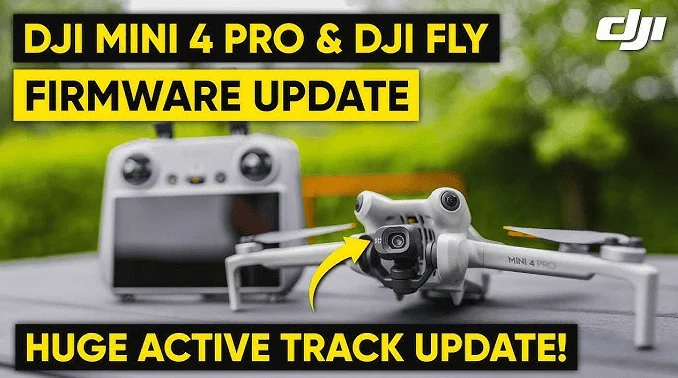
The release of the latest firmware updates for the DJI Mini 4 Pro marks a significant milestone in the evolution of ultra-lightweight drones, reinforcing DJI’s commitment to maintaining its flagship sub-250-gram aircraft at the forefront of the consumer and professional-lite market. These updates are not merely routine maintenance; they represent a comprehensive optimization of the drone’s hardware capabilities through sophisticated software engineering. By refining the flight control algorithms, expanding the utility of the omnidirectional obstacle sensing system, and introducing new creative tools within the DJI Fly app, the manufacturer has ensured that the Mini 4 Pro remains a versatile tool for photographers, videographers, and industrial inspectors who require high performance without the regulatory burdens associated with heavier unmanned aerial vehicles (UAVs).
The Evolution of the Mini Series and the Role of Software Optimization
Since the inception of the Mavic Mini in 2019, DJI has focused on maximizing the potential of drones that weigh less than 249 grams. This specific weight class is critical because it bypasses many of the stringent registration and operational requirements set by civil aviation authorities like the Federal Aviation Administration (FAA) in the United States and the European Union Aviation Safety Agency (EASA). The Mini 4 Pro, launched as the successor to the highly successful Mini 3 Pro, introduced omnidirectional obstacle sensing and the O4 transmission system.
However, hardware is only as effective as the software that governs it. Firmware updates serve as the bridge between raw hardware potential and real-world performance. In the context of the Mini 4 Pro, recent updates have focused on stabilizing the O4 video transmission, which operates on a 20km maximum range (under FCC standards), and improving the handoff between different frequency bands to minimize interference in urban environments. This technical refinement is essential for maintaining a high-definition 1080p/60fps live feed, which is the primary interface for the pilot.
Core Enhancements in the Latest Firmware Cycles
The latest iterations of the DJI Mini 4 Pro firmware have introduced several transformative features that change how the aircraft interacts with its environment and how creators capture content.
1. Advanced Vision Assist
One of the most significant additions is the Vision Assist feature. Originally seen on higher-end models like the Mavic 3 series, Vision Assist utilizes the drone’s omnidirectional vision sensors to provide the pilot with a visual representation of obstacles in multiple directions without having to rotate the gimbal. This is particularly useful during complex maneuvers, such as lateral tracking or backing away from a subject, where the primary camera is focused elsewhere. By providing a "look-around" capability, the firmware significantly reduces the risk of collisions in tight spaces.
2. Enhanced ActiveTrack 360°
The update brings substantial improvements to ActiveTrack 360°. While the hardware already supported omnidirectional sensing, the updated software allows for smoother transitions when the drone circles a subject. The "TouchTrace" interface within the DJI Fly app has been refined to allow for more intuitive flight path planning. Users can now draw specific circular or helical paths on the screen, and the drone will execute these movements while simultaneously avoiding obstacles with a higher degree of precision than seen in previous versions.
3. Integration of FPV Goggles and Motion Controllers
A major breakthrough in recent updates is the expanded compatibility with DJI Goggles 3 and the DJI RC Motion 3. This integration allows the Mini 4 Pro to be flown in a first-person view (FPV) mode, providing an immersive experience that was previously reserved for dedicated FPV drones or the Avata series. This update includes the "Easy ACRO" feature, enabling the Mini 4 Pro to perform flips, rolls, and 180-degree drifts at the touch of a button, expanding the creative repertoire of the aircraft.
Technical Specifications and Data-Driven Improvements
To understand the impact of these updates, one must look at the underlying technical specifications of the Mini 4 Pro. The aircraft features a 1/1.3-inch CMOS sensor with Dual Native ISO Fusion, an f/1.7 aperture, and 2.4μm large pixels.
Through firmware optimization, DJI has improved the image processing pipeline, specifically in the following areas:
- HDR Video Refinement: Updates have tweaked the high dynamic range (HDR) algorithms to better handle high-contrast scenes, such as sunsets or shadowed forests, reducing noise in the shadows while preserving highlights.
- D-Log M and HLG Stability: For professional color graders, the 10-bit D-Log M and HLG color modes have received stability patches that ensure consistent color reproduction across different lighting conditions.
- Night Shots Optimization: The specialized "Night Shots" mode has seen improvements in noise reduction logic, allowing for cleaner 4K/30fps footage in low-light environments.
Data from flight logs and user feedback indicate that these software tweaks have also contributed to a marginal increase in hovering stability. In wind speeds up to 10.7 m/s (Level 5 wind resistance), the updated flight controller exhibits less "wobble," which translates directly into sharper long-exposure photographs.
Chronology of the Update Process: A Step-by-Step Guide
Maintaining the Mini 4 Pro involves a systematic approach to software management. DJI typically releases updates for three components simultaneously: the aircraft firmware, the remote controller firmware (RC 2 or RC-N2), and the DJI Fly app.
Chronological Steps for a Successful Update:
- Preparation: Ensure the drone battery and the remote controller battery are charged to at least 75%. A stable internet connection via Wi-Fi is required.
- App Update: Update the DJI Fly app to the latest version through the App Store or Google Play Store, or via the DJI website for Android users.
- Connection: Power on the remote controller and then the aircraft. Link them as per standard operating procedures.
- Detection: The DJI Fly app will automatically check for firmware updates. A prompt will appear on the screen if a new version is available.
- Download and Installation: Tap "Update." The app will download the firmware and transfer it to the aircraft. During this time, the drone may restart several times, and the gimbal may move or go limp. It is crucial not to power off either device during this process.
- Calibration: After a major firmware update, it is a recommended industry practice to recalibrate the Inertial Measurement Unit (IMU) and the compass to ensure flight sensors are aligned with the new software parameters.
Regulatory Compliance and Remote ID Integration
In the current global regulatory climate, firmware updates serve a vital role in legal compliance. In the United States, the FAA’s Remote ID requirements are now fully in effect. The Mini 4 Pro’s firmware includes the necessary broadcast modules to comply with these regulations.
Furthermore, for European users, the firmware updates manage the transition between C0 and C1 classifications. Recent updates allowed users to apply for a declassification or reclassification of their drone to fly in different sub-categories of the "Open" category, depending on whether they wish to remain under the 250g limit (with the standard battery) or use the Intelligent Flight Battery Plus, which pushes the weight over the limit but offers 45 minutes of flight time. This software-level "geofencing" and "identity broadcasting" is essential for the legal operation of UAVs in 2024 and beyond.
Industry Analysis: The Strategic Impact of Continuous Support
Industry analysts suggest that DJI’s aggressive update schedule for the Mini 4 Pro is a strategic move to discourage "platform switching." By constantly adding features that were previously exclusive to more expensive models, DJI increases the "value-over-time" for the consumer.
From a competitive standpoint, drones like the Autel EVO Nano+ or the Potensic Atom offer formidable hardware, but they often struggle to match DJI’s cadence of software refinement. The ability to turn a standard camera drone into a pseudo-FPV drone via a firmware update is a significant value proposition that keeps the Mini 4 Pro at the top of "Best Drone" lists globally.
Statements and User Community Reactions
While official statements from DJI emphasize "user experience optimization" and "flight safety," the user community provides a more granular look at the update’s impact. On professional forums such as DJI Forums and various UAV subreddits, pilots have noted that the "Vision Assist" feature has become an "indispensable safety net" for commercial roof inspections and close-proximity filming.
Professional aerial cinematographer Marcus Thorne commented on the recent updates, stating, "The addition of 10-bit D-Log M to the Mini series was a game-changer, but the subsequent firmware updates that stabilized the bitrate and improved the O4 link have made the Mini 4 Pro a legitimate backup to my Mavic 3 Pro on professional sets. It’s no longer just a ‘toy’ drone; it’s a precision instrument."
Conclusion and Future Outlook
The DJI Mini 4 Pro firmware updates represent a sophisticated blend of safety enhancements, creative tools, and regulatory compliance. By leveraging the aircraft’s omnidirectional sensors and powerful processing unit, DJI has successfully extended the lifecycle of the product and provided users with a tool that grows more capable over time.
As we look forward, the trajectory of these updates suggests that DJI will continue to blur the lines between its various drone tiers. Future updates may further integrate AI-driven subject recognition and perhaps more advanced "Waypoints" functionality, which is currently a standout feature of the Mini 4 Pro compared to its predecessors. For the end-user, the message is clear: regular firmware maintenance is not just about fixing bugs; it is about unlocking the full potential of one of the most advanced pieces of aerospace technology available in the consumer market today. Owners are encouraged to remain vigilant for update notifications, as each release brings the aircraft one step closer to being the perfect aerial imaging platform.