The indelible bond between humanity and the natural world is a tapestry woven with threads of awe, resilience, and profound discovery. For some, this connection is not merely an appreciation of beauty but a foundational element of existence, shaping life’s trajectory and revealing profound truths about our place on Earth. This sentiment is echoed by the renowned environmentalist Rachel Carson, who stated, "Those who contemplate the beauty of the earth find reserves of strength that will endure as long as life lasts." This perspective is vividly illustrated by the personal journey of a photographer whose childhood in the remote Arctic fostered a lifelong dedication to capturing the essence of wild creatures, culminating in unforgettable encounters with the planet’s most majestic marine mammals.
The author’s formative years were marked by a significant geographical and cultural shift. Leaving the familiar landscapes of Saskatchewan, a province known for its agricultural heritage and the steadfast work ethic of its farming communities, the family embarked on an ambitious move to the Canadian Arctic. This transition represented a profound departure from the readily available comforts of settled life, including the ease of access to extended family, the gentle rhythms of mild summer evenings, and the predictable predictability of the changing seasons. The decision to uproot and embrace the unknown of the Arctic was driven by a desire for a different kind of richness, one found in proximity to nature. This early immersion proved to be a transformative experience, where the inherent benefits of living in close harmony with the natural world far outweighed the perceived sacrifices.
As the author matured and embarked on a career as a photographer, this deep-seated connection to nature translated into a professional passion. The camera became an indispensable tool, a conduit through which to explore and document the intricate lives of Earth’s wild inhabitants. The subjects of the lens have spanned a remarkable spectrum of the animal kingdom, from the iconic wolves and polar bears of the Arctic to the sleek penguins of the Antarctic, the elusive lynx of the boreal forests, and the formidable sharks of the ocean depths. Even the rarer, almost mythical creatures, such as the spirit bear, have graced the photographer’s portfolio. The overarching philosophy guiding this work is a profound sense of privilege, a recognition of the immeasurable bounty of biodiversity and beauty that our planet offers, a richness that transcends human comprehension.
Among the myriad of wildlife encounters that have defined the author’s career, the experiences with whales, often referred to as the true giants of Earth, stand out as particularly significant and deeply rewarding. These encounters have provided not just photographic opportunities but profound moments of connection and understanding.
The Gentle Giants: Debunking Myths of Whales
Similar to the awe and apprehension inspired by Arctic predators like wolves and polar bears, creatures such as orcas and sperm whales evoke a complex emotional response in humans. Their immense size and established roles as apex predators in their respective ecosystems often fuel a perception of danger. However, despite their formidable presence, there is a notable lack of definitive records documenting orcas or sperm whales initiating fatal attacks on humans. The author’s personal experiences, far from confirming these fears, have consistently revealed a more nuanced reality: these marine behemoths exhibit a gentle nature and profound intelligence, aspects often overshadowed by sensationalized myths and common misconceptions.
Sperm whales, in particular, have been subject to a public image shaped, in part, by fictional narratives and folklore. The iconic portrayal of Moby Dick, the elusive white whale, has undoubtedly contributed to a perception of these creatures as enigmatic and potentially dangerous leviathans. However, a real-world encounter off the coast of Dominica offered a strikingly different and deeply moving perspective.
An Unforgettable Encounter in Dominica
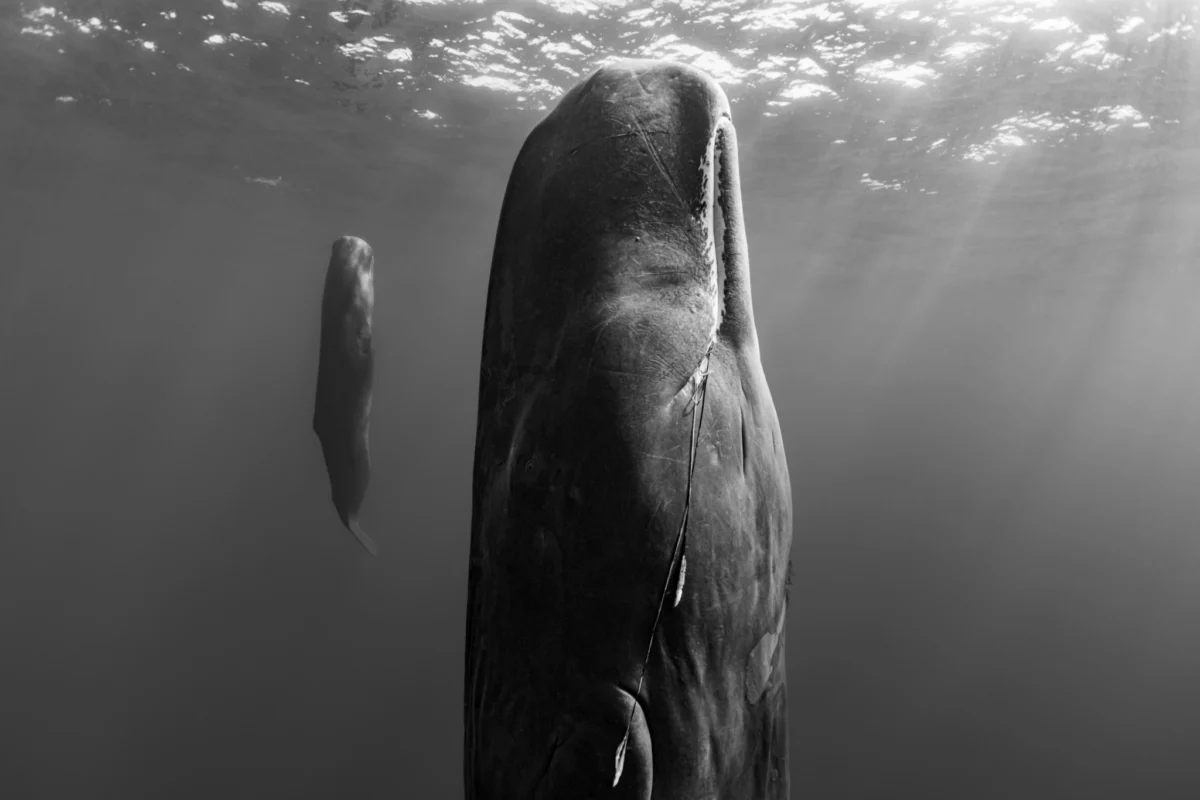
The experience in Dominica involved free-diving with a snorkel in close proximity to a pod of sperm whales. These majestic animals typically spend the majority of their time in the deep ocean, ascending to the surface primarily for respiration and rest. During these periods, they often adopt a vertical posture, suspended in the water column with their heads pointed towards the sky, appearing almost as if in a state of deep slumber. The photographer, accustomed to working with large and potentially unpredictable wildlife, approached the resting pod with respect and caution. The matriarch and her companions appeared to be aware of the photographer’s presence and exhibited a remarkable level of comfort, a testament to their inherent disposition and perhaps their familiarity with human observers.
The Playful Curiosity of a Young Sperm Whale
The dynamic of the encounter shifted when the youngest member of the pod, a calf affectionately nicknamed "Ariel" by the local community, took notice. Seemingly unbothered by the adult whales’ rest and perhaps fueled by youthful curiosity, Ariel broke away from her mother. The author found himself face-to-face with a juvenile sperm whale, estimated to be approximately 20 feet in length, charging directly towards him. While the size was intimidating, the author remained calm, a skill honed by years of experience. The young whale, rather than exhibiting aggression, opened its mouth – notably without teeth – and began to playfully gum the camera housing. This behavior, reminiscent of an inquisitive toddler exploring its environment, offered a stark contrast to the fearsome image often associated with sperm whales. The photographer was able to calmly maneuver away to regain his breath, the encounter reinforcing the notion that Ariel, far from being a mythical sea monster, was a curious, boisterous, and surprisingly gentle creature.

This interaction, documented in a photograph that captures Ariel emitting a playful stream of bubbles as she barrels past the camera, serves as a powerful visual testament to the often-misunderstood nature of these magnificent animals. The image itself, available for viewing and appreciation, encapsulates the essence of this extraordinary encounter.
The Enduring Impact of Nature Immersion
Reflecting on a life lived in close communion with the natural world, the author recognizes that the foundational experiences of childhood in the Arctic laid the groundwork for a deeper, more profound connection with Earth’s wild inhabitants. The early lessons learned from observing the behaviors of Arctic fauna, from bears to foxes, instilled a sense of respect and understanding that has informed subsequent interactions with creatures like Ariel and her pod.
The narrative underscores a fundamental truth: the more time individuals spend immersed in natural environments, the more the world unfolds, revealing new experiences and fostering a deeper appreciation for its complexity and beauty. In an era often characterized by the relentless pursuit of material possessions and the comforts of modern life, nature offers a more profound and enduring form of wealth. It provides a sense of true connection, a grounding that transcends the superficial. This connection, forged through shared experiences with the wild, is presented as the most valuable gift of all.
Broader Implications and the Future of Wildlife Photography
The author’s journey highlights the critical role of wildlife photography not just as an art form but as a powerful tool for conservation and education. By bringing the beauty and complexity of the natural world into the public consciousness, photographers like the author can foster empathy and a sense of responsibility towards its preservation. The encounters described are not isolated incidents but part of a larger narrative that seeks to challenge anthropocentric views and promote a more harmonious coexistence with other species.
The data surrounding whale populations, for instance, underscore the importance of such advocacy. While sperm whales are not currently listed as endangered globally, several populations face threats from ship strikes, entanglement in fishing gear, and pollution. Orca populations, while diverse, also face region-specific challenges, including noise pollution from shipping and seismic surveys, and declining prey availability due to climate change and overfishing. Photographers who capture the intelligence and gentle nature of these animals can play a crucial role in shifting public perception, thereby galvanizing support for conservation efforts.
The photographic evidence presented, such as the image of Ariel, serves as a tangible reminder of the individual lives and personalities within these species, moving beyond abstract statistics to create an emotional connection with the audience. This personal connection is often the catalyst for greater engagement with conservation issues.
Furthermore, the author’s narrative implicitly calls for a re-evaluation of societal priorities. The "fast pace of modern society" often prioritizes economic growth and technological advancement at the expense of environmental stewardship. The profound satisfaction derived from experiencing nature suggests an alternative path, one where human well-being is intrinsically linked to the health of the planet. This perspective is gaining traction among environmental scientists and policymakers, who are increasingly advocating for nature-based solutions and the integration of ecological considerations into all aspects of human activity.
The story of the Arctic move and the subsequent encounters with whales is more than a personal anecdote; it is a compelling argument for the intrinsic value of the natural world and the transformative power of experiencing it firsthand. It underscores the notion that true wealth lies not in material possessions but in the profound connections we forge with the living planet, a gift that, as Rachel Carson suggested, offers enduring strength for as long as life lasts. The work of photographers who dedicate their lives to capturing these moments is vital in reminding us of this truth and inspiring future generations to become stewards of the Earth.