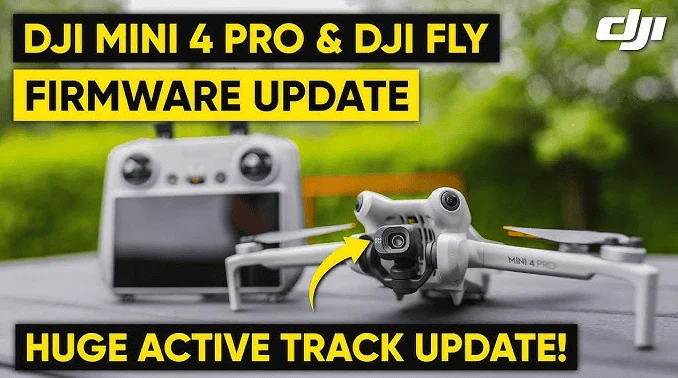
The release of the latest firmware updates for the DJI Mini 4 Pro marks a pivotal moment in the lifecycle of sub-250-gram drones, reinforcing the bridge between consumer-grade portability and professional-grade functionality. Since its initial launch, the Mini 4 Pro has served as the flagship for DJI’s lightweight category, and the recent suite of software enhancements has significantly expanded its operational envelope. These updates are not merely maintenance-oriented; they introduce sophisticated features such as Vision Assist, enhanced ActiveTrack 360° capabilities, and refined camera protocols that were previously reserved for larger, more expensive airframes like the Air 3 or the Mavic 3 series. By prioritizing software-driven hardware optimization, DJI has effectively extended the technological longevity of the Mini 4 Pro, ensuring it remains the industry standard for creators, hobbyists, and commercial inspectors who require high-performance aerial imaging without the regulatory burdens associated with heavier unmanned aerial vehicles (UAVs).
The Strategic Significance of the Mini 4 Pro Firmware Ecosystem
In the rapidly evolving landscape of drone technology, the hardware represents only half of the value proposition. The "intelligence" of the drone—its ability to process sensor data, navigate complex environments, and capture cinematic footage autonomously—is dictated by its firmware. The DJI Mini 4 Pro was designed to be a "software-forward" platform. By integrating an omnidirectional vision sensing system with a powerful onboard processor, DJI created a canvas that could be continuously improved through over-the-air (OTA) updates.
The strategic significance of these updates lies in their ability to democratize high-end features. For instance, the introduction of Vision Assist provides pilots with a multi-directional visual feed, allowing them to see potential obstacles from the side or rear without rotating the drone. This feature, which debuted on the Mavic 3 series, transforms the Mini 4 Pro into a much safer tool for complex cinematic shots in tight spaces. For the professional user, this translates to reduced risk and higher confidence during low-altitude maneuvers.
Key Feature Breakdown: Vision Assist and Enhanced Navigation
One of the most substantial additions to the Mini 4 Pro through recent firmware iterations is Vision Assist. This system utilizes the drone’s omnidirectional binocular vision sensors to create a visual representation of the environment in the DJI Fly app interface. Unlike the standard camera view, which is limited to the gimbal’s orientation, Vision Assist allows the pilot to tap directions on the screen to see a gray-scale video feed from the obstacle sensors themselves.
This capability is particularly crucial for "circle" or "dronie" shots where the aircraft moves laterally or backward. In previous generations, pilots had to rely solely on proximity beeps or a spotter to avoid collisions. With Vision Assist, the pilot has a "virtual mirror" for every side of the aircraft. Furthermore, the update has refined the Advanced Pilot Assistance Systems (APAS), allowing for smoother bypass maneuvers. Rather than jerky, sudden stops when an object is detected, the Mini 4 Pro now calculates more fluid flight paths, resulting in more usable, cinematic footage even when flying in "Bypass" mode through wooded areas or urban structures.
Cinematic Advancements: Unlocking the Full Potential of the 1/1.3-inch CMOS Sensor
While the hardware of the Mini 4 Pro features a high-performance 1/1.3-inch CMOS sensor with dual native ISO fusion, the software updates have unlocked new ways to utilize this glass. Recent firmware has improved the image processing algorithms for D-Log M and HLG (Hybrid Log-Gamma) profiles. This is a critical development for professional colorists who require maximum dynamic range.
Data suggests that the updated D-Log M profile provides a more linear color science, making it easier to match footage from the Mini 4 Pro with that of the DJI Inspire 3 or Mavic 3 Pro. Additionally, the update has optimized the 4K/60fps HDR video recording, reducing noise in the shadows—a common pain point for small-sensor drones. The "Night Mode" has also seen a significant upgrade, with better temporal noise reduction, allowing for cleaner shots in low-light environments like cityscapes at dusk.
Omnidirectional Obstacle Sensing: A Leap in Safety for Sub-250g Drones
The Mini 4 Pro is the first in its weight class to feature true omnidirectional obstacle sensing. However, the initial release was just the beginning. Subsequent updates have fine-tuned the sensitivity of these sensors. Pilots can now customize the "Warning Distance" and "Braking Distance" within the DJI Fly app.
This level of customization is essential for different flight environments. In a wide-open field, a pilot might prefer a larger safety buffer, whereas, in a controlled indoor environment or a dense forest, a tighter braking distance allows for more precise positioning. The inclusion of the "Auto-Descend" safety protocol update also ensures that the drone can land more reliably on uneven surfaces by using its downward vision sensors to detect ground hazards more accurately than ever before.
The Technical Protocol: A Chronological Guide to the Update Process
To maintain the integrity of the aircraft and ensure flight safety, DJI mandates a specific protocol for firmware installation. The process has been streamlined to minimize downtime, but it requires adherence to specific technical steps:
- Battery Preparation: Both the aircraft and the remote controller (RC-N2 or DJI RC 2) must be charged to at least 75%. Firmware updates are resource-intensive and can take up to 20 minutes; a power failure during this process can lead to a "bricked" mainboard.
- Connectivity Check: The DJI Fly app must be updated to the latest version via the App Store, Google Play, or the DJI official website. For users with the DJI RC 2, a stable Wi-Fi connection is required.
- The Synchronization Phase: Once the drone is powered on and linked to the controller, the app will automatically detect the new firmware version. The "Update" prompt initiates the download.
- The Installation Cycle: During installation, it is normal for the gimbal to go limp, the fans to run at high speed, and the aircraft to reboot multiple times. This is the system rewriting the flight controller, ESC (Electronic Speed Controller), and camera modules.
- Post-Update Calibration: Following a major firmware overhaul, it is highly recommended to recalibrate the IMU (Inertial Measurement Unit) and the Compass. This ensures that the new software parameters are aligned with the physical hardware’s orientation.
Market Analysis: Positioning the Mini 4 Pro in the 2025 Drone Landscape
The drone market is increasingly bifurcated between high-end professional rigs and consumer "toy" drones. The Mini 4 Pro occupies a unique "Prosumer" niche. By continuously updating the software, DJI is defending its market share against emerging competitors like the Autel EVO Nano series and the Potensic Atom.
Market data indicates that the "under 250g" category is the fastest-growing segment of the UAV industry due to global regulations like the FAA’s Part 107 (USA) and EASA’s Open Category (Europe). In many jurisdictions, drones under 249 grams do not require the same level of registration or pilot certification for recreational use. By packing "Mavic-level" features into this weight class, DJI makes the Mini 4 Pro an irresistible option for travel vloggers and real estate photographers who want to minimize their regulatory footprint without sacrificing 4K/100fps slow-motion or 10-bit color.
Regulatory Compliance and Remote ID Integration
A critical component of recent firmware updates has been the stabilization of Remote ID broadcasting. In the United States, the FAA requires drones to broadcast identification and location information. The Mini 4 Pro was built with this hardware, but firmware updates have ensured that the broadcast signal is consistent and compliant with the latest FAA "Means of Compliance" (MOC) documents.
Furthermore, for European users, the firmware updates have addressed the C0 and C1 labeling requirements. The ability to toggle specific altitude limits (such as the 120m height limit in certain regions) via software ensures that the drone remains legal in diverse geographic locations. This "geofencing 2.0" approach balances safety with the pilot’s need for operational flexibility.
Expert Perspectives on Software-Driven Hardware Longevity
Aviation analysts suggest that the "useful life" of a drone is no longer determined by its motors or frame, but by its processing headroom. The Mini 4 Pro was launched with a processor that was arguably "over-spec" for its initial features. This has allowed DJI to "drip-feed" advanced features over time.
"The Mini 4 Pro is essentially a flying computer," says one industry consultant. "What we are seeing with these updates is the optimization of the neural network used for ActiveTrack. The drone is getting better at ‘recognizing’ subjects—distinguishing between a cyclist and a pedestrian, for example—not because the camera changed, but because the machine learning models in the firmware were retrained."
Operational Guidelines Post-Update
To maximize the benefits of the new firmware, pilots should adjust their operational workflows. After updating, it is advised to test the new "Vision Assist" in a wide-open area to understand the perspective shift. Additionally, pilots should explore the "Enhanced Transmission" settings, which utilize the O4 system more efficiently to maintain a 1080p/60fps live feed at longer distances, even in high-interference urban environments.
The O4 transmission system update is particularly noteworthy. By optimizing the frequency hopping algorithms, the Mini 4 Pro now exhibits better resistance to signal "multipathing" (where signals bounce off buildings). This ensures a more stable link, which is the foundation of safe flight.
Conclusion
The continuous evolution of the DJI Mini 4 Pro through firmware updates represents a paradigm shift in the drone industry. It signifies a move away from "planned obsolescence" toward a model of "continuous improvement." For the user, these updates provide a tangible increase in value, offering a safer, more capable, and more creative tool with every installation. As DJI continues to refine the synergy between the Mini 4 Pro’s lightweight hardware and its heavyweight software capabilities, the aircraft remains the definitive choice for anyone looking to capture the world from above. Whether it is through the added safety of Vision Assist or the cinematic depth of 10-bit D-Log M, the Mini 4 Pro is a testament to the power of modern UAV engineering. Regular updates are not just a recommendation; they are the key to unlocking the full potential of one of the most sophisticated pieces of technology in the sky today.