The frigid waters off the coast of Norway have long been a stage for nature’s most dramatic performances, yet capturing the essence of these moments, particularly the elusive orca, presents a profound challenge. For weeks, a team of wildlife photographers and researchers navigated the unforgiving Arctic environment, their efforts focused on documenting the behavior of these apex predators. The prevailing conditions were far from ideal: days were characterized by a perpetual twilight, with the sun barely gracing the horizon, casting a fleeting pink glow that marked the peak of midday. The landscape was often shrouded in darkness, a stark and moody canvas against which the sleek black fins of orcas would occasionally break the surface, a fleeting glimpse of power in turbulent seas. This persistent struggle to find and document these magnificent creatures underscored the rarity and preciousness of any successful encounter.
The Long Wait for a Glimpse
The expedition, which spanned several weeks, was dedicated to observing and photographing orcas in their natural Norwegian habitat. Unlike their counterparts in the waters of British Columbia, which are renowned for their acrobatic displays and frequent breaches, Norwegian orcas are typically more reserved, rarely exhibiting such overt exhibitions of athleticism. This fundamental difference in behavior added another layer of complexity to the photographic mission, requiring a nuanced understanding of the animals and a heightened sense of patience.
The team had been tracking a specific pod, moving with them through the dark, often choppy waters. Each sighting, however brief, fueled their determination. The lack of consistent breaches meant that the photographers had to be prepared for any subtle shift in behavior, ready to capture the slightest indication of activity. The long hours spent at sea, battling the elements and the inherent unpredictability of wildlife, were a testament to their commitment to documenting these often-overlooked aspects of marine life.
An Unexpected Dawn Patrol
The breakthrough arrived unexpectedly on a particularly bleak morning. The team was following a pod of orcas, their distant forms barely discernible against the moody sky. Initially, the scene appeared tranquil, with only the presence of several large male orcas indicating any significant activity. The usual quietude of Norwegian orcas seemed to prevail, leading to a moment of near complacency.
However, this calm was shattered by a sudden, dramatic shift in the pod’s behavior. While still at a considerable distance, it became evident that something extraordinary was occurring. The animals were exhibiting signs of intense excitement, a clear indication of a feeding frenzy. This sudden eruption of activity galvanized the team. Their senses, dulled by weeks of patient waiting, snapped into sharp focus. The boat’s engines were accelerated, maintaining a careful distance from the pod, a crucial element in ensuring the animals’ natural behavior was not disrupted. They proceeded at approximately 20 knots, matching the powerful propulsion of the orcas, a speed that allowed for both observation and a degree of engagement with the spectacle unfolding before them.
The Spectacle of a Breaching Giant
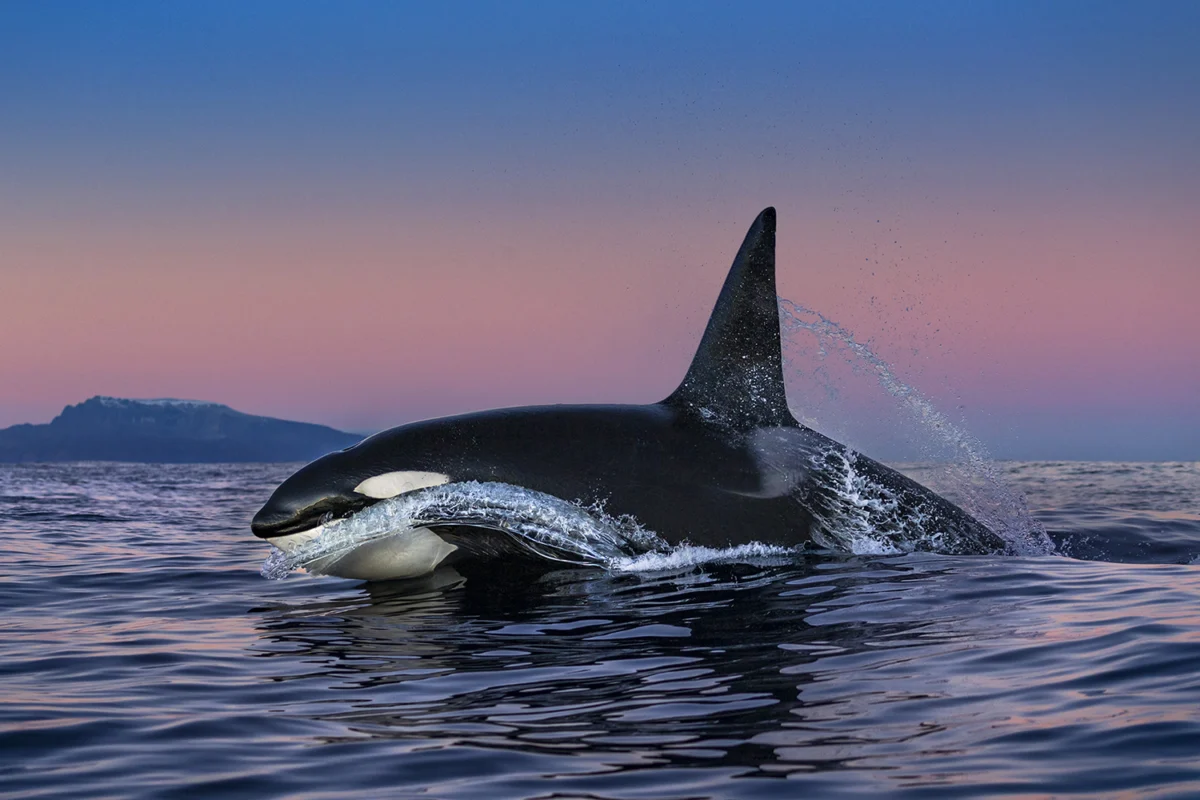
The conditions, which had so often been a hindrance, suddenly became favorable. The sea, for once, was calm, and the water’s surface offered a more cooperative backdrop for photography. Amidst this opportune setting, a massive male orca, an individual estimated to weigh around 12,000 pounds and measure approximately 25 feet in length, began to porpoise with astonishing speed and ferocity. Its leaps were explosive, sending cascades of water into the air, a powerful display of raw energy.

The photographer, positioned at the back of the boat, faced a critical challenge. The low light conditions, a hallmark of the Arctic winter, demanded a delicate balance between shutter speed and exposure. A shutter speed fast enough to freeze the intense motion was essential to prevent blur, yet the limited light made achieving this technically demanding. The sky had transformed into a painterly canvas of pink and orange hues, with the rugged Norwegian mountains providing a dramatic, natural backdrop.
The sheer scale of the orca was awe-inspiring. Its dorsal fin, standing an impressive six feet tall, and its pectoral fins, described as being the size of a car hood, were clearly visible even from a distance. The photographer aimed to capture this majestic creature in mid-leap, an endeavor that required not only skill but also a degree of luck.
The Art of Capturing the Unseen
With traditional single-lens reflex cameras, the process of capturing such fleeting moments is inherently uncertain. The act of taking a photograph involves the mirror lifting and the shutter opening, a process that momentarily blinds the photographer to the live view. At ten frames per second, this meant ten seconds of blindness for every ten captured images. This made it difficult to ascertain in real-time whether the perfect shot had been achieved.
The photographer described a feeling of uncertainty after the initial burst of activity subsided, a common sentiment after such intense and rapid events. The hope was that the captured frames would indeed hold the essence of the moment. The boat’s pilot, Goran, was credited with expertly pacing the vessel, a crucial factor in maintaining the optimal distance and angle for photography.
Upon reviewing the images on the camera’s LCD screen, a profound sense of satisfaction washed over the photographer. The entire scene, from the splashing water to the intricate details of the orca’s eye, had been perfectly preserved. The low light, the dramatic mood, and the vibrant colors had coalesced into a single, powerful image. The photographer’s initial skepticism about capturing the sharpness of the orca’s eye, given the challenging conditions, was dispelled by the remarkable clarity of the final photograph. The extensive review of the images, frame by frame, searching for any imperfection, yielded no evidence of failure.
The Enduring Impact of Nature’s Gifts
These moments, the photographer reflected, are nature’s most profound gifts. They represent the ability to translate the raw beauty of the natural world into a tangible form, preserved within the confines of a camera lens. The captured image becomes a testament to a fleeting instant, a “perfect little bottle of light and time” that will endure beyond the moment of its creation.
This particular encounter in Norway serves as a potent reminder of the extraordinary biodiversity that exists in our oceans and the dedication required to document it. The challenging conditions, the elusive nature of the subjects, and the technical demands of wildlife photography all converge to make such achievements all the more significant. The images captured are not merely aesthetic representations; they are vital records that contribute to our understanding and appreciation of these magnificent creatures and their habitats.

Broader Context and Implications
The observation of orcas in Norway is part of a larger scientific and conservation effort to understand the migratory patterns, feeding habits, and social structures of these intelligent marine mammals. Orcas in Norwegian waters, often referred to as "resident orcas," are primarily associated with the herring runs that occur during the winter months. These pods are known for their sophisticated hunting techniques, often employing a strategy known as "carousel feeding," where they cooperate to herd schools of fish into dense balls before stunning them with their powerful tails.
The distinction between Norwegian and British Columbian orca populations highlights the adaptive capabilities of the species. While BC orcas are more prone to breaching, potentially as a means of communication, echolocation, or thermoregulation, the Norwegian orcas’ behavior, including their less frequent breaching, may be influenced by different ecological pressures and prey availability.
The photographic documentation of such events can have significant implications for conservation. Vivid imagery can raise public awareness, garner support for marine protection initiatives, and inform policy decisions. The ability to capture the power and grace of these animals in their natural environment can foster a deeper connection between the public and the natural world, underscoring the importance of preserving these fragile ecosystems.
Furthermore, the technical challenges overcome by the photographer in capturing sharp images in low-light, high-speed conditions demonstrate advancements in camera technology and photographic skill. The continuous improvement in equipment allows for the documentation of increasingly elusive and dynamic wildlife behaviors, contributing valuable data for scientific research.
The "Dawn Patrol" image, as it has been titled, encapsulates the essence of this challenging yet rewarding endeavor. It represents not just a successful photographic capture but also a testament to the enduring spirit of exploration and the profound beauty that can be found when human curiosity aligns with the wild, untamed forces of nature. The journey described by the photographer underscores the fact that such moments are earned through perseverance, a deep respect for the natural world, and a commitment to sharing its wonders with the world.
The ongoing study of orca populations globally is crucial for understanding the health of marine ecosystems. As apex predators, their presence and behavior are indicators of the broader marine environment’s well-being. Threats such as pollution, climate change, and overfishing can significantly impact their prey populations, leading to declines in orca numbers or shifts in their behavior. Therefore, initiatives that combine scientific research with compelling visual documentation are vital for advocating for the protection of these iconic species and the oceans they inhabit.