Each year, as the mists recede from the glacial peaks that crown southwestern Alaska’s rugged coastline and riverine valleys, a primal drama unfolds. Brown bears emerge from their solitary existence to partake in one of the planet’s most awe-inspiring and ecologically vital spectacles: the annual salmon run. This is not merely a feeding frenzy; it is a testament to an ancient rhythm, a crucial ecological event where an estimated 30 million salmon, driven by an innate imperative, battle their way upstream to their natal streams. The sight of these massive predators, their lives inextricably linked to the piscine tide, is a profound reminder of the raw power and intricate balance of the natural world.
The Unfolding Migration: A Five-Month Feast
The salmon run is not a monolithic event but a succession of arrivals, each species with its own timing. The sockeye salmon are the vanguard, their iridescent bodies a beacon in the clear waters. They are followed by the pink salmon, their distinctive humps appearing on the males, then the coho, and finally the robust chinook, the largest of the Pacific salmon. This biological marathon spans an impressive five months, typically commencing in late May and continuing through mid-October. For the brown bears, this extended period represents a critical window for caloric accumulation.
This season is characterized by a physiological state known as hyperphagia, where bears enter a state of voracious overeating. Their primary objective is to amass the substantial fat reserves and nutritional stores necessary to survive the long, harsh Alaskan winter, during which they will enter a state of torpor. During hyperphagia, brown bears can consume hundreds of thousands of calories daily, transforming their bodies in preparation for dormancy. This intensive feeding period is not just about survival; it is a cornerstone of their annual life cycle, dictating their energy levels, reproductive success, and overall health.
A Hierarchy of Hunger: Bear Behavior at the River’s Edge
The dynamics of the salmon run are as complex as the ecosystem itself, with a distinct social hierarchy dictating access to this abundant, albeit transient, food source. Each bear possesses its preferred feeding grounds and established habits, honed by generations of instinct and experience. The undisputed kings of the riverbanks are the alpha males. These behemoths, capable of weighing up to 1,500 pounds (approximately 680 kilograms), assert their dominance by claiming the prime fishing spots. Their sheer mass and muscularity allow them to stand resolute in the powerful currents, patiently intercepting the salmon as they surge past. Their presence is an undeniable force, a living embodiment of strength and territorial control.
Adjacent to these dominant figures are the younger, more agile bears. Often relegated to less optimal positions, these individuals, including subadult males and females, exhibit a different strategy. They are quick to exploit any available opportunity, darting in to snatch fish that elude the larger bears or those that stray too close to the banks. Their survival hinges on their speed and opportunistic nature, a stark contrast to the brute force of the alphas.
A particularly poignant and vulnerable group is the mothers with their cubs. For these maternal units, the salmon run presents a dual challenge: the imperative to feed themselves and their offspring, and the constant need to ensure the safety of their young. Mother bears are models of vigilance, their senses heightened, their attention unwavering. They must navigate the treacherous currents, secure sustenance, and simultaneously protect their cubs from the myriad dangers of the wild, including the ever-present threat of infanticide.
The Shadow of Infanticide: A Harsh Reality of the Wild
While the salmon run is a spectacle of abundance, it also lays bare the brutal realities of nature. One of the most significant threats faced by mother bears and their cubs is infanticide, a grim phenomenon where male bears, often including dominant individuals, kill cubs. The motivations behind this behavior are complex and have been the subject of extensive scientific research and observation. Theories range from the reduction of competition for scarce food resources, particularly during lean periods, to sexual selection—eliminating cubs that are not their own to prompt the female to become receptive to mating sooner. In some instances, cubs may even be consumed, serving as a supplemental food source.
For a mother bear, the primary concern is the immediate protection of her young. The presence of large, dominant males transforms the riverbanks into a landscape of potential peril. Her every action is calculated to shield her cubs, to keep them hidden, and to deter any advances from potential threats. The maternal instinct, amplified by the inherent dangers, drives an extraordinary level of awareness and protective behavior.

A Moment of Serenity and Peril
It was during one such late August evening, at the very midpoint of the salmon run, that an observer found themselves immersed in the profound quietude of a pristine riverbank. The air was filled with the distant, rhythmic splash of salmon battling upstream, a natural soundtrack to the unfolding scene. Upstream, several large bears were engaged in their focused pursuit of sustenance, their movements economical and purposeful.
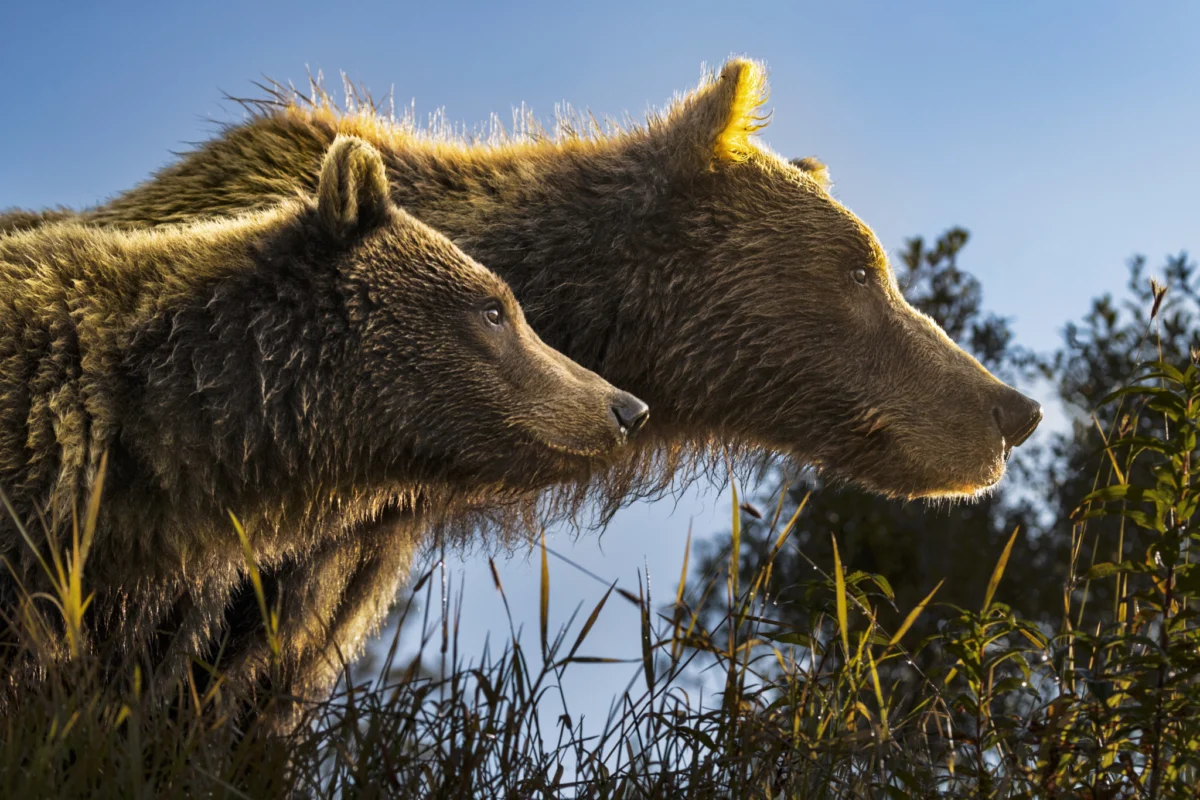
Suddenly, a subtle shift in the underbrush, a mere eight feet away, signaled a presence. The sound was almost imperceptible, a soft rustling that hinted at something substantial. In that moment of heightened awareness, the observer, armed only with a wide-angle lens, encountered a mother brown bear and her cub. The cub, no more than eight months old, tentatively peered from the dense foliage, its youthful curiosity mingling with an instinctive caution.
In such encounters, the protocols of wildlife observation become paramount. Slowed breathing, averted gaze, and a posture of humility are crucial to de-escalating potential tension. The observer adopted a stance that conveyed respect and a lack of threat, a silent apology for encroaching upon their natural domain. The mother bear emerged from the brush, her ears pricked, her eyes scanning the environment. Her focus, however, was not on the observer, nor, it seemed, on the distant splash of fish. Her attention was riveted on a large male bear feeding upstream, a formidable presence oblivious to their presence. Yet, the mother bear remained acutely aware, observing, listening, learning.
The Art of the Encounter: Patience and Respect
The observer, realizing the extraordinary nature of the moment, slowly raised their camera. The objective was to capture the scene without disrupting the delicate equilibrium. Two rapid shots were taken, a testament to the fleeting nature of such opportunities. The photographer expressed that in such instances, "everything slows down." The process demands a calming of nerves, a steadying of hands, and a commitment to slow, deliberate movements, akin to the fluid grace of Tai Chi. Every action, even the swift change of a lens, must be executed with smoothness and intention.
This particular capture, born from a confluence of luck, timing, and respectful observation, has become one of the most cherished images in the photographer’s portfolio. It encapsulates a profound moment where an animal, in its wild domain, implicitly permits an observer into its presence. The mother and cub acknowledged the observer’s presence, understanding that they posed no threat. The true danger lay in the larger male upstream. This photograph represents a rare intersection of chance, perfect timing, and happenstance, captured in the ethereal glow of the fading day.
Ecological Significance and Broader Implications
The annual salmon run is far more than a captivating wildlife display; it is a linchpin of the Alaskan ecosystem. The salmon, returning to their ancestral spawning grounds, deliver vital marine nutrients inland, fertilizing forests and supporting a diverse array of species, including bears, eagles, and even terrestrial plant life. The health of the salmon populations is a direct indicator of the health of the marine environment, the ocean waters that the photographer works to protect.
The cyclical nature of the salmon run, from the initial surge of sockeye to the final push of chinook, underscores the interconnectedness of these ecosystems. Disruptions to this cycle, whether through climate change impacting ocean conditions, overfishing, or habitat degradation, have cascading effects throughout the food web. The brown bears, as apex predators dependent on this resource, are particularly vulnerable to such changes. Their ability to successfully navigate hyperphagia and prepare for winter directly influences their survival and reproductive success, ultimately impacting the long-term viability of bear populations.
The documented behaviors, from the dominance of alpha males to the protective instincts of mothers, highlight the complex social structures and survival strategies within bear communities. Understanding these dynamics is crucial for effective conservation efforts. The observation of infanticide, while disturbing, provides valuable insights into the pressures and evolutionary adaptations that shape these animals’ lives.
The photographic record of such moments serves as a powerful tool for conservation advocacy. By sharing these intimate glimpses into the lives of wild animals, individuals and organizations can foster greater public awareness and support for the protection of these critical habitats. The image captured in that Alaskan twilight is not just a beautiful photograph; it is a testament to the resilience of nature, the power of maternal devotion, and the urgent need to preserve the wild places that sustain these magnificent creatures. The ongoing efforts to protect the ocean waters and the salmon that call them home are therefore directly linked to ensuring the continued existence of these age-old spectacles, a vital inheritance for generations to come.