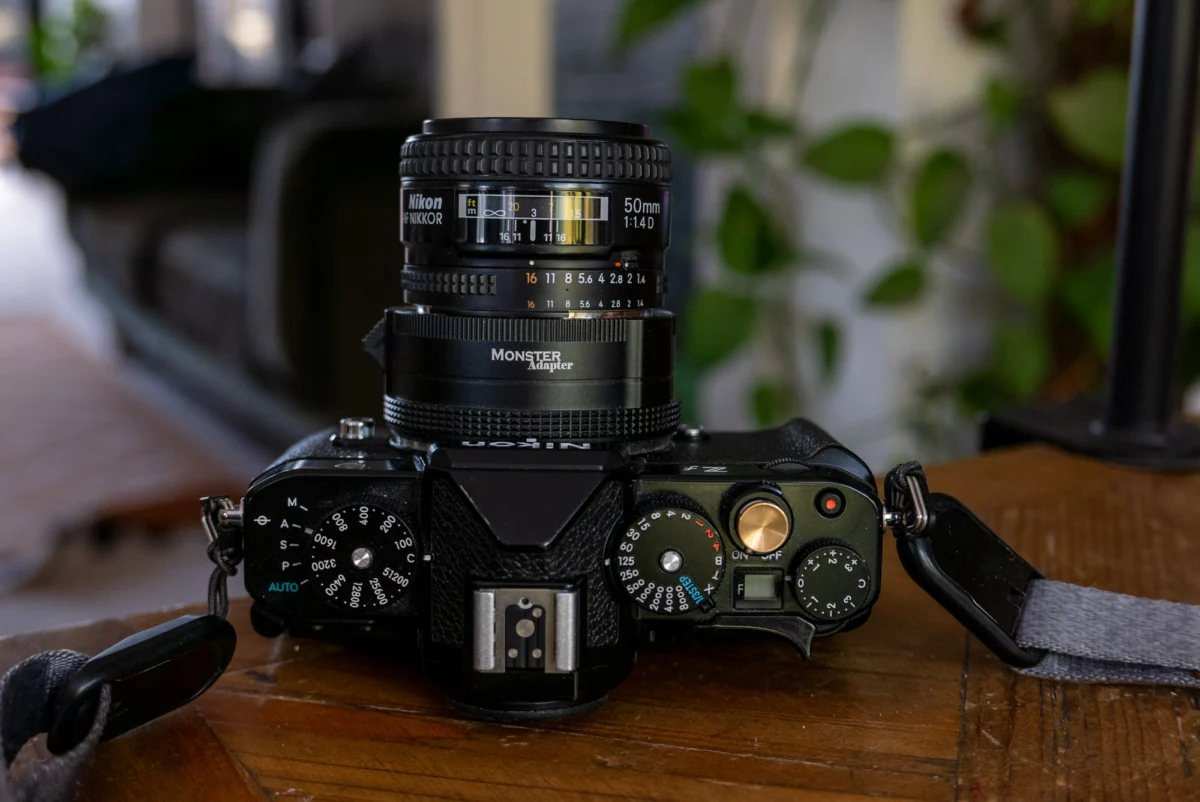
The transition from the legacy Nikon F-mount to the modern mirrorless Z-mount has presented a significant technological hurdle for photographers possessing extensive collections of AF-D series lenses. While Nikon’s official FTZ and FTZ II adapters provide seamless integration for AF-S, AF-I, and AF-P lenses, they notably lack the internal screw-drive motor required to autofocus older AF and AF-D glass. The Monster Adapter LA-FZ1 has emerged as a specialized third-party solution designed to bridge this gap, integrating a mechanical motor within the adapter housing to drive the autofocus mechanisms of legacy Nikkor lenses. Recent field evaluations utilizing the Nikon Zf and the latest firmware version 1.2 for the LA-FZ1 have provided critical data on the viability of this combination, specifically when paired with the iconic Nikon 50mm f/1.4 AF-D.
Technical Context and the Evolution of the Nikon F-Mount
To understand the significance of the Monster Adapter LA-FZ1, one must examine the chronology of Nikon’s lens mount evolution. The Nikon F-mount, introduced in 1959, underwent a major transformation in the 1980s with the introduction of autofocus. The "AF" and subsequent "AF-D" (Distance information) lenses relied on a "screw-drive" system, where a motor inside the camera body turned a physical screw on the lens mount to move the optical elements.

In the late 1990s, Nikon began transitioning to AF-S lenses, which featured an "unlimited" Silent Wave Motor (SWM) built directly into the lens. When Nikon launched the mirrorless Z-mount in 2018, the company prioritized compatibility with these internal motor lenses. Consequently, millions of AF-D lenses, including the popular 50mm f/1.4, were relegated to manual focus only on Z-series cameras when using official Nikon adapters. The Monster Adapter LA-FZ1 represents a sophisticated engineering effort to restore autofocus functionality to these lenses by placing the drive motor back into the adapter itself.
The Testing Platform: Nikon Zf and Firmware 1.2
The Nikon Zf serves as a unique testing platform for legacy glass. While its exterior pays homage to the vintage Nikon FM2, its internal architecture is powered by the Expeed 7 processor, the same engine found in the flagship Nikon Z9 and Z8. This provides the camera with advanced subject detection and 3D tracking capabilities.
Firmware version 1.2 for the LA-FZ1 is a critical component of this performance analysis. Earlier iterations of third-party AF-D adapters often struggled with "hunting"—the lens moving back and forth without locking onto a subject—and inconsistent communication with the camera’s phase-detection pixels. Version 1.2 aims to refine the communication protocol between the lens, the adapter’s motor, and the Zf’s autofocus algorithms.

Operational Parameters and Autofocus Performance
Field testing of the Nikon 50mm f/1.4 AF-D via the LA-FZ1 was conducted across three primary scenarios: static subjects in optimal light, low-light environments, and high-speed subject tracking. The objective was to determine if the combination met the threshold of being "usable" for professional and enthusiast applications, rather than expecting it to rival modern native Z-mount optics.
Static Subject Acquisition
In controlled environments with adequate lighting, the 50mm f/1.4 AF-D demonstrated high levels of accuracy. When the camera was configured for back-button autofocus—decoupling the AF activation from the shutter release—the lens achieved focus locks with minimal delay. While the mechanical noise of the screw-drive system remains audible and significantly louder than modern stepper motors (AF-P) or linear motors, the speed of acquisition was described as "sufficiently brisk." For portraiture or street photography involving stationary subjects, the adapter allowed the Zf to utilize its eye-detection AF with surprising precision, hitting the focus plane at f/1.4 consistently.
Low-Light Challenges
As ambient light levels decrease, the limitations of both the aging lens design and the adapter’s motor become more apparent. During evaluations in dimly lit indoor environments, the system exhibited increased "hunting." The 3D tracking mode, which relies heavily on color and contrast data, occasionally struggled to maintain a lock, necessitating a switch to single-point AF or wide-area AF modes.

Despite these challenges, the hit rate remained acceptable for non-critical work. The performance in low light is heavily bolstered by the Nikon Zf’s sensor, which is rated for autofocus sensitivity down to -10 EV. This suggests that the camera body is compensating for some of the mechanical lag inherent in the screw-drive adapter.
High-Speed Subject Tracking
The most rigorous test involved tracking a fast-moving subject, such as a dog running toward the camera. In this scenario, the disparity between 30-year-old lens technology and modern optics is most pronounced. While a native Z-mount lens or a modern third-party lens (such as those from Viltrox or Tamron) typically yields an 80% to 90% hit rate in similar conditions, the 50mm f/1.4 AF-D on the Monster Adapter produced a hit rate of approximately 20%.
The lag is attributed to the physical torque required to move the lens elements and the latency in the communication loop between the camera’s AI-driven subject tracking and the adapter’s motor. The system proved more successful as the subject’s velocity decreased, indicating that while the adapter can follow motion, it cannot yet match the "instantaneous" response required for high-speed sports or action photography.

Comparative Analysis: Legacy vs. Modern Optics
The Nikon 50mm f/1.4 AF-D is celebrated for its specific optical rendering—often described as having a "classic" look with a gentle fall-off and unique bokeh characteristics that modern, ultra-sharp lenses sometimes lack. The primary appeal of the Monster Adapter LA-FZ1 is the ability to retain this aesthetic while gaining the convenience of autofocus.
Data suggests that for users prioritizing "perfect" autofocus, the native Nikkor Z 50mm f/1.8 S remains the superior choice, offering silent, near-instantaneous focus and superior edge-to-edge sharpness. However, for photographers who own a library of AF-D glass, the $400–$500 investment in an LA-FZ1 adapter is more cost-effective than replacing multiple lenses with their Z-mount equivalents, which can cost thousands of dollars.
Technical Specifications and Firmware Stability
Firmware 1.2 has been noted for improving the stability of the connection. Previous versions occasionally resulted in "frozen" focus or required a camera restart. During extensive testing with the Nikon Zf, the LA-FZ1 remained responsive over several hours of use. The adapter supports:

- Full EXIF data transmission (Lens focal length, aperture, and distance).
- Aperture control via the camera body.
- Support for the Zf’s advanced AF modes, including 3D Tracking and Subject Detection (Human, Animal, Vehicle).
The mechanical drive within the adapter is powered by the camera battery. While there is a measurable increase in power consumption compared to using native lenses, it does not significantly compromise the Zf’s battery life for a standard day of shooting.
Broader Implications for the Photography Market
The success of the Monster Adapter LA-FZ1 with firmware 1.2 has broader implications for the secondary market of Nikon lenses. AF-D lenses had seen a decline in resale value following the launch of the Z-mount, as they were perceived as "manual only" for mirrorless users. The availability of a reliable autofocus adapter is likely to stabilize, or even increase, the market value of classic lenses like the 28mm f/2.8, 50mm f/1.4, and 85mm f/1.8 AF-D.
Furthermore, this development puts pressure on Nikon to reconsider its stance on a motorized FTZ adapter. While Nikon has historically cited the bulk and complexity of such a device as reasons for its absence, third-party manufacturers like Monster Adapter have demonstrated that a relatively compact, functional solution is technically feasible.

Conclusion and Future Outlook
The Nikon 50mm f/1.4 AF-D, when paired with the Monster Adapter LA-FZ1 on a Nikon Zf, represents a successful marriage of vintage optical character and modern digital convenience. While the combination is not a replacement for native Z-mount lenses in high-speed or professional sports contexts, it provides a "workable" and "expected" level of performance for general photography.
The refinements found in firmware version 1.2 suggest that the developer is actively closing the gap between third-party hardware and native camera software. For the photography community, this ensures that the "Nikon look" of the 1990s and early 2000s can continue to be utilized on the most advanced mirrorless sensors available today, preserving the utility of legacy glass for another generation. Future firmware updates are expected to further refine motor torque curves and low-light acquisition speeds, potentially making the AF-D series more viable for a wider range of shooting conditions.