Southwestern Alaska’s rugged coastline and verdant river valleys transform annually into a theatre of nature’s most profound dramas with the arrival of the salmon run. This spectacular and ecologically vital migration sees an estimated 30 million salmon battling upstream to their ancestral spawning grounds, a monumental undertaking that draws the region’s iconic brown bears from their mountain refuges. The convergence of these ancient forces creates an unforgettable spectacle, a testament to the intricate web of life that sustains these wild landscapes.
The Annual Alaskan Salmon Run: A Five-Month Spectacle
The salmon run is not a singular event but a meticulously sequenced procession, commencing in late May and extending through mid-October, a period of approximately five months. The sockeye salmon are the vanguard, followed by pink salmon, then coho, chum, and finally, the mighty chinook salmon. This staggered arrival ensures a continuous food source for the wildlife that depends on this annual bounty, most notably the Ursus arctos, or brown bears.
For the bears, this period is critical for survival. The influx of nutrient-rich salmon provides the essential calories and fat reserves needed to endure the long, harsh Alaskan winter. This intense feeding period is characterized by a physiological state known as hyperphagia, where the bears consume vast quantities of food, often exceeding hundreds of thousands of calories daily, to maximize their fat storage. This biological imperative drives their behavior, pushing them to the riverbanks in pursuit of this vital sustenance.
Bear Behavior and Social Dynamics During the Salmon Run
Each brown bear exhibits distinct feeding preferences and territorial behaviors, shaped by individual needs and the inherent hierarchy within bear populations. The dominant alpha males, some of which can weigh up to 1,500 pounds (680 kg), are typically the first to claim the most advantageous fishing spots. Their sheer size and strength allow them to navigate the turbulent currents with relative ease, standing firm against the powerful flow of the rivers to intercept the migrating salmon.
"Their sheer bulk and muscle mass allow them to wade into the middle of the rushing stream and just stand there, braced against the current as they gorge themselves on whatever fish happens to come their way," observed one naturalist familiar with the region’s wildlife.
Younger, more agile bears often adopt different strategies, seeking out less contested areas or utilizing the cover of dense vegetation. Subordinate males and females, while not always possessing the same level of dominance, display a keen awareness of their surroundings. They understand the importance of avoiding direct confrontation with the larger, more aggressive males, prioritizing their own safety and the opportunity to feed without risking injury.
The Maternal Imperative: Mothers and Cubs Navigating Peril
Perhaps the most compelling and vulnerable participants in this annual drama are mother bears and their cubs. For these mothers, the salmon run is a period of intense vigilance and unwavering dedication. Their primary responsibility is to nourish their offspring, ensuring they gain the necessary strength and fat reserves for the impending winter, while simultaneously shielding them from the myriad dangers present in their environment.
"This is a sight that always gladdens my heart," reflects a seasoned observer of wildlife. "These mothers are wise beyond words. They have to be, because they have the added responsibility of looking not only after themselves but their cubs as well."
Young cubs, especially those only five to six months old, are particularly defenseless. They remain reliant on their mothers for protection and sustenance, still nursing but beginning to explore solid foods, including protein-rich grasses. The riverbanks, a prime feeding ground, also present one of the most perilous environments for a mother and her young.
The Shadow of Infanticide: A Stark Reality of Nature
The challenges faced by mother bears extend beyond mere foraging. The specter of infanticide looms large, a grim facet of natural selection in the wild. Male bears, particularly dominant individuals, are known to kill cubs, sometimes even their own offspring. While the precise motivations remain a subject of ongoing scientific research and observation, theories suggest a complex interplay of factors, including the reduction of competition for scarce food resources, sexual selection, and, in some instances, cubs being viewed as a potential food source.

Regardless of the underlying causes, the threat is undeniable. Mother bears must remain perpetually alert, their instincts honed to detect and evade potential threats to their young. Their protective instincts are paramount, driving them to employ every strategy at their disposal to safeguard their vulnerable cubs from predatory males.
A Moment of Serene Coexistence: An Encounter on the Riverbank
In late August, amidst the peak of the salmon run, an observer found themselves on a tranquil stretch of Alaskan riverbank as the day began to wane. The air was filled with the distant sounds of salmon splashing in the river, a gentle counterpoint to the otherwise serene atmosphere. Several large bears were visible upstream, engrossed in their pursuit of an easy meal.
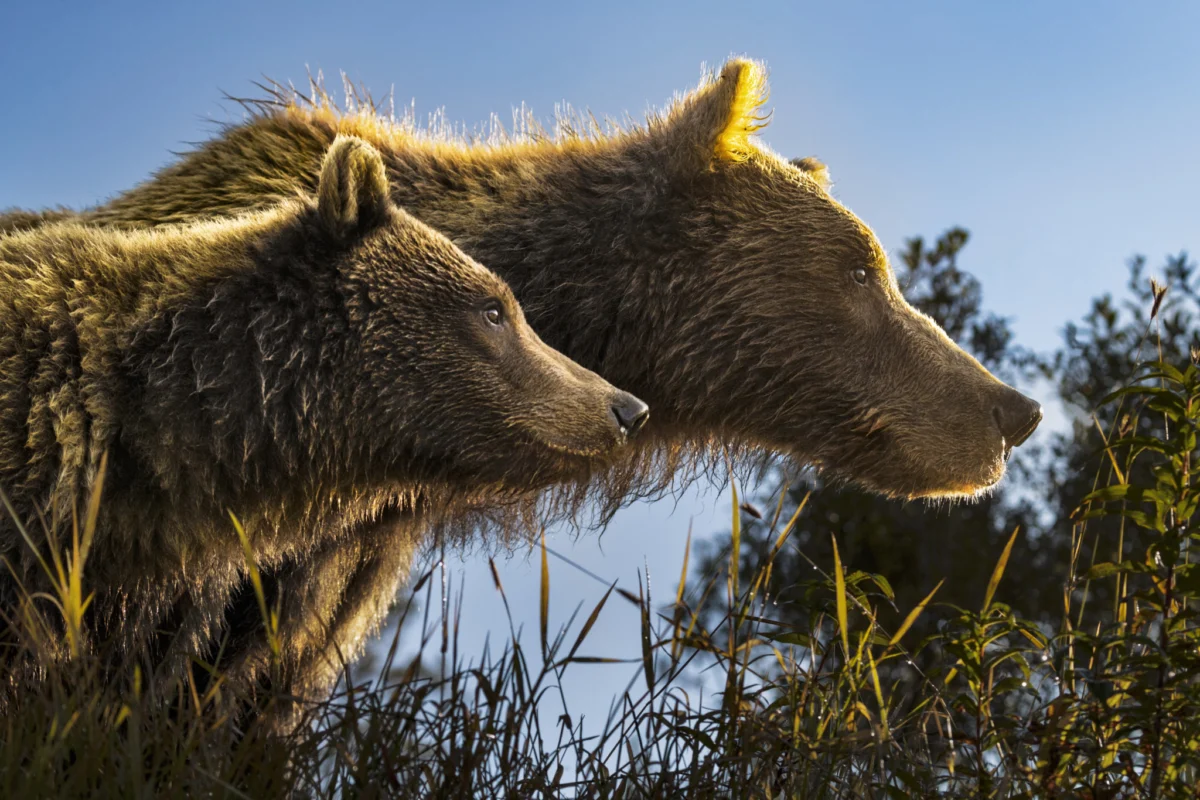
Suddenly, a subtle shift in the underbrush nearby drew attention. A rustling sound, indicative of something substantial moving, emerged from the dense foliage. About eight feet away, a mother bear and her cub cautiously emerged. The cub, estimated to be no more than eight months old, was still remarkably small. The observer, understanding the delicate nature of the encounter, instinctively slowed their breathing and avoided direct eye contact, adopting a posture of humility and deference.
Without a telephoto lens, and equipped only with a wide-angle zoom, the photographer prepared to document the scene. The mother bear, her ears erect and eyes keenly scanning her surroundings, stepped fully into view. Her focus, however, was not on the human observer but intently fixed on a large male bear fishing further upstream. This dominant male appeared oblivious to their presence, but the mother bear’s vigilance was palpable as she observed, listened, and learned.
The Art of Patience and Respect in Wildlife Photography
The photographer’s approach to this rare moment exemplified the principles of ethical wildlife observation. "Everything slows down in moments like that," the observer recounted. "You calm your nerves, steady your hands as much as you can, and move very, very slowly and gently. I always teach my field assistants to move around the bears as if they are doing Tai Chi – even when they are in a rush to move or change a lens; Tai Chi. Every motion needs to be smooth, slow and studied."
With utmost care, the camera was raised, the intention being to capture the essence of the moment without disrupting the fragile peace. Two quick shots were taken, with no immediate certainty of their success. However, one of these captured images has since become a particularly cherished and profoundly pleasing photograph, a testament to the power of patience and respectful observation.
This encounter underscored a fundamental truth about interacting with wild animals: acceptance into their presence is granted, and their rules dictate the terms of engagement. Both the mother bear and her cub were aware of the observer’s presence, yet they perceived no threat. The true danger lay with the larger male upstream. The photographer was simply a fortunate witness, a serendipitous participant in a chance intersection of luck, timing, and happenstance, capturing a fleeting moment as the last rays of daylight faded behind the Alaskan mountains.
The Broader Ecological Significance of the Salmon Run
The annual salmon run is far more than a spectacle for bears; it is a cornerstone of the Alaskan ecosystem. The journey of these anadromous fish, from their freshwater spawning grounds to the vast ocean and back again, facilitates a critical transfer of marine-derived nutrients into terrestrial and freshwater environments. This influx supports a diverse array of wildlife, including birds, mammals, and invertebrates, and plays a vital role in maintaining the health and productivity of the region’s forests and rivers.
The health of the salmon populations is intrinsically linked to the health of the ocean environments they inhabit. Issues such as overfishing, pollution, and climate change in marine ecosystems can have cascading effects, impacting the abundance and vitality of the salmon runs. Conservation efforts aimed at protecting these crucial oceanic habitats are therefore essential for ensuring the continued survival of the salmon and the countless species that depend on them.
Conclusion: A Delicate Balance of Power and Survival
The annual salmon run in southwestern Alaska is a powerful reminder of the intricate and often brutal realities of the natural world. It is a cycle of life, death, and survival, where the pursuit of sustenance drives extraordinary feats of endurance and adaptation. The majestic brown bears, the determined salmon, and the vigilant mother bears all play their part in this ancient drama. Understanding and appreciating these complex ecological interactions is crucial for advocating for the continued protection of these invaluable wild landscapes and the magnificent creatures that call them home. The images and experiences captured during these times serve not only as artistic expressions but as vital documentation of the delicate balance that sustains life in one of Earth’s last great wildernesses.