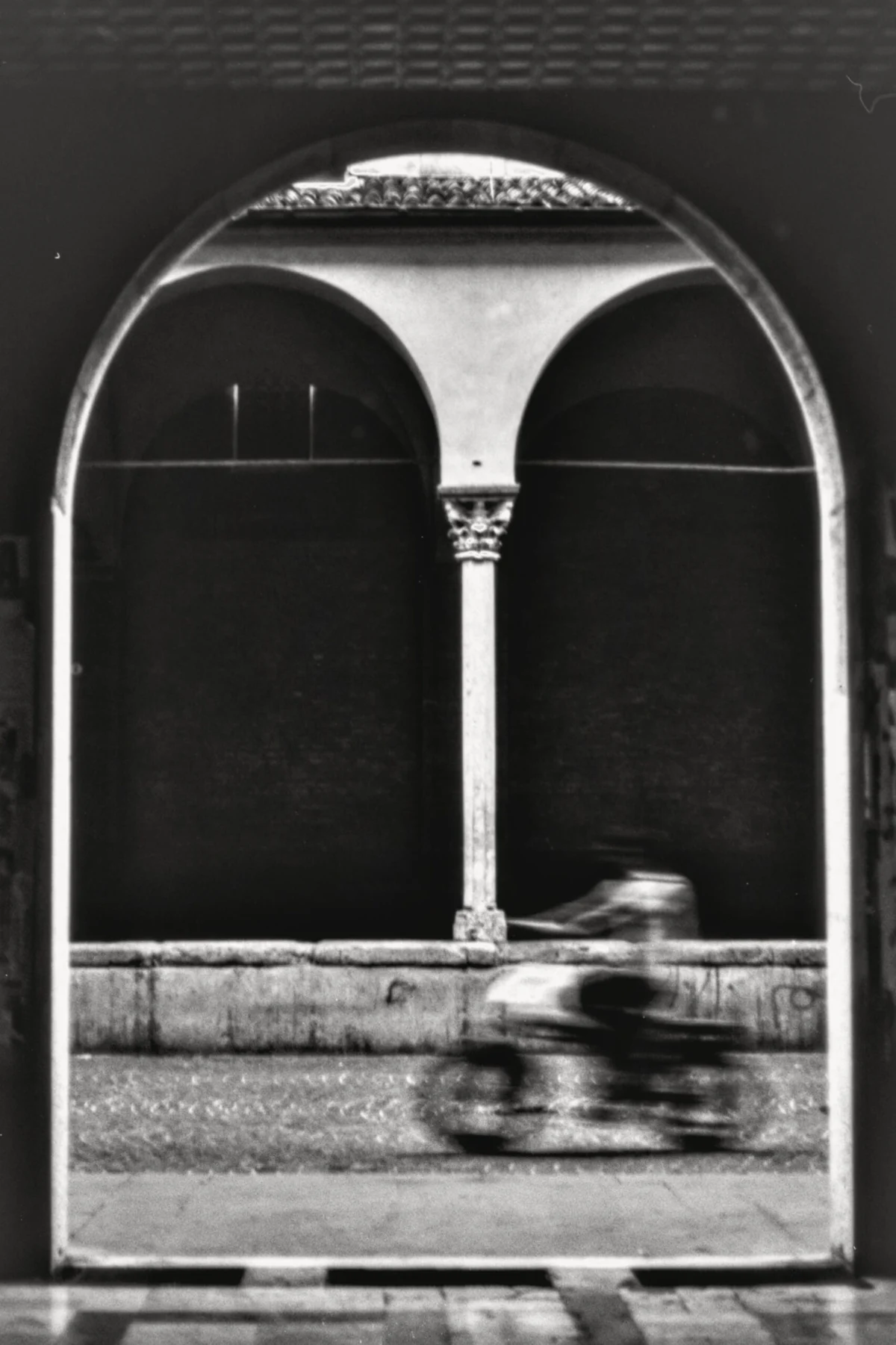
The city of Padua, a historic center of academic and architectural significance in Northern Italy, has recently become the backdrop for a rigorous technical debate regarding the synthesis of classical framing and modern street photography. On March 20, 2026, photographer Andrea Monti released a study of a specific capture taken in the city’s center, utilizing a Nikon 35TI camera and Ferrania P30 film. The image, which features a cyclist passing through a double-arched architectural frame, has sparked a broader discussion among visual theorists concerning the "compositional dilemma"—the tension between static architectural perfection and the unpredictable nature of urban subjects. This analysis explores the technical specifications of the equipment used, the psychological impact of visual directionality, and the historical context of the medium in the mid-2020s.
Technical Specifications and the Resurgence of Analog Precision
The choice of equipment for this capture reflects a significant trend in the 2020s: the continued reliance on high-end analog technology for professional artistic documentation. The Nikon 35TI, a premium point-and-shoot camera originally released in the 1990s, remains a staple for street photographers due to its Nikkor 35mm f/2.8 lens and its distinctive analog needle display system. The "TI" designation refers to its titanium construction, providing durability in urban environments while maintaining a lightweight profile.
Complementing the hardware is the Ferrania P30 film, a stock with deep roots in Italian cinematic history. Reintroduced by Film Ferrania in the late 2010s and stabilized in production by 2026, the P30 is a 80 ISO black-and-white film based on the legendary P30 motion picture stock used by mid-century directors such as Federico Fellini and Pier Paolo Pasolini. The film is characterized by its high silver content, which results in a high-contrast image with almost imperceptible grain and a wide tonal range in the shadows. In the context of Padua’s stone architecture, this film stock emphasizes the textures of the masonry and the stark geometry of the city’s famous porticos and windows.
The Compositional Dilemma: Framing vs. Disturbance
The central conflict of the photograph in question lies in the use of "internal framing," a technique where elements within the scene—such as a window or an archway—are used to border the primary subject. Monti’s objective was to utilize Padua’s medieval and Renaissance structures to create a "painting-like" effect. However, the introduction of a dynamic element—a biker—into this rigid geometric space created what the photographer described as a "disturbance."
In professional photography, the inclusion of a human element is often intended to provide scale or a focal point. Yet, in this instance, the subject’s positioning created a series of technical challenges:
- Directional Tension: The subject moves from right to left. In Western visual culture, which is conditioned by left-to-right reading patterns, movement toward the left is often perceived as "retreating" or "exiting" the frame. This creates a psychological sense of unease or incompleteness, as the viewer’s eye naturally expects the subject to move into the open space of the frame rather than away from it.
- Spatial Timing: The "decisive moment," a concept pioneered by Henri Cartier-Bresson, requires the subject to be in the optimal position to balance the frame. Monti noted that while waiting for the subject to reach the exact center might have improved symmetry, it would have introduced a "tangent"—a visual intersection where the vertical line of the window’s central pillar would appear to emerge directly from the cyclist’s head, a common error that flattens the image’s depth.
- Abstraction vs. Reality: The scene presents a choice between a purely abstract study of light and shadow (the empty window) and a documentary-style capture of urban life. The photographer concluded that, in hindsight, the purity of the architectural geometry might have been a more effective choice than the inclusion of a subject that disrupted the intended order.
Chronology of the Capture and Cultural Context
The production of this image occurs at a time when Padua is undergoing a cultural renaissance regarding its visual identity. As a UNESCO World Heritage site known for its 14th-century fresco cycles, the city has become a focal point for photographers looking to bridge the gap between historical art and modern life.
- Early 2026: Increased interest in "Slow Photography" movements leads to a surge in the use of Italian-made film stocks like Ferrania P30.
- March 15-19, 2026: Andrea Monti conducts a series of architectural studies in the center of Padua, focusing on the interplay of shadow in the city’s narrow corridors.
- March 20, 2026: The specific image of the biker is captured and subsequently analyzed, leading to a public discussion on the merits of "empty space" in architectural photography.
The debate mirrors a larger movement within the 2026 art world, where the saturation of high-speed digital imagery has led to a renewed appreciation for the deliberate, often "imperfect" nature of film. The dilemma faced by Monti is representative of the challenges faced by contemporary photographers attempting to find silence and order in increasingly crowded urban environments.
Supporting Data: The Analog Market in 2026
Market data from the first quarter of 2026 indicates that the film photography industry has reached its highest valuation since the early 2000s. The demand for premium compact cameras like the Nikon 35TI has seen a 15% year-over-year increase in the resale market, with collectors and professionals seeking out lenses that offer "character" over digital perfection.
| Metric | 2024 Statistics | 2026 Statistics (Projected) |
|---|---|---|
| Global Film Roll Production | 85 Million Units | 112 Million Units |
| Ferrania P30 Market Share (B&W) | 4.2% | 7.8% |
| Premium Analog Camera Value | +12% YoY | +18% YoY |
| Professional Use of Film in Fine Art | 22% | 31% |
This data suggests that the technical choices made in the Padua shoot were not merely aesthetic but were aligned with a broader industrial shift toward high-fidelity analog media. The use of Ferrania P30, in particular, highlights a preference for regional, high-quality manufacturing that caters to specific artistic needs.
Expert Reactions and Theoretical Analysis
Visual theorists have weighed in on the implications of Monti’s "compositional dilemma." Dr. Elena Rossi, a professor of Visual Arts at the University of Padua, suggests that the "disturbance" mentioned by the photographer is actually the most valuable element of the image.
"The tension between the static, historical architecture of Padua and the transient, ‘wrong-way’ motion of the cyclist creates a narrative of modern friction," Rossi stated in a brief commentary. "In a world of AI-generated images that prioritize perfect symmetry, the ‘dilemma’ of a human figure moving in an unnatural direction provides a layer of authenticity that an empty, perfect frame cannot achieve."
Conversely, some purists argue that the intrusion of speed into a static space ruins the "Golden Ratio" established by the arches. This school of thought maintains that the Nikon 35TI’s optics are best utilized for capturing the intricate details of stone and light, and that human subjects often serve as a distraction from the mathematical beauty of the environment.
Broader Impact and Implications for Street Photography
The discussion surrounding the Padua photograph reflects a pivotal moment in street photography. As urban spaces become more monitored and digitized, the act of capturing a spontaneous, unscripted moment on film becomes a form of historical preservation. The "dilemma" identified by Monti highlights the core struggle of the medium: the balance between the photographer’s intent and the reality of the street.
The implications of this analysis extend to how future photographers approach architectural subjects. If a subject "disturbs" a frame, is it a failure of the composition or a success of the documentary record? In the context of 2026, where the "perfect" image is easily manufactured, the value of the "difficult" image—one that poses questions rather than providing a balanced aesthetic—is on the rise.
Furthermore, the focus on the Nikon 35TI and Ferrania P30 underscores a shift toward "intentional photography." By using equipment with limited exposures and specific chemical properties, photographers are forced to engage more deeply with their surroundings. The "dilemma" in Padua is a direct result of this engagement, proving that even in a city as photographed as Padua, there are still new ways to challenge the viewer’s perception of space, time, and motion.
As the photographic community continues to analyze these technical and philosophical intersections, the consensus remains that the choice between an empty frame and a "disturbed" one is not a matter of right or wrong, but a reflection of the photographer’s relationship with the ever-changing urban landscape. The streets of Padua, with their centuries-old arches and modern commuters, remain a primary laboratory for this ongoing exploration of visual truth.