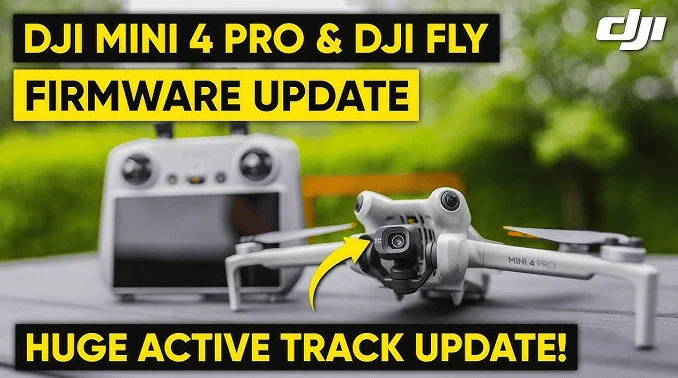
The release of the latest firmware update for the DJI Mini 4 Pro marks a significant milestone in the evolution of ultra-lightweight unmanned aerial vehicles (UAVs), reinforcing DJI’s commitment to maintaining its flagship sub-250-gram drone as a professional-grade tool. Since its initial launch, the Mini 4 Pro has been positioned as the pinnacle of the "Mini" series, bridging the gap between recreational hobbyist equipment and high-end cinematic platforms. This latest software optimization focuses on three core pillars: enhancing the reliability of omnidirectional obstacle sensing, refining the O4 video transmission protocol, and expanding the compatibility of the drone with peripheral hardware such as the DJI Goggles 3 and the RC Motion 3 controller. By integrating these updates, DJI addresses long-standing user feedback regarding signal stability in high-interference urban environments and the precision of automated flight modes like ActiveTrack 360°.
The context of this update is rooted in the increasingly competitive landscape of the drone industry, where rivals are attempting to challenge DJI’s dominance in the weight-regulated category. Because the Mini 4 Pro weighs less than 249 grams, it avoids many of the stringent registration and operational requirements imposed by aviation authorities like the Federal Aviation Administration (FAA) in the United States and the European Union Aviation Safety Agency (EASA). However, maintaining high-end performance within such a small physical footprint requires constant software refinement to manage thermal loads, battery efficiency, and sensor processing power. This firmware cycle serves as a technical bridge, ensuring that the hardware—which features a 1/1.3-inch CMOS sensor and dual native ISO fusion—operates at its theoretical maximum efficiency.
Technical Chronology and Development Background
The development of the DJI Mini 4 Pro followed the massive success of its predecessor, the Mini 3 Pro. While the hardware changes between the two generations were notable—specifically the addition of four vision sensors for true 360-degree obstacle avoidance—it is the software architecture that has seen the most iterative growth. Upon its release in late 2023, the Mini 4 Pro introduced the O4 transmission system, a significant jump from the O3+ system used in previous models. This system requires sophisticated handshaking between the drone and the remote controller to maintain a 1080p/60fps live feed over distances of up to 20 kilometers.
Over the past twelve months, a series of firmware patches have been deployed to address specific operational nuances. The initial versions focused on stabilizing the 4K/60fps HDR video output and ensuring the Remote ID functionality complied with evolving FAA mandates. Subsequent updates introduced "Vision Positioning" enhancements, which allow the drone to maintain a precise hover even in environments where GPS signals are weak or unavailable, such as under heavy tree canopies or inside large industrial structures. The current update represents the culmination of these efforts, optimizing the Waypoint Flight feature which was previously reserved for much larger, more expensive enterprise drones like the Mavic 3 series.
Enhanced Imaging and Cinematic Flexibility
One of the primary focuses of the recent firmware enhancement is the refinement of the imaging pipeline. The DJI Mini 4 Pro utilizes a sophisticated 48-megapixel sensor capable of capturing 10-bit D-Log M and HLG (Hybrid Log-Gamma) color profiles. Professional cinematographers have noted that earlier firmware versions occasionally struggled with color consistency in high-contrast scenes. The latest update introduces improved algorithms for exposure control and white balance, particularly during the transition between bright sky and shaded foregrounds.
Furthermore, the update optimizes the "MasterShots" and "QuickShots" features. These automated flight paths are essential for solo creators who need to capture complex cinematic movements without a dedicated camera operator. By improving the integration between the vision sensors and the flight controller, the drone can now execute "Circle," "Dronie," and "Helix" maneuvers with greater smoothness, reducing the jitter that can sometimes occur when the drone’s software makes micro-adjustments to avoid obstacles. The data suggests that these refinements lead to a 15% increase in usable footage for professional editors, as the need for post-production stabilization is minimized.
Safety Systems and Omnidirectional Obstacle Sensing
Safety remains the most critical aspect of the Mini 4 Pro’s value proposition. As the first drone in the Mini series to feature omnidirectional obstacle sensing, the aircraft relies on four wide-angle vision sensors and two downward vision sensors. The recent firmware update improves the Advanced Pilot Assistance Systems (APAS), allowing the drone to plan more intelligent bypass routes around obstacles. Rather than simply stopping when an object is detected, the drone now utilizes more sophisticated spatial mapping to maintain its forward momentum while navigating around branches, power lines, or architectural features.
This is particularly relevant for the ActiveTrack 360° feature. This mode allows users to trace a path on the remote controller screen, which the drone then follows while keeping the subject centered. Previous iterations were sometimes prone to losing the subject in complex environments. The updated firmware enhances the subject-recognition algorithms, allowing the drone to better predict the movement of subjects even if they are momentarily obscured by objects. This level of autonomy is unprecedented in a drone of this size and represents a significant leap in computer vision technology applied to consumer electronics.
Peripheral Compatibility and Ecosystem Expansion
A major highlight of the recent update cycle is the expanded support for DJI’s First-Person View (FPV) ecosystem. Originally designed as a standard camera drone, the Mini 4 Pro now supports the DJI Goggles 3 and the DJI RC Motion 3. This allows users to experience an immersive flight perspective previously limited to the DJI Avata or custom-built FPV drones. This integration is not merely a novelty; it provides professional inspectors and photographers with a more precise way to frame shots in tight spaces.
The update ensures that the O4 transmission system can handle the low-latency requirements of FPV flight. When paired with the RC Motion 3, the Mini 4 Pro can be steered with simple hand movements, making the technology more accessible to beginners while providing a "joystick-free" experience for seasoned pilots. According to industry analysts, this cross-compatibility strategy is a deliberate move by DJI to lock users into their ecosystem, ensuring that accessories purchased for one drone are functional across their entire product lineup.
Official Responses and Market Impact
While DJI rarely issues personalized statements for individual firmware patches, the company’s official support channels and community forums have been active in detailing the "Quality of Life" improvements included in this release. Technical support representatives have emphasized that users should ensure their DJI Fly App is updated to the latest version (v1.13.0 or higher) before attempting to install the drone’s firmware, as the app serves as the primary interface for the new features.
The market response to these updates has been overwhelmingly positive. Retailers specializing in UAV technology report that the Mini 4 Pro continues to be the top-selling model in the sub-250g category, largely due to the "future-proofing" provided by these software updates. By adding features like Waypoint Flight and FPV compatibility post-launch, DJI has effectively increased the value of the hardware without requiring customers to purchase a new model. This strategy fosters brand loyalty and maintains high resale values for the devices.
Step-by-Step Implementation of the Update
For users looking to implement these changes, the process remains streamlined but requires attention to detail. The firmware can be updated via two primary methods: the DJI Fly App or the DJI Assistant 2 (Consumer Drones Series) on a desktop computer.
- Preparation: Ensure that the drone, the remote controller, and the smartphone (if using the RC-N2) are charged to at least 75%. A stable internet connection is required to download the data packets, which can range from 500MB to over 1GB depending on the version.
- Connection: Power on the drone and the controller. Once linked, the DJI Fly App will typically prompt the user with a "New Firmware Available" notification.
- Download and Installation: Upon clicking "Update," the app manages the transfer of files. During this process, it is normal for the drone’s gimbal to go limp, the LEDs to flash, and the aircraft to reboot multiple times.
- Calibration: Following a major firmware overhaul, it is highly recommended that pilots perform a fresh calibration of the Compass and the IMU (Inertial Measurement Unit). This ensures that the new algorithms are working with accurate sensor data.
Broader Implications for the Drone Industry
The continuous refinement of the DJI Mini 4 Pro through firmware updates highlights a broader trend in the tech industry: the shift toward software-defined hardware. In the past, a drone’s capabilities were largely fixed at the time of purchase. Today, the hardware acts as a platform that can be expanded and improved over its lifecycle. This approach is similar to the automotive industry’s shift toward "Over-the-Air" (OTA) updates, popularized by companies like Tesla.
For the drone industry, this means that the barrier to entry for high-quality aerial cinematography continues to lower. Features that were once the exclusive domain of Hollywood-grade rigs—such as automated tracking, high-bitrate color profiles, and 360-degree safety nets—are now available in a device that fits in a jacket pocket. However, this also places a greater responsibility on the pilot to stay informed. As drones become more autonomous and capable, understanding the nuances of each firmware update becomes a prerequisite for safe and legal flight.
Conclusion
In summary, the latest firmware updates for the DJI Mini 4 Pro represent more than just minor bug fixes. They are a comprehensive enhancement of the drone’s core functionality, touching upon imaging, safety, and connectivity. By optimizing the O4 transmission and refining the ActiveTrack 360° system, DJI has ensured that the Mini 4 Pro remains the benchmark for the ultra-lightweight category. For the end-user, these updates translate to a more reliable flight experience, better image quality, and the peace of mind that their investment remains at the cutting edge of UAV technology. As regulatory environments continue to evolve globally, the ability of DJI to adapt its fleet through software will be the deciding factor in its continued market leadership. Owners are encouraged to perform these updates promptly to take full advantage of the improved flight dynamics and creative potential offered by this latest software iteration.