The rapid proliferation of generative artificial intelligence has fundamentally altered the landscape of visual content production, shifting the industry’s primary constraint from creative output to commercial viability. While marketers can now transform abstract concepts into high-fidelity images within seconds, the ease of generation has introduced a complex layer of risk regarding licensing, brand consistency, and technical provenance. In an era where "good enough" visuals are infinite, the distinction between a generated image and one that is truly "commercial-ready" has become the new frontier of professional marketing strategy.
The Shift from Production Scarcity to Governance Necessity
For decades, the primary bottleneck in global marketing was the physical and financial limitation of production. Executing a high-level campaign required a synchronized effort involving photographers, talent, location scouts, and extensive post-production teams. Stock photography agencies initially disrupted this model by providing a repository of pre-cleared, professionally produced assets, offering a middle ground between bespoke shoots and budget constraints.
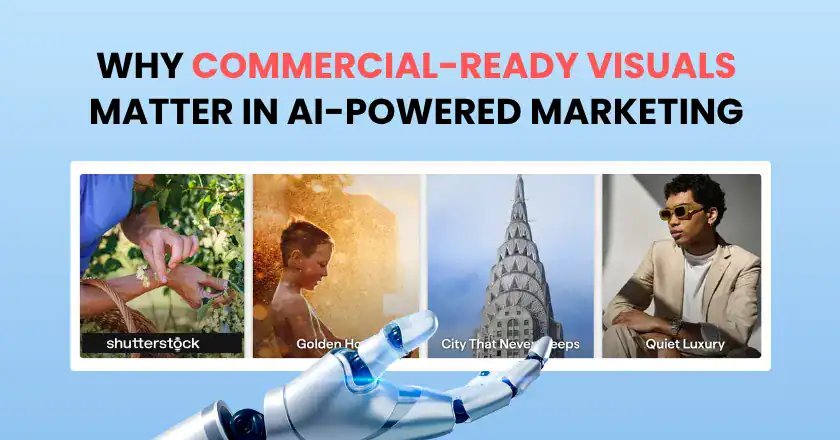
The advent of generative AI, however, has accelerated this evolution to a point of hyper-abundance. Creative teams are no longer limited by the number of shots they can take in a day but by their ability to filter and validate the thousands of variations an AI model can produce. This shift has necessitated a move away from simple "content creation" toward "content governance." The challenge for modern enterprises is no longer generating a striking image; it is ensuring that the image can legally and technically withstand the rigors of a global multi-channel campaign.
A Chronology of Visual Media Integration in Marketing
To understand the current importance of commercial readiness, one must examine the timeline of how visual technology has integrated into the corporate workflow:
- Pre-2000s: The Era of Physical Assets. Marketing relied on physical film, manual typesetting, and high-cost proprietary shoots. Rights management was handled through physical contracts and limited-run licenses.
- 2000–2010: Digital Transformation and the Rise of Stock. The transition to digital photography and the birth of platforms like Shutterstock democratized access to professional imagery, introducing the concept of the "Royalty-Free" license as an industry standard.
- 2011–2021: Social Media and High-Volume Demand. The explosion of platforms like Instagram and Pinterest created a "content treadmill," where brands needed daily visual updates, leading to the rise of mobile-first content and micro-stock.
- 2022–Present: The Generative AI Explosion. The public release of models like DALL-E, Midjourney, and Stable Diffusion turned every marketer into a potential creator. In late 2022, major stock agencies began integrating these tools, with Shutterstock leading through a landmark partnership with OpenAI to provide ethically sourced training data.
Defining Commercial Readiness in the AI Age
A visual asset is considered "commercial-ready" only when it satisfies a rigorous set of creative, legal, and technical criteria. As AI tools often scrape data from across the open web, the lack of clear provenance can lead to significant liabilities.
Legal Indemnification and Licensing
The most critical component of commercial readiness is the guarantee of usage rights. Many open-source AI models are trained on datasets that include copyrighted material, trademarks, and protected likenesses. For a global brand, using an asset with "murky" origins can lead to intellectual property litigation. Commercial-ready platforms solve this by offering indemnification—a legal promise that the platform will cover the costs if an asset is found to infringe on third-party rights.
Technical Scalability and Metadata
AI-generated images often suffer from technical limitations such as low native resolution, "hallucinated" artifacts, or a lack of vector scalability. A commercial-ready asset must be adaptable across formats, from a 1080×1080 social media post to a 40-foot billboard. Furthermore, professional assets include embedded metadata and "Content Credentials" (C2PA standards) that track the asset’s history, ensuring transparency in how the image was altered or generated.
Ethical Sourcing and Contributor Compensation
The industry is seeing a growing push for "Ethical AI." This involves training models exclusively on licensed data where the original creators—photographers and illustrators—are compensated for the use of their work in the training set. Brands that prioritize Corporate Social Responsibility (CSR) are increasingly demanding that their AI-powered workflows respect the intellectual property of the human artists who made the technology possible.

Supporting Data: The Economic and Risk Landscape
Recent industry reports highlight the growing tension between AI adoption and commercial risk. According to a 2023 Gartner survey, approximately 70% of marketing leaders expressed concern over the legal risks associated with generative AI. Furthermore, data from McKinsey suggests that while generative AI could increase marketing productivity by up to 15%, the "cost of correction"—the price of replacing non-compliant or off-brand assets—can negate these gains if not managed through a secure supply chain.
The stock media market itself reflects this transition. Valued at approximately $4 billion globally, the industry is pivoting from selling "images" to selling "integrated creative solutions." Usage data indicates that while AI generation is high for brainstorming and internal mock-ups, over 80% of final campaign "hero" assets still originate from professionally captured photography or highly vetted, indemnified AI outputs.
The Hybrid Workflow: Stock Media as "Creative Raw Material"
Rather than replacing traditional photography, AI is repositioning professional stock content as the "ground truth" or raw material for more complex edits. The emerging industry standard is a hybrid workflow that combines the reliability of stock with the flexibility of AI.

In this model, a creative team might select a professionally shot, high-resolution stock image of a mountain range—ensuring perfect lighting and technical quality. They then use AI-assisted tools to "outpaint" the borders for a wide-screen format, swap the seasonal colors to match a specific brand palette, or insert a localized product shot. This approach maintains the "commercial-ready" foundation of the original image while utilizing AI to achieve the speed and customization required for modern digital advertising.
Brand Consistency and the "Model Collapse" of Visual Identity
One of the most significant risks of an AI-only approach is the erosion of brand coherence. AI models, by their nature, tend toward a "mean" or average aesthetic based on their training data. Without the anchor of professional source material, a brand’s visual output can become fragmented.
Professional creative directors emphasize that brand recognition is built on repetition and stylistic consistency—specific lighting ratios, color grading, and "human" moments that resonate emotionally. AI-generated visuals, while often beautiful, can lack the intentionality of human-directed photography. By using curated stock collections as a baseline, brands can ensure that even their AI-augmented content adheres to a unified visual language, preventing "creative fatigue" and maintaining a distinct market presence.

Official Responses and Industry Implications
Leading figures in the creative technology sector have called for a "safety-first" approach to AI integration. Paul Hennessy, CEO of Shutterstock, has frequently noted that the goal is to "protect the artist while empowering the user," emphasizing that AI should be a tool for enhancement rather than a replacement for human-vetted quality.
Legal experts in the field of intellectual property also warn that the United States Copyright Office (USCO) has currently maintained that purely AI-generated works without significant human intervention cannot be copyrighted. This creates a strategic vacuum for brands: if they cannot own the copyright to their primary campaign visuals because they are 100% AI-generated, they cannot prevent competitors from using the same or similar imagery. Commercial-ready workflows that blend human-made stock with AI modifications offer a potential path toward establishing the "human authorship" necessary for copyright protection.
Broader Impact: The Future of the Visual Economy
The long-term impact of this shift will likely be the professionalization of the AI creative process. As the novelty of generative AI fades, the market will reward those who can provide "certainty" alongside "creativity."

For the individual creator, the value of professional photography and illustration is actually increasing in its role as "verified data." For the enterprise, the focus is shifting toward "Content Authenticity" and "Brand Safety." In a digital environment increasingly saturated with synthetic media, the ability to prove the origin of a visual and guarantee its legal safety is no longer a luxury—it is a foundational requirement for any serious commercial endeavor.
The future of visual marketing is not a zero-sum game between human creators and machines. It is a sophisticated ecosystem where professionally produced, commercial-ready visuals serve as the structural framework, and AI provides the modularity to scale that framework across a global, fragmented audience. In this new reality, the most important creative decision a brand can make is not what to generate, but what to trust.