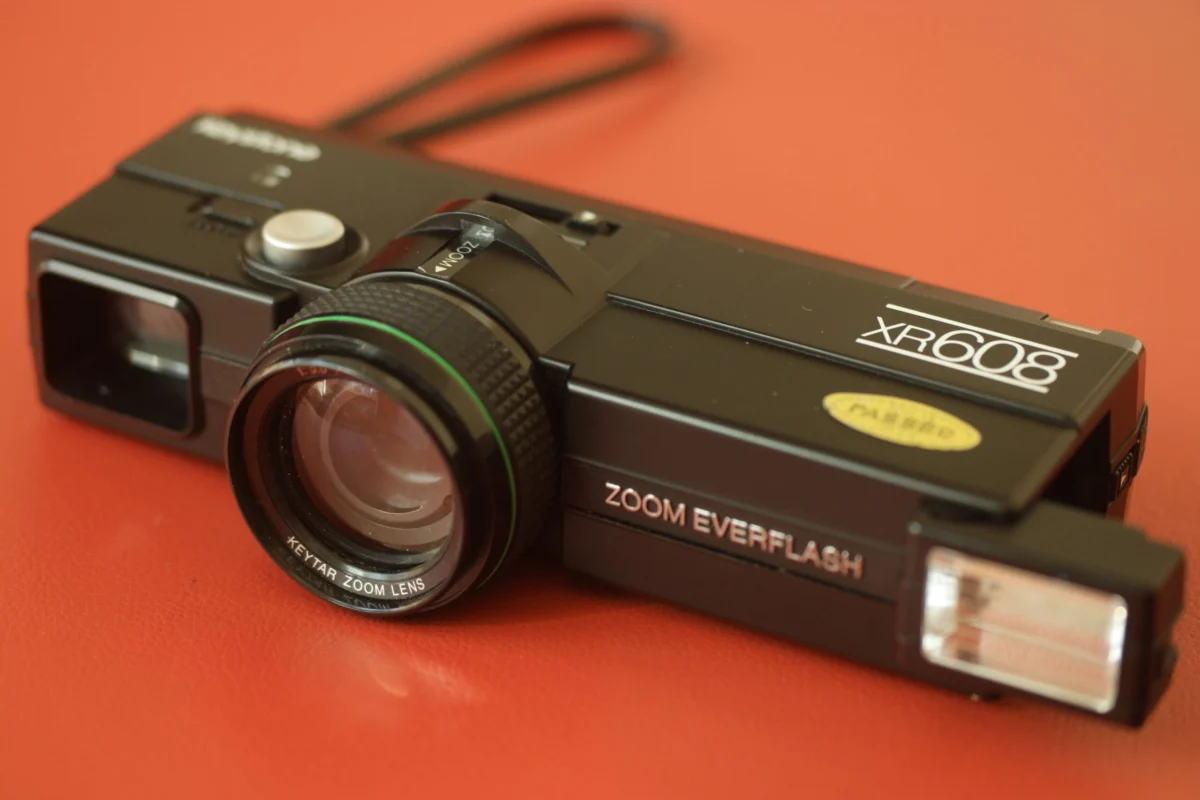
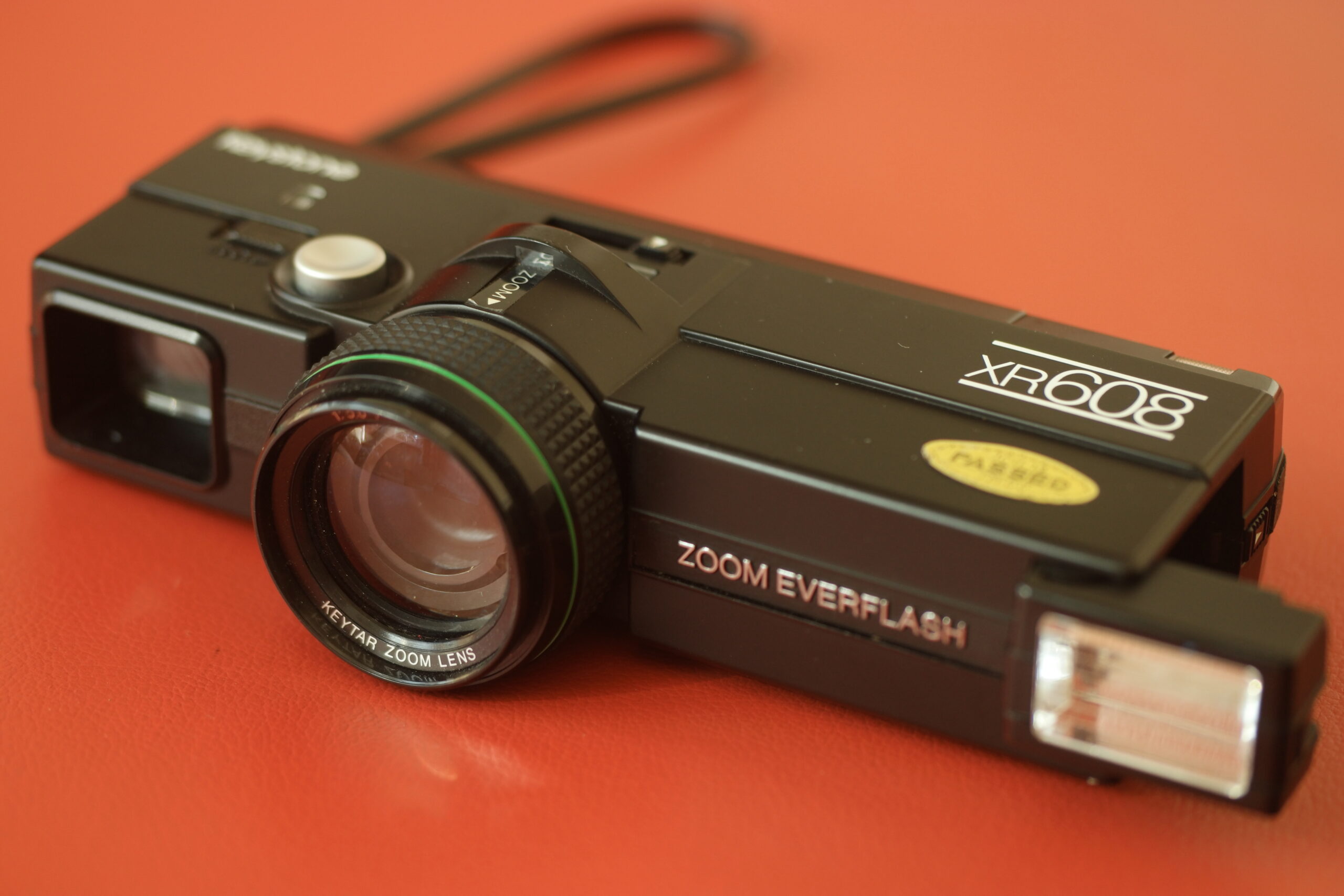
The Keystone Zoom EverFlash XR608 110 camera stands as a significant artifact from the 1980s, a decade that marked both the zenith and the beginning of the decline for the 110 pocket film format. Manufactured in Japan for the American-based Keystone Camera Company, the XR608 was part of a massive wave of "chocolate bar" style cameras that flooded the consumer market. These cameras were characterized by their elongated, slim profiles designed for maximum portability, mirroring the design philosophy of high-end competitors like the Fujica Pocket 330 Zoom. While Keystone was often positioned as a more accessible brand compared to the premium Japanese optics of the era, the XR608 represented an ambitious attempt to provide amateur photographers with advanced features, such as optical zoom and integrated flash technology, within a simplified, user-friendly interface.
The Rise and Fall of the Keystone Camera Company
To understand the XR608, one must look at the trajectory of the Keystone Camera Company. Founded in 1919 in Boston, Massachusetts, Keystone originally established its reputation as a premier manufacturer of movie cameras and projectors. For much of the mid-20th century, it was a dominant force in the American photographic industry, providing affordable yet reliable equipment to the burgeoning middle-class hobbyist market. However, as the industry shifted toward electronic automation and compact film formats in the 1970s and 80s, Keystone faced intense competition from Japanese giants like Canon, Nikon, and Minolta.
The production of the XR608 in Japan highlights a pivotal era of globalization in the photographic trade. By the 1980s, many American firms had outsourced manufacturing to Japanese facilities to leverage superior electronic integration and cost-effective production lines. Despite these efforts to remain competitive, the rapid evolution of 35mm point-and-shoot cameras and the eventual rise of digital technology proved insurmountable for the company. Keystone’s long history ended in the early 1990s when it filed for bankruptcy, marking the end of a seventy-year legacy in American optics.
Technical Specifications of the XR608 EverFlash
The Keystone Zoom EverFlash XR608 was marketed as a "point-and-press" solution for the consumer who desired more versatility than a standard fixed-lens camera. The standout feature of the device is its push-pull zoom mechanism. In the context of the 110 film format, the lens offers a focal range of 25mm to 42mm. When translated to the standard 35mm full-frame equivalent, this provides a range of approximately 50mm to 84mm, moving from a standard perspective to a moderate telephoto ideal for portraiture.
A sophisticated touch for a camera in this class is the dynamic viewfinder. As the user moves the zoom slider, the field of view within the optical finder adjusts accordingly, allowing for accurate framing—a feature often omitted in cheaper 110 models. However, the camera maintains a fixed-focus system across all focal lengths, relying on a relatively narrow aperture of f/5.6 to provide a deep enough depth of field to keep subjects in focus. This reliance on a slow aperture meant the camera was primarily intended for outdoor use or flash photography.
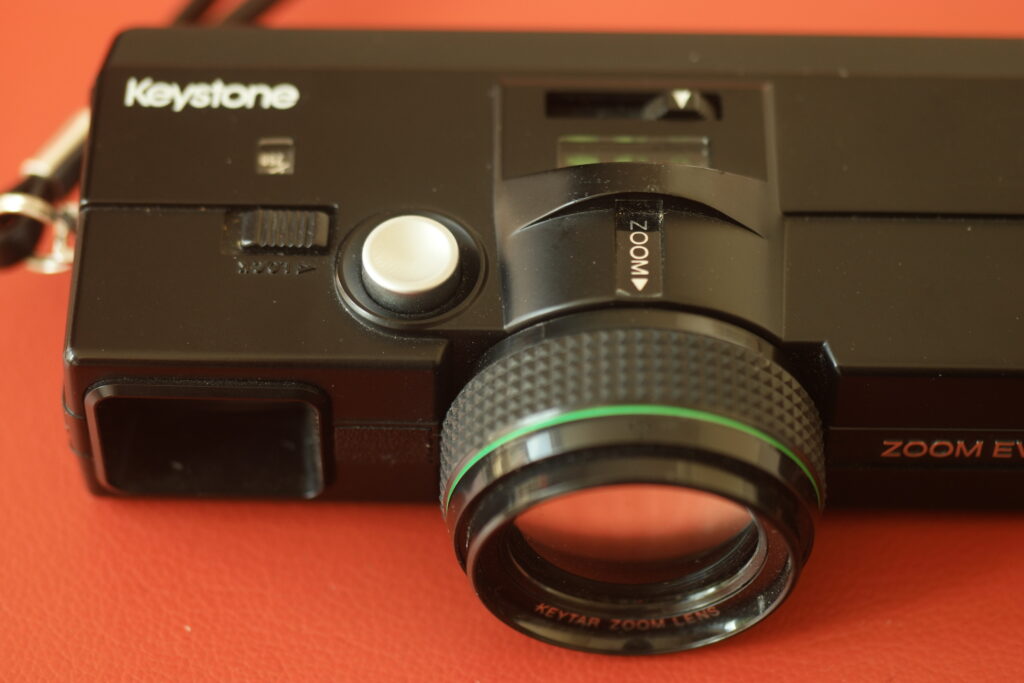
For exposure control, the XR608 utilizes a manual slider rather than an automated light meter. Users could select settings based on environmental conditions: full sun, hazy light, or overcast skies. This mechanical simplicity ensured the camera remained affordable and durable, though it required a basic understanding of lighting from the operator. The film advancement is handled by a ridged thumbwheel located on the bottom of the chassis, a departure from the rapid-advance levers found on more expensive models, reinforcing its identity as a compact, pocket-ready device.
The 110 Format: Context and Convenience
The 110 film format, introduced by Kodak in 1972, was designed to address the primary complaint of amateur photographers: the complexity of loading 35mm film. The 110 cartridge was a "drop-in" system that eliminated the need for threading film leaders or rewinding the roll after the final exposure. This convenience made it the format of choice for casual snapshots, vacations, and family gatherings throughout the 1970s and 80s.
The Keystone XR608 was designed to maximize these advantages. By removing the technical barriers of film handling, Keystone allowed users to focus on the newly added zoom functionality. This was a strategic move to capture the "prosumer" segment of the 110 market—individuals who enjoyed the ease of the format but felt limited by the fixed wide-angle lenses found on basic Kodak Instamatics.

Integrated Flash Technology and Power Management
The "EverFlash" moniker refers to the camera’s built-in electronic flash, which was a major selling point during an era when many pocket cameras still relied on disposable "flip-flash" bars or "magicubes." The flash unit on the XR608 is a pop-out design, emerging from the left side of the body when activated. This design helped reduce the "red-eye" effect by increasing the distance between the flash tube and the lens axis.
The unit is powered by two AAA batteries housed in a slide-out tray. In the modern vintage market, this specific component is often the "Achilles’ heel" of the XR608. Many units found today suffer from terminal corrosion caused by alkaline batteries left inside the device for decades. When functional, however, the integrated flash provided a level of spontaneity that defined the 110 era, allowing for indoor photography without the need for bulky external accessories.
Performance Analysis and Image Characteristics
In contemporary photographic circles, the image quality of the Keystone XR608 is often described as "impressionistic." Due to the very small negative size of 110 film (13mm x 17mm) and the simple plastic or low-element glass lenses used in these cameras, the resulting images lack the surgical sharpness of 35mm or medium format photography.

When tested with modern emulsions, such as Lomography Orca (ISO 100), the XR608 produces images with a distinct aesthetic: soft edges, noticeable grain, and a dreamlike quality. Analysts suggest that the camera performs best under high-contrast lighting or when using faster films, such as ISO 400, to compensate for the slow f/5.6 aperture. The shutter is notably sensitive and quiet; while it includes a locking mechanism to prevent accidental exposures, the "hair-trigger" nature of the release button frequently results in candid, unintentional shots—a phenomenon that enthusiasts of the "lo-fi" photography movement often embrace as part of the camera’s character.
Comparative Market Position
During its production run, the Keystone XR608 occupied a middle-ground market position. It was more advanced than the basic "aim-and-shoot" models from budget brands like Vivitar or Ansco, yet it lacked the optical precision and robust build quality of the Fujica Pocket 330 or the Minolta 110 Zoom SLR. The Fujica series, in particular, is often cited as the gold standard for the "chocolate bar" form factor, offering sharper lenses and more reliable mechanical tolerances.
Nevertheless, the Keystone XR608 was a commercial success because it offered a high "feature-to-price" ratio. For the average American consumer, the ability to zoom in on a subject and have a built-in flash in a pocketable device was more important than professional-grade edge-to-edge sharpness.

The Modern Revival of 110 Photography
The legacy of the Keystone XR608 has seen a surprising resurgence in the 21st century. While 110 film was largely considered a dead format by the mid-2000s, companies like Lomography have revitalized the medium by producing new film stocks, including black and white, color negative, and even "fals-color" infrared-style emulsions.
Specialized laboratories, such as Photo Hippo Lab in the United Kingdom, continue to provide high-quality development and scanning services for these miniature negatives. This infrastructure allows a new generation of "analog" enthusiasts to experiment with vintage hardware like the XR608. For these photographers, the camera is not a tool for precision, but a medium for artistic expression, offering a nostalgic look that digital filters struggle to replicate authentically.
Conclusion and Historical Significance
The Keystone Zoom EverFlash XR608 serves as a window into a specific moment in photographic history when convenience and miniaturization were the primary drivers of innovation. While the Keystone Camera Company ultimately succumbed to the pressures of a rapidly changing market, products like the XR608 demonstrate the brand’s commitment to bringing advanced photographic concepts to the general public.

Today, the XR608 is valued by collectors and lomo-photographers for its unique form factor and its "imperfect" aesthetic. It stands as a testament to the era of the 110 format—a time when photography became truly portable, and the "ever-flashing" promise of the 1980s captured the everyday lives of millions. Whether viewed as a budget alternative to Japanese optics or a charming relic of a bygone era, the XR608 remains a functional piece of history for those willing to embrace the quirks of small-format film.