The transition from a sustained period of frigid temperatures to a mild winter afternoon in New York City often serves as a catalyst for increased public activity in the city’s historic communal spaces. On Friday, February 13, following a multi-week cold snap that had constrained outdoor movement, Washington Square Park emerged as a primary hub for social reintegration. This date, coinciding with the eve of Valentine’s Day, saw a notable influx of residents and visitors drawn to the park’s unique atmosphere, which observers describe as a blend of traditional Bohemianism and modern communal engagement. Unlike other high-traffic New York landmarks that have increasingly transitioned into static backdrops for digital social media consumption, Washington Square Park continues to function as a dynamic "Third Place," where interpersonal connection and spontaneous collaboration remain the primary modes of interaction.
Historical and Social Context of Washington Square Park
Washington Square Park, located in the heart of Greenwich Village, has maintained a reputation for over a century as a sanctuary for non-conformists, artists, and activists. Established as a public park in 1827, the site has evolved from a parade ground and potter’s field into a symbol of New York’s intellectual and artistic life. Historically, the park was the epicenter of the Beat Generation in the 1950s and the folk music revival of the 1960s. This legacy of "Bohemian" quality continues to influence its current demographic, which consists of a diverse mix of international tourists, New York University students, and long-term local "regulars."
In the contemporary urban landscape, the park stands in stark contrast to locations such as Times Square, Rockefeller Center, or the DUMBO waterfront in Brooklyn. Urban sociologists note that while these latter locations are often characterized by "transient consumption"—where individuals arrive, capture digital assets for social media platforms, and depart without meaningful interaction—Washington Square Park fosters a culture of "presence." In this environment, the act of "hanging out" is a primary activity rather than a secondary one. This distinction is vital for understanding the social fabric of the city, as it provides a space where the barriers to entry for conversation and communal participation are significantly lower than in commercialized tourist zones.
The Evolution of Street Photography: From Candid to Engagement
The practice of documenting life within Washington Square Park has a long lineage, featuring work by renowned photographers such as Diane Arbus and André Kertész. Traditionally, street photography has relied on the "candid" approach—capturing subjects without their knowledge to preserve an unfiltered reality. However, a contemporary shift toward "engagement street portraiture" has begun to take root among modern practitioners. This methodology involves a proactive approach where the photographer initiates a dialogue with the subject, transforming the act of image-making from a solitary observation into a collaborative event.
This style of engagement is particularly effective in the social ecosystem of Washington Square Park. By approaching subjects in a friendly manner and engaging in several minutes of conversation before the shutter is released, photographers are able to capture a more nuanced version of the individual. This collaborative process often allows the subject to influence their own representation, choosing their pose or suggesting props, which results in a portrait that reflects both the photographer’s vision and the subject’s self-identity.
Case Study: The Collaborative Portrait of Ian
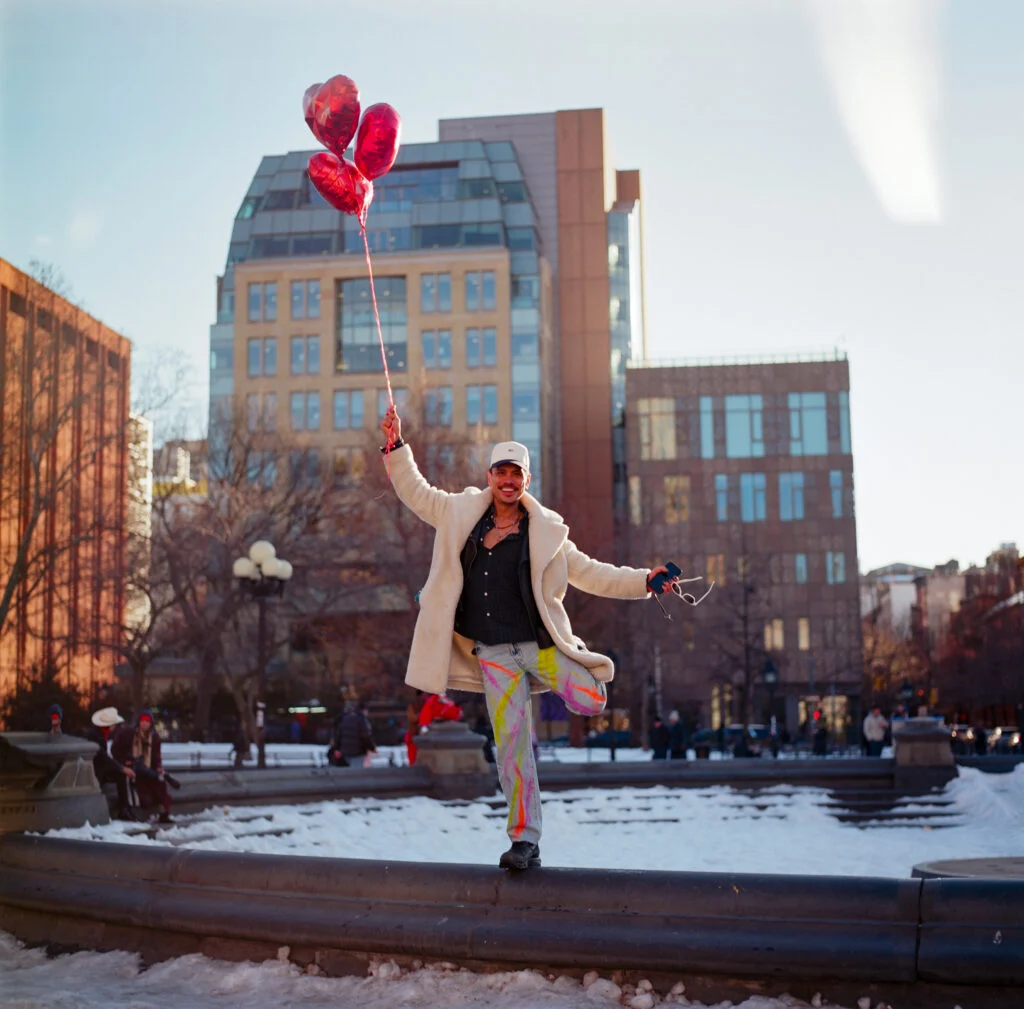
A notable instance of this collaborative dynamic occurred on the afternoon of February 13, involving a park regular identified as Ian. The encounter serves as a primary example of how the park’s environment encourages high-energy, spontaneous artistic production. When approached for a portrait, Ian did not merely consent to be photographed; he assumed the role of a creative director, asserting specific requirements for the composition and narrative of the image.
The production of the portrait involved several logistical and creative steps:
- Selection of Setting: Ian identified the rim of the park’s central fountain as the primary stage for the photograph, seeking an elevated position that would command the viewer’s attention.
- Acquisition of Props: Demonstrating the interconnectedness of the park’s denizens, Ian approached a nearby individual dressed in a "Clifford the Big Red Dog" plushie costume to borrow a cluster of bright red foil Mylar balloons.
- Physical Composition: Ian executed a complex pose, standing on one leg atop the fountain rim, holding the balloons aloft. This gesture was intended to evoke the spirit of Valentine’s Day and the general sense of levity present in the park that afternoon.
The technical execution of the shot required the photographer to adapt to Ian’s rapid movements and the specific lighting conditions of the late afternoon sun. Initial framing proved difficult; the photographer was positioned approximately 20 feet too close to capture the full verticality of the pose and the balloons. After a brief pause to reposition, the photographer moved back to secure a head-to-toe frame. To manage the lighting, the photographer navigated the challenge of "backlighting," aiming to create a visual "pop" or silhouette effect without causing lens flare or overexposing the film.
Technical Specifications and the Role of Analog Media
The choice of equipment for such street portraits is significant. In this instance, the photographer utilized a Hasselblad 503CW, a medium-format film camera known for its exceptional image quality and Zeiss optics—specifically the Zeiss Planar 80mm f/2.8 lens. The use of analog film, in this case, Kodak Ektar, provides a specific color rendition and grain structure that digital sensors struggle to replicate. Ektar is particularly valued for its high saturation and ultra-fine grain, making it an ideal choice for vibrant, daylight scenes featuring bold colors like the red of the Valentine’s balloons.
The reliance on film photography in a public space like Washington Square Park also changes the pace of the interaction. Unlike digital photography, where results are instantaneous, the "delayed gratification" of film requires the photographer to be more deliberate with each frame. This intentionality often resonates with subjects who appreciate the craftsmanship involved in the process.
Broader Implications for Urban Vitality and Mental Health
The social dynamics observed on February 13 highlight the importance of public parks in maintaining the psychological well-being of a city’s population. The "infectious joy" noted in the interaction between the photographer and Ian is more than a personal anecdote; it is a reflection of the "thaw" effect—both literal and metaphorical. After weeks of social isolation caused by extreme weather, the ability to congregate in a space that encourages "b.s.-ing," joking, and communal art serves as a vital release valve for urban stress.
Furthermore, the willingness of individuals like Ian to participate in such elaborate public displays suggests a high level of "social trust" within the park. This trust is a key indicator of a healthy urban environment. When people feel comfortable enough to engage with strangers and collaborate on creative projects, it strengthens the social fabric of the neighborhood.
Analysis of Visual Data and Outcomes
Upon processing the film at a professional laboratory, the resulting images confirmed the success of the collaborative approach. The most effective frame was the first staged shot, which Ian had directed. Analysis of the image reveals several key elements that contribute to its impact:
- Gestural Communication: The way the subject holds his sunglasses and the specific angle of his smile convey a sense of genuine enthusiasm that is difficult to manufacture in a purely candid or strictly directed setting.
- Symbolism: The red balloons and the proximity to the "Clifford" costume (visible in the periphery) anchor the image in a specific time and place, capturing the cultural zeitgeist of New York City on the brink of a holiday.
- Compositional Balance: The use of the fountain as a pedestal provides a geometric stability to the image, contrasting with the fluid, organic movement of the subject and the balloons.
Conclusion
The events of February 13 in Washington Square Park underscore the enduring relevance of public spaces that prioritize human interaction over digital consumption. Through the lens of street photography, we see a microcosm of New York City’s resilience and its capacity for spontaneous joy. The collaboration between the photographer and the subject, Ian, serves as a testament to the power of the "engagement" model of street portraiture, which treats the subject not as a passive object to be captured, but as an active participant in the chronicling of urban life. As the city continues to evolve, the preservation of "old-fashioned" social hubs like Washington Square Park remains essential for the continued vitality of its cultural and social landscape.