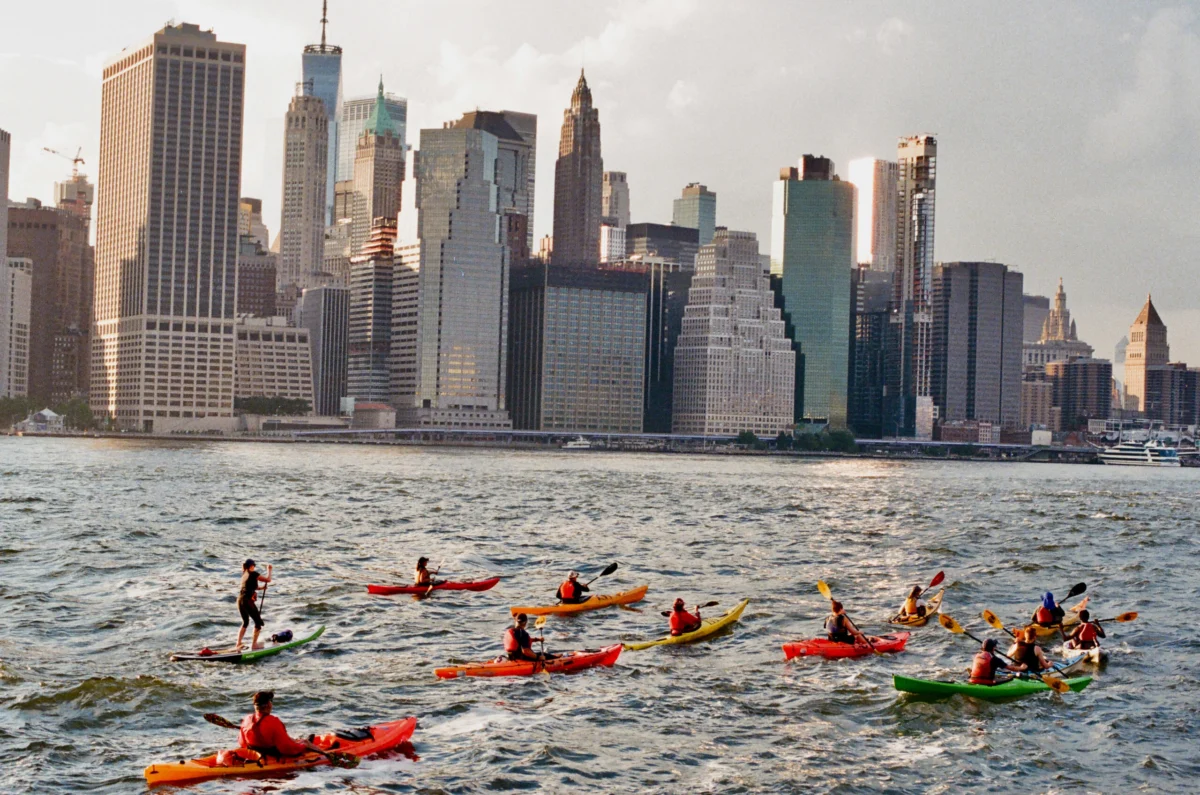
The resurgence of analog photography and the continued revitalization of New York City’s maritime corridors converged in late August 2026 as a documented excursion along the East River highlighted the enduring relevance of vintage 35mm equipment in modern street and landscape documentation. Photographer David Pauley, a noted practitioner of traditional film techniques, captured a group of sea kayakers navigating the challenging currents of the East River against the backdrop of the lower Manhattan skyline. The event, documented on a Nikon FE coupled with a Nikkor 50mm f/1.4 lens, serves as a case study for the current market value of vintage optics, the technical nuances of aperture-priority systems, and the shifting preferences within the film photography community toward color-negative workflows.
Technical Specifications and Market Context of the Nikon FE
The primary instrument used in the documentation of the East River kayakers was the Nikon FE, a semi-professional 35mm film SLR produced by Nikon in Japan between 1978 and 1983. In the context of 2026, the Nikon FE remains a cornerstone of the "analog revival," prized for its robust construction and its electronic focal-plane shutter capable of speeds from 8 seconds to 1/1000 of a second.
Market data from 2026 indicates that a Nikon FE in "excellent" condition, paired with a fast prime lens such as the Nikkor 50mm f/1.4, carries a secondary market valuation of approximately $240. This pricing reflects a stabilized demand for the "Compact F-series" cameras, which also includes the mechanical FM and the later FE2 and FM2 models. The specific lens utilized, the 50mm f/1.4, is celebrated for its seven-element design and its ability to provide a shallow depth of field, which is critical for separating subjects from complex urban backgrounds like the Manhattan skyline.
Furthermore, the documentation notes the potential utility of the Nikkor H 85mm f/1.8 telephoto lens, which currently commands a market price of roughly $145. The choice between a 50mm "normal" lens and an 85mm "short telephoto" lens represents a classic dilemma in maritime photography; while the 85mm offers better compression and subject isolation for distant vessels, the 50mm provides the necessary field of view to capture the environmental context of the East River’s industrial and residential architecture.
Chronology of the East River Excursion
The capture of the "Kayaks on the East River" image followed a specific timeline that mirrors the workflow of many contemporary film enthusiasts.
- August 2026 (The Capture): During a sunset walk along the East River waterfront, Pauley observed a colorful line of sea kayakers. The group was moving upstream, a maneuver that requires significant physical effort given the East River’s status as a tidal strait with currents that can reach up to 5 knots.
- Equipment Selection: The Nikon FE was loaded with Fujicolor 400, a versatile color-negative film. Notably, the film was "rated at 200," a common technique among film photographers where the camera’s ISO is set to half the film’s box speed. This overexposure of one stop serves to provide more detail in the shadows and increase color saturation, which is particularly effective during the "golden hour" of sunset.
- Late August to Mid-September 2026 (Processing): The exposed roll was delivered to Photo Life, a professional laboratory located in Brooklyn. The facility provided development and high-resolution scanning services, reflecting a broader trend where photographers outsource the chemical and digital conversion stages to maintain high quality while focusing on the act of capture.
- September 21, 2026 (Publication): The resulting imagery and technical analysis were released to the public, sparking discussions on the merits of "simple" photography versus more labor-intensive formats.
Supporting Data: The State of Analog Photography in 2026
The use of Fujicolor 400 in this instance highlights the current state of the film manufacturing industry. As of 2026, color-negative film remains a high-demand commodity. While digital sensors have surpassed film in terms of pure resolution and low-light sensitivity, the "aesthetic signature" of film—characterized by its grain structure and highlight roll-off—continues to drive a niche but profitable market.
Industry reports suggest that the cost of professional lab services in metropolitan areas like Brooklyn has seen a 12% increase over the last two years, driven by the rising costs of photofinishing chemicals and the specialized labor required to maintain aging C-41 processing machines. Despite these costs, the "simplicity" of the 35mm workflow remains a significant draw for photographers who otherwise spend their time in the high-stakes environment of large-format black and white photography.
In the case of the East River shoot, the Nikon FE’s aperture-priority autoexposure mode was cited as a critical factor in the success of the images. This system allows the photographer to set the desired f-stop while the camera automatically selects the corresponding shutter speed. In a rapidly changing environment like a waterfront at sunset, this automation ensures accurate exposure without the need for constant manual adjustments, allowing the photographer to focus on the composition of the kayakers as they moved through the frame.
Environmental Context: The East River as a Recreational Hub
The subject matter of the photograph—sea kayakers on the East River—points to the successful environmental reclamation of New York City’s waterways. Historically, the East River was an industrial artery, often considered too dangerous for human-powered craft due to heavy commercial traffic and pollution.
However, by 2026, organizations such as the Brooklyn Bridge Park Boathouse and the Manhattan Community Boathouse have normalized recreational use of the strait. The presence of kayakers beating their way "back upstream" toward New York Harbor is a testament to the increased accessibility of the waterfront. The "towers of lower Manhattan" mentioned in the report serve as a geographic marker for the Financial District, one of the most photographed skylines in the world. The juxtaposition of the small, colorful kayaks against the massive glass and steel structures provides a narrative of human-scale interaction within a hyper-urbanized environment.
Analysis of Implications: The Shift Toward "The Simple and The Pretty"
The documentation of the East River kayakers reflects a psychological shift within the photography community. For much of 2026, the trend among serious hobbyists and professionals has leaned toward "effortful" photography—specifically medium and large format black and white work that requires extensive darkroom labor.
The East River session, however, advocates for a more balanced approach. The professional analysis of this event suggests several key takeaways for the industry:
- Diversification of Media: Photographers are increasingly encouraged to move between monochrome and color film to avoid creative stagnation.
- Outsourced Workflow: There is a growing acceptance of using professional labs (like Photo Life) for development and scanning, rather than insisting on home-processing for every frame. This allows for a more prolific output and supports the local small-business ecosystem.
- The Value of Vintage Glass: The performance of the 50mm f/1.4 Nikkor lens in this scenario reaffirms that vintage optics from the 1970s and 80s are more than capable of meeting the demands of modern high-resolution scanning.
Conclusion and Future Outlook
The capture of "Kayaks on the East River, August 2026" is more than a singular aesthetic achievement; it is a data point in the ongoing narrative of how 20th-century technology is used to document 21st-century urban life. The Nikon FE, despite being nearly 50 years old, remains a viable and efficient tool for capturing high-speed action in complex lighting conditions.
As the summer season of 2026 concludes, the photography community anticipates a continued interest in these "classic" setups. The ease of use provided by aperture-priority systems, combined with the distinctive look of overexposed Fujicolor 400, provides a template for both amateur and professional photographers looking to document the changing face of urban recreation. Future reviews of the Nikon FE and its compatibility with a growing set of vintage lenses are expected to further solidify the camera’s place in the regular rotation of modern street photographers.
The East River waterfront remains a vital laboratory for this intersection of technology, art, and environment, offering a constant stream of subjects for those willing to carry a camera and a few rolls of film on an evening walk.