The intersection of classical architecture and modern optical technology has facilitated a resurgence in the "layered city" style of street photography, a trend exemplified by recent work from the Czech capital. During a five-day photographic expedition in Prague this past September, photographer Cosme Lapena utilized the high-resolution capabilities of the Leica Q3 to document the complex visual narratives found within the city’s historic arcades. The resulting imagery, centered on the National Theatre (Národní divadlo), highlights a sophisticated use of double-glazed reflections to create "in-camera" compositions that bypass traditional digital manipulation. This approach underscores a growing movement among contemporary street photographers to find complexity in the mundane physics of glass and light, rather than through post-processing.
The Architectural Canvas of the National Theatre
The National Theatre in Prague serves as more than a cultural landmark; it is an optical environment characterized by its Neo-Renaissance architecture and specific lighting conditions. Located on the banks of the Vltava River, the theatre’s arcade creates a dramatic drop in ambient light, a phenomenon that often causes pedestrians to bypass the entrance in favor of better-lit thoroughfares. However, for street photographers, this high-contrast environment provides the necessary conditions for "chiaroscuro" effects and isolated reflections.
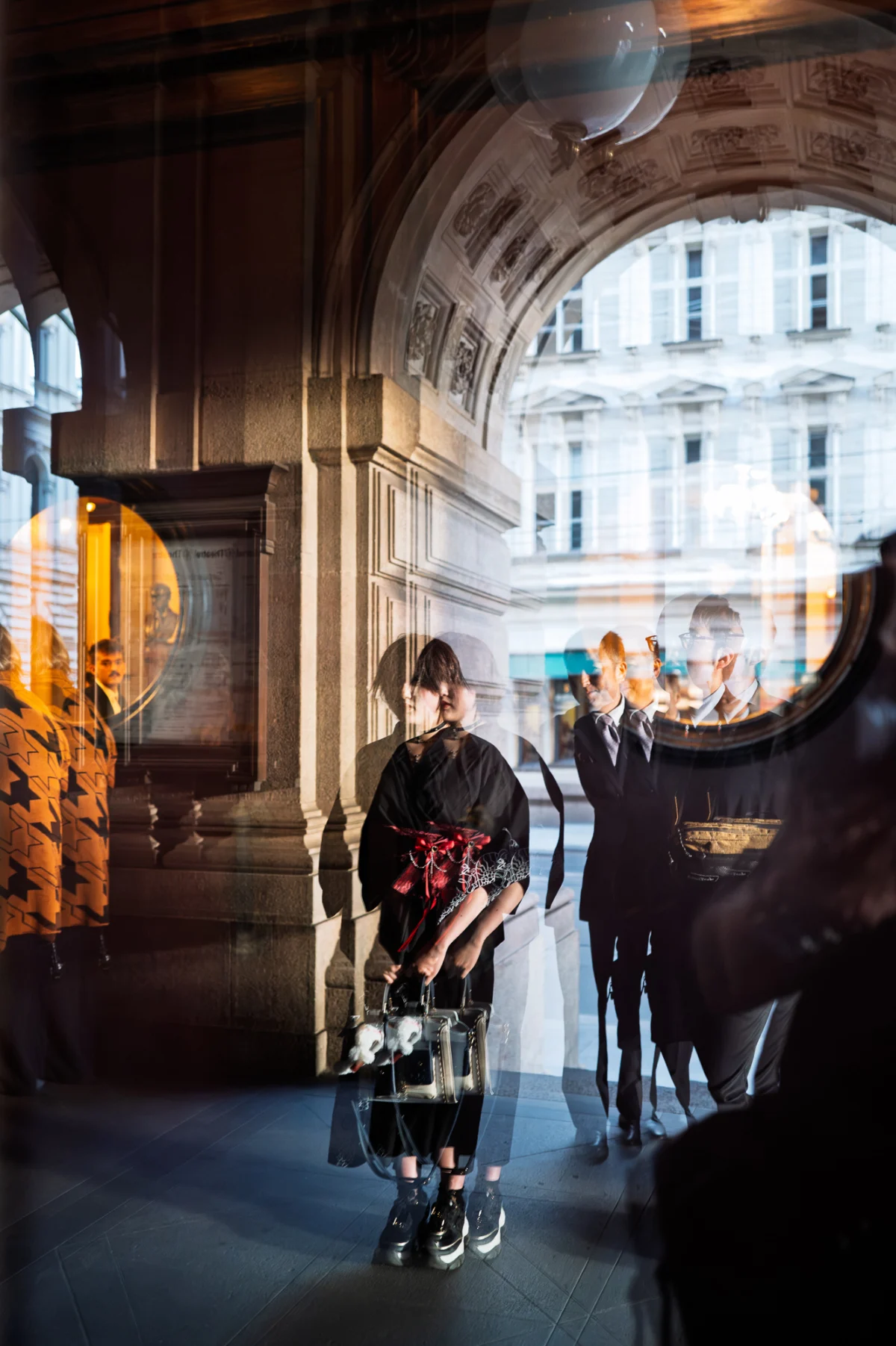
The wooden doors of the theatre, featuring inset glass panels, are a focal point for Lapena’s study. The presence of double glazing in these historic doors introduces a unique optical artifact: the "double reflection." Because the glass consists of two layers separated by a small gap, light reflecting off both surfaces returns to the lens slightly out of register. This creates a ghosting effect where stone arches, coffered vaults, and the white façades of the buildings across the street are stacked atop one another. In the context of street photography, this mimics the aesthetic of multiple exposures or complex printmaking techniques, despite being a single-frame capture of a natural occurrence.
Chronology of the Photographic Encounter
The specific event that has drawn attention from the photography community occurred during the mid-afternoon hours in late September. Lapena’s five-day itinerary was dedicated to exploring "reflections in glass and water," a thematic pursuit that culminated in the arcade of the National Theatre.
At approximately 15:00 CET, Lapena positioned himself in front of the theatre’s glass-paneled doors. For several minutes, the photographer remained stationary, observing the shifting layers of the street scene as they appeared in the glass. The objective was not to capture the doors themselves, but to use them as a translucent mirror for the activity occurring behind him.
The critical moment occurred within a fifteen-second window. A subject—a young woman dressed in a black, kimono-style outfit with a distinctive red bow and white charms—entered the frame from the street side. Accompanied by two older men, she moved toward the entrance. Rather than turning to face the subject directly, which would have alerted her to the presence of the camera and potentially altered her natural behavior, Lapena maintained his focus on the reflection.
Using the camera’s autofocus system to lock onto the reflected figure, Lapena captured two frames. The first frame caught the subject in a moment of stillness, framed by the drifting, doubled architectural elements of the theatre. The second frame captured her in profile as she moved out of the reflection’s range. The entire encounter concluded as the group entered another door, leaving the photographer with a candid record of a person he never viewed directly.
Technical Analysis and Data Specifications
The execution of this photograph required a specific technical configuration to compensate for the low-light conditions of the arcade while maintaining a sharp focus on a reflected subject. The use of the Leica Q3, a fixed-lens full-frame camera, was central to the outcome.
The metadata for the primary image reveals several key technical decisions:
- Focal Length: 28mm. The wide-angle perspective allowed for the inclusion of both the subject and the surrounding architectural "layers," providing context to the reflection.
- Aperture: f/1.7. Shooting "wide open" was a necessity due to the sharp drop in light under the stone vaulting. This also provided a shallow depth of field, which helped isolate the subject within the glass layers.
- Shutter Speed: 1/250s. This speed was sufficient to freeze the motion of the walking subject and prevent handshake blur, even in a handheld configuration.
- ISO Sensitivity: 4000. To maintain the necessary shutter speed at f/1.7, the sensor’s sensitivity was pushed significantly. Modern BSI (Back-Side Illuminated) sensors, such as the 60-megapixel sensor in the Q3, are designed to handle high ISO levels with minimal noise, a factor that was critical in the "swallowing" light of the National Theatre’s arcade.
This technical data illustrates the challenges of modern street photography in historic urban environments, where the interplay of light and shadow often demands equipment capable of high-performance output in sub-optimal conditions.
Perspectives on the "Layered City" Methodology
The methodology employed by Lapena—focusing on reflections rather than direct subjects—is a recognized technique in the lineage of street photography, popularized by figures such as Saul Leiter and Vivian Maier. By utilizing glass as a medium, photographers are able to compress two distinct planes of reality into a single two-dimensional image.
In professional circles, this is often referred to as "the layered city" approach. Analysts suggest that this style reflects a modern urban experience characterized by transparency, surveillance, and the blurring of public and private spaces. The use of the Leica Q3 in this context is also a point of discussion. As a high-end tool often associated with "slow photography," its use in a fast-paced, high-ISO environment demonstrates the versatility required of today’s street documentarians.
While the photographer’s personal blog, bclphoto.com, provides a more narrative account of the trip, the broader implications for the photography industry are found in the technical success of the images. The ability to capture "doubled and drifting" reflections with such clarity at ISO 4000 suggests that the hardware limitations that once hindered street photographers in dark European arcades have largely been mitigated.
Broader Impact and Implications for Urban Documentation
The work produced in Prague highlights several emerging trends in urban documentation. First, there is a shift away from the "perfectly timed" single-subject shot toward more atmospheric, complex compositions. The "layered" approach allows the city itself—its glass, stone, and weather—to become a co-author of the photograph.
Furthermore, the incident at the National Theatre raises questions regarding the "observer effect" in street photography. By choosing to photograph a reflection rather than the person, the photographer minimizes his impact on the scene. This "non-turning" technique preserves the authenticity of the subject’s movement, a priority for those seeking to document the genuine rhythm of city life.
From a sociological perspective, the presence of traditional cultural attire—the kimono-style outfit—within the Neo-Renaissance setting of Prague speaks to the increasingly globalized nature of urban centers. The charms and red bow mentioned in the report act as visual punctuation marks in a scene dominated by the heavy, grey stone of the Czech capital.
Conclusion: The Persistence of the Decisive Moment
The five days spent in Prague by Cosme Lapena serve as a case study in the persistence of Henri Cartier-Bresson’s "decisive moment," updated for the 21st century. While the technology has evolved from film to high-resolution digital sensors, the core requirement remains the same: the photographer’s decision of "where to stand."
The National Theatre reflection stands as a testament to the fact that even in highly photographed cities like Prague, new perspectives are available to those who focus on the physics of the environment. The "layered city" is not a digital construct but a physical reality created by the interaction of light and glass. As street photography continues to evolve, the emphasis on capturing these complex, naturally occurring layers is likely to grow, providing a more nuanced view of the modern urban landscape.
For researchers and photography enthusiasts interested in the technicalities of reflection-based street photography, the data from this September excursion provides a clear benchmark for the capabilities of modern mirrorless systems in challenging light. The resulting images offer a silent narrative of a city that is simultaneously ancient and modern, clear and doubled, seen yet unseen.