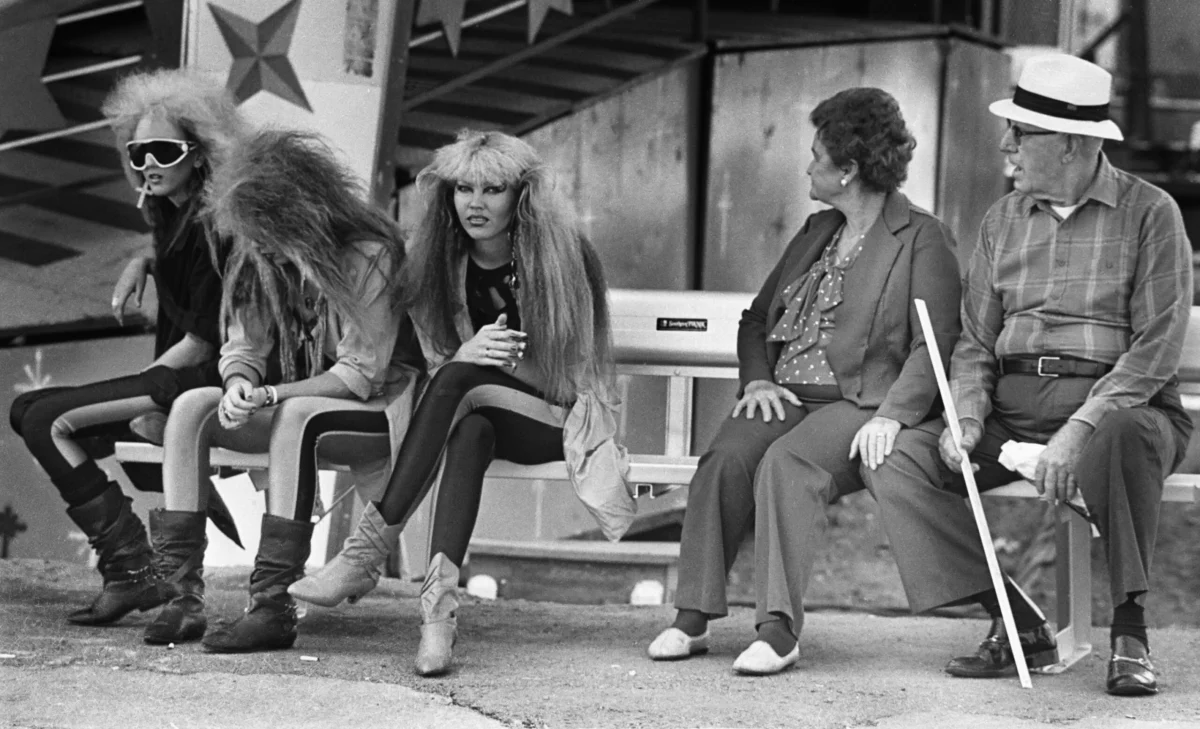
In November 1985, during the height of the glam metal era and a period of significant cultural transition in the United States, photographer Art Meripol captured a singular image that has since become a study in the sociological "generation gap." The photograph, taken at a regional state fair, juxtaposes two distinct American subcultures: the burgeoning youth movement centered around the heavy metal band RATT and the traditional agricultural community represented by prize-winning livestock exhibitors. This specific encounter, documented through a "stealth" photography technique, highlights a long-standing debate within the discipline of street photography regarding the ethics of candid versus posed portraiture and the role of the camera as a silent observer of social friction.
The November 1985 State Fair Incident
The scene unfolded outside a coliseum at a state fair, a venue that traditionally served as a crossroads for rural and urban populations. On this particular day, the venue was prepared to host the band RATT, which was then touring in support of their multi-platinum album, Invasion of Your Privacy. The fans, characterized by their spandex attire, teased hair, and rebellious aesthetic, stood in sharp contrast to the fair’s primary daytime demographic: agricultural workers and families involved in livestock competitions.
Meripol, a professional photographer on assignment to capture feature shots of the fair, observed a specific group waiting for the concert doors to open. Seated adjacent to the RATT fans were an older couple who had spent the day showing prize pigs. The visual dissonance between the two groups—the "too cool" indifference of the youth and the visible apprehension of the older couple—provided a microcosm of the 1980s cultural divide. Recognizing the volatility of the moment, Meripol opted for a candid approach, fearing that direct engagement or eye contact would cause the subjects to self-modify their behavior, thereby destroying the authenticity of the scene.
Technical Methodology: The Ethics of Stealth Photography
The technique employed by Meripol involves what is often referred to in the industry as "shooting from the hip" or the "distraction method." To capture the image without alerting the subjects, the photographer positioned himself 90 degrees away from the group, kneeling on one knee and pretending to service his equipment. By feigning a film change, a common necessity in the pre-digital era of 35mm photography, he was able to pre-focus his lens on the estimated distance of the subjects.
This method falls under the "stealth" category of street photography, a tradition championed by figures such as Henri Cartier-Bresson, who sought the "decisive moment" through invisibility. The opposing school of thought, which Meripol notes he frequently employs in his contemporary work, involves seeking permission and engaging in a collaborative portrait process. The "permission" approach often results in a more environmental portrait that explores the subject’s story through dialogue, whereas the "stealth" approach captures raw, unmediated social interactions. In the context of the 1985 photograph, the stealth method was deemed necessary to preserve the genuine reaction of the older man—whose jaw was reportedly hanging open in disbelief—and his wife, whose hand was placed on his knee in a gesture of reassurance.
Cultural Backdrop: Glam Metal and the Reagan Era
To understand the weight of the photograph, one must examine the cultural climate of 1985. The band RATT was a central figure in the "Hair Metal" or "Glam Metal" movement that dominated MTV and the Billboard charts. Their 1984 debut, Out of the Cellar, had sold over three million copies, and their follow-up work continued to push a visual identity defined by excess, leather, and gender-blurring fashion.
This movement was frequently at odds with the conservative values of the mid-1980s, particularly in rural or traditional settings. The "Parental Advisory" labels, spearheaded by the Parents Music Resource Center (PMRC) led by Tipper Gore, were introduced in 1985, the same year this photograph was taken. The tension captured in the frame is not merely between four individuals, but between two competing versions of American identity: the stoic, traditionalist values of the agricultural Midwest and South, and the loud, neon-colored rebellion of the MTV generation.
Historical Timeline: Evolution of the Street Photography Debate
The debate over how a photographer should interact with their subject has evolved significantly over the last four decades.
- The 1950s-1970s (The Golden Age of Candidness): Photographers like Robert Frank and Garry Winogrand popularized the idea of the "fly on the wall." The camera was a tool for social critique, often used without the subject’s knowledge to document the "true" American experience.
- The 1980s (Transition and Subculture): As subcultures became more visually distinct (punks, goths, metalheads), photographers like Meripol began documenting the "clash of cultures." The stealth technique remained a primary tool for capturing these collisions.
- The 1990s-2000s (Digital Revolution and Privacy): The advent of digital cameras and eventually smartphones increased the volume of street photography but also heightened public awareness of being photographed. This led to increased legal and ethical scrutiny regarding "candid" shots in public spaces.
- The 2010s-Present (The Collaborative Shift): Modern street photography has seen a trend toward the "humanist" approach, where photographers like Brandon Stanton (Humans of New York) prioritize the narrative and permission over the "stealth" shot. Meripol himself notes that his current preference has shifted toward this interactive style.
Data and Sociological Implications of the "Generation Gap"
The "generation gap" is a term that gained prominence in the 1960s but saw a unique resurgence in the 1980s due to rapid technological and media shifts. According to sociological data from the mid-80s, the divide was exacerbated by the divergent ways generations consumed information. While the older generation in 1985 (the "Silent Generation" and older "Baby Boomers") relied on traditional newspapers and local community structures, the youth were the first to be fully immersed in a globalized, image-driven media culture via cable television.
The reaction of the older couple in Meripol’s photograph—characterized by physical contact and visible shock—aligns with psychological studies of "cultural shock" within one’s own environment. For the prize-pig exhibitors, the state fair was a place of order, tradition, and reward for hard work. The presence of RATT fans represented a disruption of that order. Conversely, the fans’ refusal to acknowledge the older couple suggests a "subcultural insulation," where the youth movement’s internal social hierarchy renders the "outside" world irrelevant.
Broader Impact and Implications for Modern Archiving
The preservation of such images serves as a vital record for social historians. While the "stealth" vs. "permission" debate continues, the utility of the candid shot in documenting historical friction is undeniable. A posed portrait of the RATT fans and the pig farmers would likely have resulted in a "polite" image where both parties suppressed their natural reactions to accommodate the photographer. By remaining hidden, Meripol captured a factual record of how these two groups actually perceived one another in 1985.
In a modern context, where privacy laws in various jurisdictions (such as the GDPR in Europe) have placed restrictions on candid photography, the 1985 photograph serves as a reminder of what is lost when the "stealth" option is removed. The image provides a window into a specific moment of American history that cannot be replicated: the exact point where the loud, aggressive culture of the 80s met the quiet, steady traditions of the past.
The photograph remains a testament to the importance of the photographer’s role as a silent witness. As Art Meripol transitioned throughout his career from the stealthy observer of a RATT concert crowd to a photographer who seeks the "story" through permission, his body of work reflects the broader evolution of the medium. However, it is the candid moments—the "wild animals" of photography that require a lack of eye contact—that often provide the most honest reflection of a society’s internal divisions.
Ultimately, the 1985 state fair photograph is more than a nostalgic look at 80s fashion; it is a document of a changing world. It captures the exact second when the spandex-clad future ignored the pig-farming past, and the past looked on with a mixture of confusion and concern, held together only by a hand on a knee and the shared space of a coliseum waiting line. This visual evidence of the generation gap continues to resonate as new subcultures emerge and the cycle of cultural friction repeats in the modern era.