The solar eclipse of August 12, 2026, marked a significant moment in astronomical and social history for the United Kingdom, particularly within the urban landscape of London. At approximately 7:00 p.m. BST, as the sun descended toward the horizon, the routine operations of the city’s transport network underwent a spontaneous transformation. At Finchley Central Station in North London, a location typically defined by the rapid transit of commuters, the pedestrian bridge became an impromptu observatory. This phenomenon, characterized by a sudden cessation of movement among the public, provided a unique case study in how modern metropolitan populations interact with rare celestial events amidst challenging environmental conditions.
Astronomical Context and Timeline of the Event
The solar eclipse of August 12, 2026, was the first total solar eclipse visible from continental Europe since 1999. While the path of totality crossed through Greenland, Iceland, and northern Spain, London experienced a deep partial eclipse with a magnitude of approximately 0.92. This meant that at its peak, over 90% of the sun’s surface was obscured by the moon.
The chronology of the event in the London area was precisely timed by the Royal Observatory Greenwich. The partial eclipse began at approximately 6:15 p.m. BST, reaching its maximum obscuration at 7:12 p.m. BST. Because the event occurred so close to sunset, the sun was positioned low in the sky, at an altitude of roughly 10 to 12 degrees. This low angle made the event highly visible to pedestrians in open areas and on elevated structures, such as the station bridge at Finchley Central, but also increased the atmospheric distortion and the "golden hour" effect on the light quality.
By 7:00 p.m., the light levels in London had begun to deviate significantly from standard evening luminosity. Witnesses reported a "silvery" or "metallic" quality to the light, a common occurrence when a high percentage of the sun is covered but the sky remains clear. The event concluded shortly before sunset, leaving a lasting impression on those who had gathered to witness the transition.
Meteorological Conditions: The 2026 Summer Heatwave
The astronomical event took place against a backdrop of extreme weather conditions that had persisted throughout the summer of 2026. The Met Office had issued several Amber Weather Alerts leading up to August 12, citing a prolonged period of high temperatures and a lack of significant precipitation. London, in particular, was experiencing a severe heatwave, with temperatures on the day of the eclipse hovering around 31°C (87.8°F) even into the early evening.
The heat contributed to the atmosphere of the day, creating a palpable sense of environmental tension. The dry conditions meant that the air was clear of the usual humidity-induced haze, providing an exceptionally sharp view of the solar disk. However, the Amber Alert also meant that public health officials had warned against excessive time outdoors. Despite these warnings, the allure of the eclipse drew thousands into the streets and onto elevated platforms. The "heat of the day," captured in photographic records of the event, underscores the dual nature of the summer: a season of both celestial wonder and climatic concern.
Sociological Observations at Finchley Central
Finchley Central Station, situated on the High Barnet branch of the Northern Line, serves as a vital artery for commuters. Under normal circumstances, the station bridge is a conduit for movement. However, as the eclipse approached its peak, the functional nature of the architecture shifted.
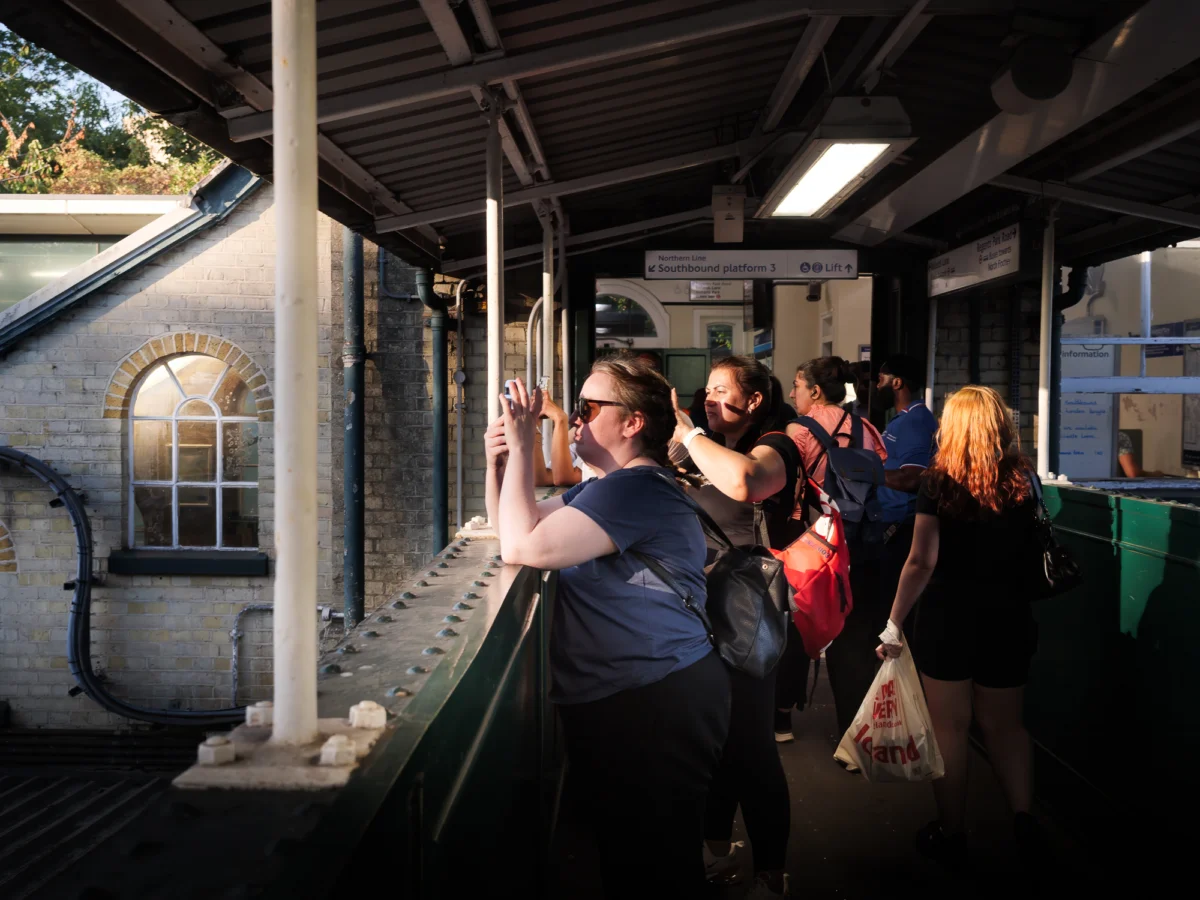
Observations from the site indicated that the crowd was not composed primarily of astronomical tourists or "eclipse chasers" who had traveled specifically for the event. Instead, it consisted of local residents, commuters returning home, and station staff. This spontaneous gathering highlighted a deep-seated human instinct to pause and acknowledge significant natural deviations. Even the station staff, tasked with maintaining the flow of passengers, were seen pausing to observe the sky, signaling a temporary suspension of professional roles in favor of collective experience.
The behavior of the crowd also reflected the technological mediation of the 21st century. Rather than viewing the sun directly—which remains dangerous without specialized filtration—the majority of observers viewed the event through the screens of their smartphones. This "digital observation" created a secondary layer to the event: a crowd of people facing the sun, yet looking down or forward at handheld devices to witness a filtered version of reality.
Technical Documentation and Photographic Methodology
The documentation of the 2026 eclipse at Finchley Central was characterized by two distinct approaches. While the general public focused on capturing the solar disk itself, professional and hobbyist photographers often turned their lenses toward the spectators.
One notable photographic record utilized a Panasonic Lumix G9 equipped with an Olympus Zuiko 12–40mm f/2.8 lens. Set to Program mode with an ISO of 400, the photographer chose to focus on the human element rather than the astronomical one. This technical choice highlighted the "indirect" nature of the event. By capturing the light as it fell on the watchers and the station’s infrastructure, the photographs documented the impact of the eclipse rather than its visual form.
This methodology aligns with a broader trend in documentary photography that prioritizes the "phenomenon of observation." The images produced at Finchley Central captured the smartphones, the sunlight on the observers’ bodies, and the specific orange-red hue of the 7:00 p.m. sun, providing a more comprehensive record of the societal moment than a direct shot of the moon-covered sun could offer.
Official Responses and Safety Protocols
In the weeks prior to August 12, 2026, Transport for London (TfL) and the Department for Transport issued guidelines regarding the eclipse. Concerns were raised about potential overcrowding on station platforms and bridges, particularly those with a clear western view.
"Our primary concern was the safety of passengers during a period of reduced visibility and high ambient heat," a TfL spokesperson stated in a post-event briefing. "We observed a significant ‘slow-down’ effect across the network as the peak approached. While this did not lead to major service disruptions, it required staff to be vigilant about platform edges and bridge capacities."
Public health officials also emphasized the dangers of retinal damage. The sale of "eclipse glasses" surged in the days leading up to the event, though many people, as noted at Finchley Central, opted to use their phones as a safe viewing buffer. This reliance on technology likely prevented a significant number of eye injuries, as the phone camera acts as a natural filter between the sun’s rays and the human eye, though it does not protect the phone’s sensor from potential damage.
Analysis of Implications: Light, Perception, and Environment
The 2026 eclipse served as a reminder of the relationship between urban life and natural cycles. In a city like London, where artificial lighting and high-density buildings often obscure the sky, a solar eclipse forces a reorientation of the public’s attention.
- The Interruption of Routine: The event demonstrated that natural phenomena still possess the power to interrupt the "familiar progression" of the modern workday. The transition from daylight to evening, usually a gradual and ignored process, became a conscious point of interest.
- The Digital Divide in Experience: The reliance on screens to view the eclipse suggests a shift in how humans experience "the sublime." The event is no longer just a direct physical experience but a digital one that is recorded and shared simultaneously.
- Climatic Intersection: The coincidence of the eclipse with a severe heatwave and Amber Weather Alerts provided a stark contrast between the beauty of the cosmos and the volatility of the Earth’s current climate. The heat felt by the watchers was a reminder of local environmental crises, even as they looked toward a global astronomical event.
Historical Comparison and Scientific Legacy
Compared to the 2015 partial eclipse and the 1999 total eclipse, the 2026 event was better documented by the general public due to advancements in mobile camera technology and social media integration. For scientists, the 2026 eclipse provided valuable data on how the ionosphere reacts to a sudden loss of solar radiation during a period of solar maximum (the peak of the sun’s 11-year cycle).
For the citizens of London, the event was less about scientific data and more about a shared moment of pause. The bridge at Finchley Central, for twenty minutes, ceased to be a transit point and became a communal space. As the peak passed and the light returned to its normal evening trajectory, the crowd dispersed, and the station returned to its primary function of movement.
The photograph taken at Finchley Central—showing the people, the phones, and the golden, heat-heavy light—remains a definitive artifact of the day. It poses a final, reflective question for the era: in an age where every event is captured through a lens or a screen, did the participants truly "see" the eclipse, or did they merely document their presence within its shadow? The answer likely lies in the collective memory of that hot, dry August evening, when for a few minutes, the sun was the only thing that mattered in the heart of the city.