The journey of Rowan Dear, a distinguished underwater photographer, exemplifies a profound transformation from an amateur enthusiast on a Welsh farm to an acclaimed professional whose work captures the mesmerizing beauty of the marine world. His story, a feature in the ongoing interview series "From Amateur to Professional," showcases how an innate love for nature, combined with a courageous leap into the unknown, can carve out an extraordinary career. This series delves into the practices and evolution of established nature photographers, offering insights into their creative and technical development over time.

Born and raised amidst the rolling landscapes of a Welsh farm, Dear’s childhood was steeped in a deep appreciation for the natural world. His days were often spent exploring the fields, encountering the diverse terrestrial wildlife of the United Kingdom, from elusive badgers and cunning foxes to charming hedgehogs and a myriad of bird species. This early immersion fostered a lifelong connection to the environment, a foundational element that would later guide his professional trajectory. Like countless others, Dear’s imagination was ignited by the iconic BBC nature documentaries presented by Sir David Attenborough. These cinematic windows into distant ecosystems, particularly the enigmatic underwater world, fuelled a fervent dream: to one day witness and document these fascinating creatures firsthand.
His initial forays into photography were rudimentary, involving disposable cameras used to capture candid moments of family pets. Attempts to photograph wild animals were met with limited success, a common hurdle for aspiring wildlife photographers. At that nascent stage, the world of professional wildlife photography seemed a distant and privileged realm, largely inaccessible to someone without significant financial resources or established connections. This perception underscored a broader challenge for many aspiring artists: overcoming the perceived barriers to entry in specialized fields.

The pivotal turning point in Dear’s journey came in 2017 when he confronted a deep-seated fear of water. Embarking on dive courses in Sydney, Australia, he began to peel back the layers of a world he had only dreamt of. This act of personal courage was not merely about mastering a skill; it was an emotional and psychological breakthrough that unlocked an entirely new dimension for his passion. By 2020, just three years after his first dive, Rowan Dear had fully embraced underwater photography. This rapid transition was marked by significant achievements, including several prestigious competition wins that propelled him into an exciting and demanding career as a professional underwater photographer.
The Evolution of a Vision: From Early Attempts to Masterful Captures
Rowan Dear’s photographic journey provides a compelling case study in the relentless pursuit of artistic and technical mastery. His early underwater work, while a personal triumph at the time, starkly illustrates the learning curve inherent in this specialized field. He recalls his first "proper" underwater image, taken with a dedicated dive camera rather than a basic GoPro, featuring a giant cuttlefish at a dive site near Sydney. This was a subject he had long yearned to photograph, envisioning a vibrant and captivating capture.

However, the reality fell short of the aspiration. The resulting image was, in his own words, "quite flat, uninteresting, and not very colourful." While he initially shared it on social media with a sense of accomplishment, comparing it to professional work quickly revealed its technical shortcomings. This experience is common for beginners in underwater photography, where challenges such as rapid light attenuation, color absorption, particulate matter (backscatter), and the dynamic movement of subjects combine to make achieving a clear, well-exposed, and aesthetically pleasing image exceptionally difficult. The underwater environment often strips away red and yellow light quickly, requiring artificial lighting (strobes) and careful white balance adjustments to restore natural colors.
In stark contrast to this early attempt, Dear’s current portfolio showcases a profound evolution in skill and artistic vision. Among his most cherished works are images that embody the very qualities his first cuttlefish shot lacked. One such image captures two male giant cuttlefish locked in a dramatic struggle for dominance, vying for the right to mate with a female. This photograph is a symphony of color, behavior, and raw character. Giant cuttlefish (Sepia apama) are renowned for their incredible ability to rapidly change skin texture and color for camouflage, communication, and display, making them highly photogenic subjects. Dear’s image not only freezes a moment of intense interaction but also utilizes light to enhance the cephalopods’ vibrant displays, drawing the viewer into their intricate world. The depth and layers of detail in the photograph allow observers to discern the nuances of their behavior, evoking a sense of being present at the scene.

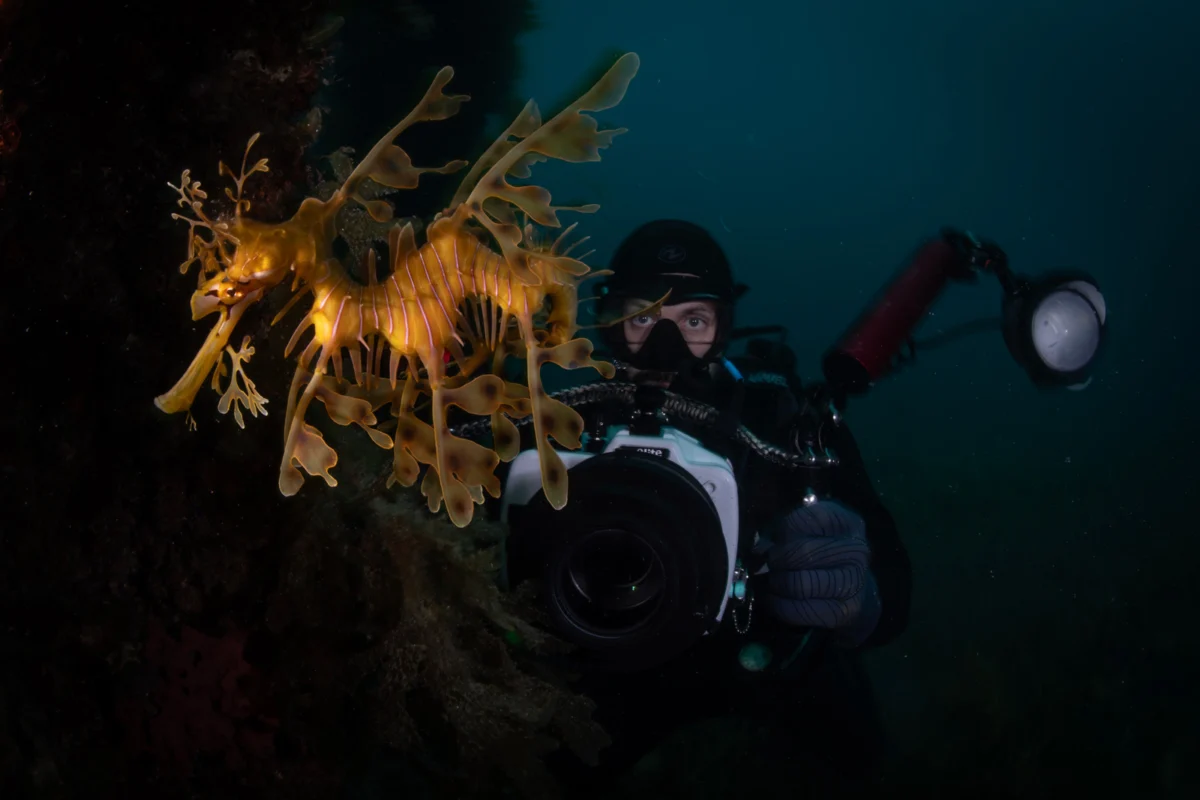
Another favorite is a striking portrait of a leafy seadragon (Phycodurus eques). This image stands out for its exquisite symmetry and the sheer difficulty involved in its capture. Leafy seadragons, masters of camouflage, are notoriously shy and blend seamlessly with their surroundings. To achieve a full, front-on headshot with the animal perfectly angled requires immense patience and a deep understanding of its behavior. Dear recounts the meticulous process: shooting at night to minimize disturbance, using a subtle red focus light, and waiting for the precise moment the seadragon turned to face the camera. The resulting portrait is not just a photograph; it is a testament to perseverance, technical precision, and an intimate connection with the subject, allowing the viewer to appreciate the delicate artistry of nature. The leafy seadragon, endemic to the southern and western coasts of Australia, is a protected species, and such detailed imagery plays a crucial role in raising awareness for its conservation.
Strategic Re-engagement: Understanding and Capturing Dynamic Ecosystems
Rowan Dear emphasizes that truly exceptional wildlife photography goes beyond mere capture; it requires an in-depth understanding of the species, their habitat, and their behaviors. This philosophy underpins his practice of revisiting specific locations and subjects, allowing for a deeper immersion and the opportunity to refine his approach.

One such site is Whyalla in South Australia, a globally significant location where, each year, over 10,000 giant cuttlefish aggregate to mate. This natural spectacle, occurring in shallow waters (approximately 5 meters deep) with easy shore access, allows for multiple, extended dives daily. The prolonged time spent underwater provides unparalleled opportunities to observe and photograph a vast array of cuttlefish characters and their dynamic color changes, offering a truly immersive experience. Dear strategically employs a range of lenses—from wide-angle and fisheye for capturing the vastness of the aggregation and environmental context, to macro lenses for intricate close-ups of individual cuttlefish and their detailed skin patterns. This versatility ensures a comprehensive visual narrative of the event, capturing both the grandeur and the minute details of this remarkable marine phenomenon. The annual aggregation at Whyalla is not only a biodiversity hotspot but also a significant ecotourism draw, highlighting the economic value of healthy marine ecosystems.
Beyond cuttlefish, Dear’s re-engagement strategy extends to other iconic marine sites. Byron Bay, off the coast of New South Wales, Australia, is another favored destination, particularly during the summer months when large aggregations of leopard sharks (Stegostoma tigrinum, also known as zebra sharks) gather. This location offers diverse photographic possibilities depending on prevailing conditions. On clear, sunny days, Dear can capture stunning shallow-water shots with ethereal sunrays piercing through the water column, creating a dramatic backdrop for the graceful sharks. In contrast, on days with less ideal visibility, he adapts by focusing on top-down shots, documenting numerous leopard sharks at varying depths, showcasing their elegant movements and patterns from a different perspective. Leopard sharks are generally harmless to humans and their seasonal gatherings are a key attraction for divers and snorkelers, contributing to local marine tourism.

Heron Island, nestled within the pristine Great Barrier Reef, represents another extraordinary canvas for Dear’s freediving photography. This location is particularly captivating during the turtle hatching season, typically from February to April. Here, he witnesses and documents the poignant journey of newly hatched turtles as they instinctively make their way into the ocean. The island is also home to year-round residents, including various ray species, numerous adult turtles, and a thriving population of lemon sharks (Negaprion brevirostris). The unique tidal conditions around Heron Island allow for extended periods in the water before and after peak high tide, providing ample opportunities to interact with and photograph a multitude of marine animals in their natural habitat. The Great Barrier Reef, a UNESCO World Heritage site, is the world’s largest coral reef system, emphasizing the importance of documenting and protecting its delicate biodiversity.
The Professional Ascent: An Organic Journey Validated by Achievement
Rowan Dear’s transition to professional photography was not a calculated decision but rather an organic evolution driven by an unyielding passion for the ocean and the art of capturing its wonders. He describes it as a natural progression: initially striving to improve his photography for personal satisfaction, then sharing his work with close acquaintances, and finally reaching out to a broader community of animal and ocean enthusiasts. This gradual, passion-led approach underscores that true professional success often emerges from an authentic love for one’s craft.

A significant turning point in his career, a "eureka moment" as he describes it, was the validation he received from winning major photography competitions. These accolades instilled a crucial sense of confidence in his work, affirming that his images met the rigorous standards of his peers and the esteemed professionals he admired within the underwater photography sphere. In an age dominated by social media, where "likes" and "follows" can often create a distorted perception of one’s skill and standing, competition wins offer a more tangible and credible measure of artistic merit and technical excellence. Such recognition not only boosts personal morale but also provides invaluable credibility, opening doors to commissions, publications, and collaborations.
Beyond the artistic aspect, Dear emphasizes that professional wildlife photography is also about meticulous planning and proactive opportunity creation. Success hinges not just on talent but on extensive research to align the optimal time of year, locations, and weather conditions to maximize the chances of capturing desired images. This strategic foresight transforms an artistic pursuit into a disciplined professional endeavor, requiring a blend of creativity, logistical expertise, and a deep understanding of natural cycles.

Refining the Art: Technical Evolution and Philosophical Shifts
As Rowan Dear’s career matured, his photography process underwent significant refinement, particularly concerning post-production. He now dedicates considerably less time to editing, a testament to his improved in-camera skills and deeper knowledge of his equipment and subjects. His philosophy has evolved: if an image requires excessive editing, it often indicates a fundamental flaw in the initial capture, suggesting the need to return to the field and secure a better shot. This principle reflects a mastery of exposure, composition, and lighting, minimizing the need for extensive digital manipulation. For instance, he consciously works to avoid common underwater photography pitfalls like overexposure or excessive backscatter (particles in the water illuminated by flash), understanding that these mistakes are difficult to salvage without compromising image quality.
Dear’s photographic style is characterized by its reliance on abundant natural light, aiming to create images that appear as authentic and unaltered as possible. He maintains a minimalist approach to editing, typically spending only a few minutes per image. This commitment to naturalism aligns with a growing trend in ethical wildlife photography, where the integrity of the scene and the true representation of nature are paramount. His work seeks to present the underwater world as it is, allowing its inherent beauty to shine through without artificial embellishment.

The biggest challenge, both when starting out and currently, remains the inherent unpredictability of wildlife photography. Despite meticulous planning—researching migration patterns, breeding seasons, and environmental conditions—nature often has its own agenda. Dear recounts experiences where extensive planning did not guarantee success, such as a trip to photograph minke whales that was thwarted by adverse weather and zero sightings. These moments underscore the humility required in working with nature, where patience and adaptability are as crucial as technical skill.
For underwater photography specifically, the pursuit of "perfect" conditions—excellent visibility and ideal lighting—is a constant aspiration, yet rarely a reality. Professionals must learn to "make do with the hand you are dealt." Dear highlights that with experience, photographers develop the ability to maximize opportunities even under challenging circumstances. He cites a recent expedition to Argentina to photograph southern right whales (under a stringent government permit), where visibility was far from ideal due to strong winds. Despite the less-than-perfect conditions, the experience itself was "magical," and he was able to capture the best possible images given the limitations. This demonstrates a crucial professional trait: the capacity to adapt, problem-solve in real-time, and still produce compelling work. The need for government permits for sensitive species like southern right whales further highlights the ethical and regulatory frameworks governing responsible wildlife photography.

Wisdom Gained: Advice for Aspiring Photographers
Reflecting on his journey, Rowan Dear offers invaluable advice to his younger self and to aspiring photographers. He acknowledges that a past lack of confidence, while perhaps fueling a relentless drive for improvement, may also have hindered him from pursuing opportunities he was more than capable of handling. This self-awareness points to a common dilemma for artists: balancing self-critique with self-belief. His perfectionist tendencies, while ensuring high-quality output, made it challenging to release work that didn’t meet his exceedingly high personal standards.
His core advice resonates with timeless principles of artistic and professional growth:
- Define Your Goals: Understand where you want to go and what you want to achieve.
- Seek Inspiration: Follow and learn from those who inspire you, but critically,
- Trust Your Instincts and Forge Your Style: Develop a unique artistic voice rather than merely replicating others.
- Hone Your Craft: Continuously work on technical skills and artistic vision.
- Embrace Continuous Improvement: Never be complacent; always strive to learn and grow.
- Cultivate Self-Critique and Self-Appreciation: Be critical of your work