The acclaimed "From Amateur to Professional" interview series, dedicated to charting the transformative journeys of established nature photographers, features Rowan Dear, a compelling figure whose path from a pastoral Welsh upbringing to a celebrated underwater photographer offers profound insights into dedication, overcoming personal challenges, and the relentless pursuit of artistic and ecological understanding. This series aims to illuminate how practices evolve, change, and improve over time, providing a valuable resource for aspiring artists and enthusiasts alike.
Early Inspirations and the Call of the Wild
Rowan Dear’s deep appreciation for the natural world was forged in the idyllic landscapes of a Welsh farm during his childhood. Growing up amidst rolling fields and verdant hills, he spent countless hours observing the rich biodiversity of the United Kingdom, encountering native species such as badgers, foxes, hedgehogs, and a diverse array of birdlife. This early immersion fostered an innate connection to nature, laying the groundwork for his future calling.

Like many children of his generation, Dear’s imagination was captivated by the groundbreaking BBC nature documentaries presented by Sir David Attenborough. These cinematic explorations of remote ecosystems and exotic species ignited a fervent desire within him to witness the planet’s most fascinating creatures, particularly those inhabiting the mysterious underwater world. His initial forays into photography were rudimentary, involving disposable cameras used to capture candid moments of family pets. Attempts to photograph wild animals proved largely unsuccessful, hampered by limited equipment and nascent skills. At this stage, the aspiration of becoming a wildlife photographer seemed a distant, almost unattainable dream, perceived as a pursuit reserved for individuals with substantial financial resources and inherent privilege. This early perception highlights a common barrier for many aspiring nature photographers, emphasizing the initial challenge of access and equipment in a field that often demands specialized gear.
Diving In: Overcoming Fear and Discovering a New World
A pivotal moment in Dear’s journey occurred in 2017 when he confronted a deeply ingrained fear of water. This personal challenge led him to embark on a series of dive courses in Sydney, Australia. Sydney, with its vibrant marine life and numerous dive sites, provided an ideal environment for this transformative experience. Overcoming his trepidation was not merely a personal triumph but a gateway to an entirely new dimension of nature observation. This profound experience underwater reshaped his perspective and ignited a new passion.
By 2020, Dear fully embraced underwater photography, a decision that rapidly propelled him into the professional sphere. This transition was marked by significant achievements, including multiple competition wins that garnered critical acclaim and established his reputation within the underwater photography community. These accolades provided crucial external validation, reinforcing his artistic direction and technical proficiency. His success subsequently launched an exciting and fulfilling career dedicated to capturing the hidden wonders of the aquatic realm. The rapid ascent from a hobbyist to a recognized professional in just three years underscores a combination of innate talent, rigorous practice, and an unyielding passion for his subject matter.

The Evolution of a Lens: From First Shots to Masterpieces
The progression of any artist is often best illustrated by comparing their earliest works with their mature creations. Rowan Dear’s first significant underwater image, captured with a dedicated dive camera rather than a consumer-grade action camera, depicted a giant cuttlefish at a dive site near Sydney. This encounter with a species he had long admired was a highly anticipated moment. However, the resulting photograph was, in his own retrospective assessment, "quite flat, uninteresting, and not very colourful." While initially satisfied enough to share it on social media, he soon recognized its amateur quality when benchmarked against the work of professional and semi-professional photographers. This critical self-assessment is a hallmark of artistic development, moving beyond initial excitement to a more discerning evaluation of technique and impact.
Today, Dear’s portfolio showcases images of remarkable depth, colour, and narrative power. Among his favourites is a dynamic shot of two male giant cuttlefish engaged in a fierce struggle for dominance during mating season. Giant cuttlefish (Sepia apama), renowned for their intelligence, vibrant colour changes, and complex mating rituals, present a fascinating challenge for photographers. Dear highlights their interactive nature and stunning appearance as key attractions. The photograph, rich in colour and intricate detail, effectively captures the intense character and behaviour of these cephalopods, offering viewers a layered visual experience. His objective is to transcend mere documentation, aiming to evoke the same emotion and immersion in non-divers as he experienced firsthand. This pursuit of emotional resonance elevates his work beyond technical excellence.
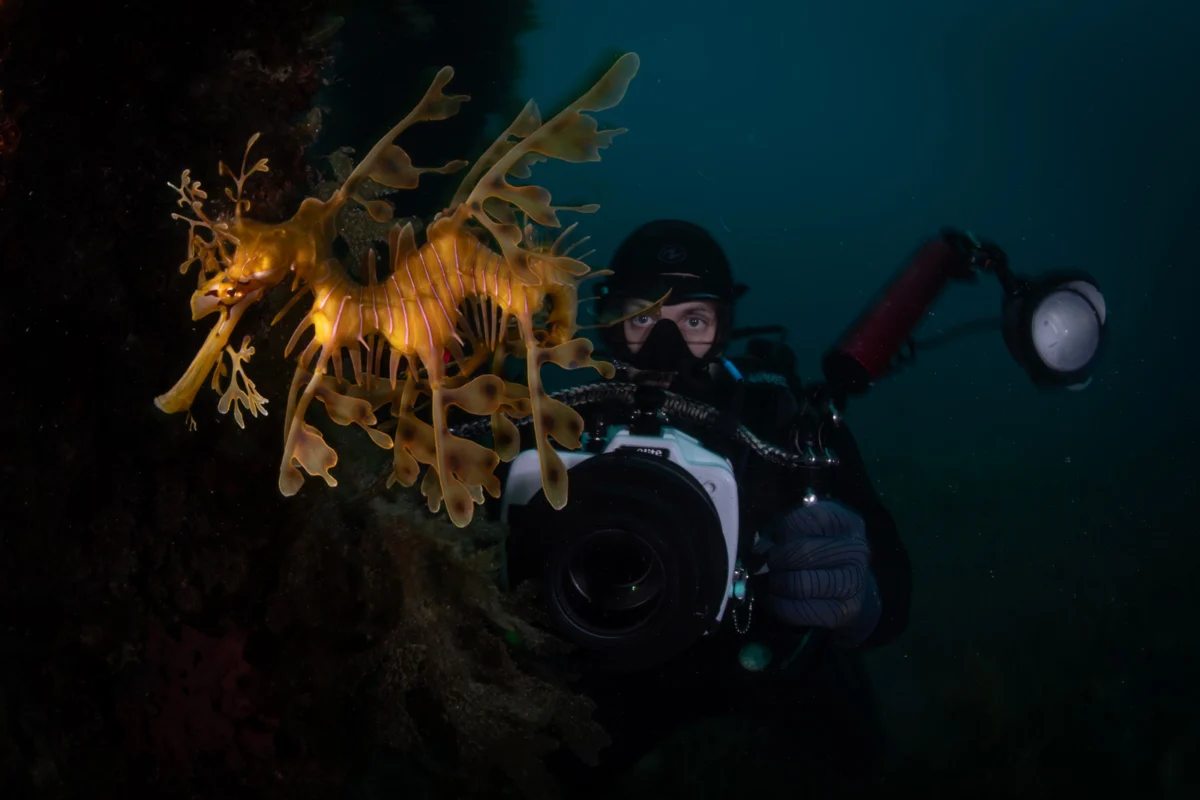
Another cherished image is a meticulously composed portrait of a leafy seadragon (Phycodurus eques). These ethereal creatures, native to the temperate waters of southern and western Australia, are masters of camouflage, making them incredibly challenging subjects. The photograph exhibits striking symmetry, a testament to Dear’s patience and technical skill. Achieving this shot required precise planning and execution during a night dive, utilizing a red focus light to minimize disturbance to the delicate seadragon. He patiently waited for the creature to orient itself perfectly, allowing him to capture a full, front-on headshot. This image not only demonstrates his mastery of composition and lighting but also his commitment to ethical wildlife photography, prioritizing the well-being of his subjects.

Deep Dives and Familiar Waters: Revisiting Key Locations
A core tenet of Rowan Dear’s photographic philosophy is the importance of intimate understanding: comprehending a species, its habitat, and its behaviours to authentically portray its beauty. This approach necessitates repeated visits to specific locations, allowing for deeper engagement and evolving photographic techniques.
One such revisited location is Whyalla, South Australia, a globally renowned site for the annual aggregation of over 10,000 giant cuttlefish. This spectacular natural event, occurring typically from May to August, sees these cephalopods converge for their breeding season in the shallow waters of the Spencer Gulf. The dive site itself, approximately 5 metres deep and accessible directly from the shore, offers unparalleled opportunities for photographers. The shallow depth and easy entry allow for extended bottom times and multiple dives per day, providing ample opportunity to observe and photograph diverse behaviours under varying light conditions throughout the day. Dear strategically employs a range of lenses—from wide-angle to fisheye for capturing the vastness of the aggregation and the underwater environment, to macro lenses for intricate close-ups of individual cuttlefish details and behaviours. This versatility ensures a comprehensive visual narrative of this extraordinary marine spectacle.
Beyond Whyalla, Dear frequently returns to Byron Bay, New South Wales, where large aggregations of leopard sharks (Stegostoma tigrinum, also known as zebra sharks) gather each summer. This location offers dynamic photographic opportunities, allowing for shallow close-up shots bathed in sunrays, as well as top-down perspectives that capture numerous sharks at varying depths. The interplay of light, water clarity, and shark behaviour provides a constant source of inspiration and technical challenge.

Heron Island, situated within the Great Barrier Reef, a UNESCO World Heritage site, is another cherished destination. This locale is particularly exceptional for freediving, especially during the turtle hatching season, which typically runs from February to April. Here, photographers can witness the poignant spectacle of newly hatched turtles making their perilous journey to the ocean. The island is also home to year-round residents such as lemon sharks, a multitude of ray species, and adult turtles. By meticulously timing dives with optimal tides, Dear can spend several hours immersed in this vibrant ecosystem, capturing a diverse array of marine life. These repeated visits to ecologically significant sites underscore his commitment to documenting and sharing the beauty and fragility of marine environments.
The Professional Tide: An Organic Transition
Unlike many who consciously decide to pursue a professional career, Rowan Dear describes his transition as an organic evolution rather than a deliberate choice. His primary motivation has always been the quest for magical underwater experiences, striving to capture them with increasing skill and artistic refinement. Initially driven by personal satisfaction, his work soon resonated with friends and, subsequently, a broader community of animal and ocean enthusiasts.
This natural progression, fueled by an unwavering passion for the ocean and photography, led to the seamless integration of his two loves into a vocation. The consistent improvement of his craft, coupled with an intrinsic drive to share the underwater world, gradually transformed his hobby into a professional endeavour. This highlights a common trajectory for many successful nature photographers, where genuine passion and consistent dedication ultimately pave the way for professional recognition and opportunity.

Navigating the Challenges: Planning, Patience, and Perception
A significant turning point in Dear’s career was the recognition he received through major photography competitions. Winning these prestigious awards provided invaluable confidence, affirming that his work met the rigorous standards of his peers and the wider photographic industry. This external validation was crucial in distinguishing genuine professional quality from the potentially distorted perceptions fostered by social media metrics like "likes" and "follows." In an era dominated by digital platforms, it is easy for artists to conflate popularity with professional excellence, making objective critical assessment essential.
Wildlife photography, by its very nature, presents inherent challenges, primarily the unpredictability of the natural world. Being in the "right place at the right time" is often a product of extensive planning, research, and a degree of fortune. Dear emphasizes the meticulous preparation involved in his expeditions: researching optimal seasons, geographical locations, prevailing weather patterns, and the specific behaviours of target species. However, even the most thorough planning cannot guarantee success. He recounts a minke whale photography trip plagued by adverse weather and zero sightings, illustrating how nature can often have "other ideas."
For underwater photography, specifically wide-angle shots, ideal conditions—excellent visibility and perfect lighting—are highly coveted but rarely align perfectly. The reality often demands adaptability and resourcefulness. Dear’s experience in Argentina, photographing southern right whales under a government permit, exemplifies this. Despite challenging conditions with poor visibility exacerbated by wind, the experience remained profoundly "magical." He notes that, with accumulated experience, a photographer can still maximize such opportunities, producing impactful images even when circumstances are less than ideal. This ability to work within constraints and still achieve compelling results is a hallmark of a seasoned professional.

Mastering the Craft: The Art of In-Camera Excellence
Rowan Dear’s photographic process has evolved significantly over time, particularly in his approach to post-processing. He now dedicates considerably less time to editing, a change he attributes directly to improved in-camera skills and deeper technical knowledge. His philosophy is clear: "if a photo takes too long to edit, you just need to go back out and take a better one." This commitment to capturing superior images directly through the lens minimizes the need for extensive digital manipulation.
He consciously avoids common underwater photography pitfalls such as overexposure or excessive backscatter (tiny particles in the water reflecting light from strobes), which can degrade image quality and require arduous correction in post-production. Dear’s distinctive style prioritizes abundant natural light, aiming to create images that appear as authentic and untouched as possible. His editing workflow is now remarkably streamlined, typically requiring only a few minutes per image. This efficiency not only reflects his technical mastery but also reinforces his dedication to presenting the natural world with minimal intervention, aligning with a journalistic ethos of truthfulness and ecological integrity.
Reflections and Advice: Trusting the Journey
Reflecting on his journey, Dear acknowledges a past lack of confidence in his abilities. While this self-critical stance arguably propelled him to continuously learn and grow, it also, at times, led him to hesitate in pursuing opportunities he was more than capable of handling. This internal conflict between aspiration and self-doubt is a common experience for many creatives. As a perfectionist, releasing work that doesn’t meet his exacting standards—a "1000% happy" threshold—remains a significant challenge.

His invaluable advice to aspiring photographers encapsulates the essence of his professional journey:
- Define Your Vision: Clearly articulate your goals and where you aspire to be in your photographic career.
- Seek Inspiration and Guidance: Identify and follow individuals whose work genuinely inspires you, learning from their techniques and perspectives.
- Trust Your Instincts: Develop and rely on your unique artistic intuition.
- Cultivate a Unique Style: Strive to create a distinct photographic voice that sets your work apart.
- Hone Your Craft: Continuously refine your technical skills and artistic sensibilities through practice and learning.
- Embrace Continuous Improvement: Never become complacent; always seek avenues for growth and enhancement.
- Balance Self-Criticism with Self-Appreciation: Be critical of your work to foster improvement, but also acknowledge and value your achievements.
- Trust Your Process and Ability: Cultivate unwavering faith in your methods and capabilities.
Rowan Dear’s trajectory from a nature-loving child in Wales to an internationally recognized underwater photographer underscores the profound impact of passion, persistence, and a deep respect for the natural world. His journey serves as a powerful testament to the idea that a professional career can emerge organically from genuine dedication, validated by both personal growth and external recognition, ultimately enriching the global understanding of Earth’s diverse ecosystems.