The traditional creative process has long romanticized the blank canvas as the ultimate symbol of artistic freedom and original thought. However, in the high-stakes environment of modern commercial marketing, starting from nothing is increasingly viewed as a costly luxury that many brands can no longer afford. As the demand for multi-channel content reaches an all-time high, the marketing industry is undergoing a fundamental shift toward a hybrid production model. This emerging standard moves away from pure generation or manual creation, favoring a workflow where teams begin with high-quality, professionally produced stock media and utilize integrated artificial intelligence (AI) to accelerate the final output.
This transition is driven by the sheer volume of assets required for a single contemporary campaign. A standard product launch may necessitate dozens, if not hundreds, of unique creative variations tailored for website hero sections, social media platforms, email marketing, display advertising, and regional international markets. In this context, AI is not merely a tool for generating new imagery from text prompts; its most significant value lies in its ability to transform existing professional assets into flexible, modular building blocks. By leveraging AI-enhanced stock media, creative teams are effectively bypassing the most time-consuming stages of production, allowing for a faster transition from conceptualization to market deployment.
The Economic Reality of the Production Paradox
The primary catalyst for this shift is the "production paradox": marketing budgets and timelines are shrinking even as the requirement for content volume expands. According to recent industry reports from the Content Marketing Institute, nearly 70% of B2B marketers have reported an increased demand for content over the past year, yet many creative departments remain understaffed or burdened by legacy workflows.
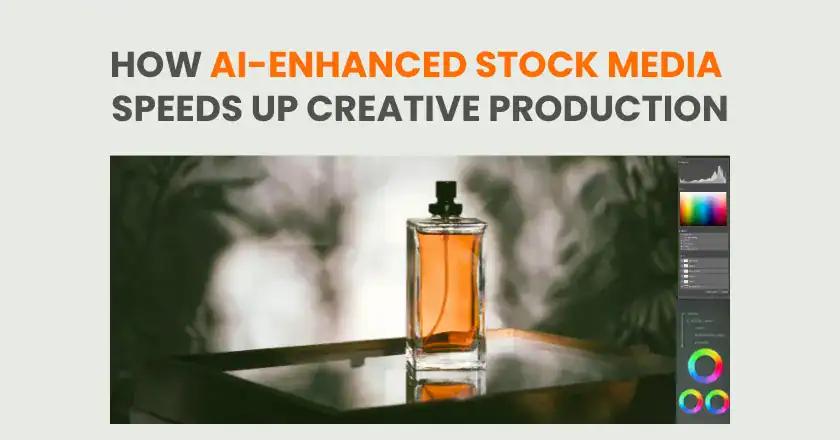
Starting a project from a zero-base—whether through a custom photoshoot or manual graphic design—involves a complex chain of decisions, approvals, and technical tasks. For example, creating a single social media campaign often requires a designer to crop, resize, and retouch the same central image for nine different aspect ratios. While essential, these tasks do not add strategic or creative value; they are administrative burdens that consume hours of professional time.
Data suggests that creative teams spend upwards of 30% to 40% of their time on repetitive production tasks rather than actual art direction. By utilizing AI-enhanced stock media, these teams can automate the mechanical aspects of design. Tools like generative expand, which uses AI to intelligently fill in backgrounds beyond the original frame, allow a single horizontal photograph to be converted into a vertical mobile ad in seconds. This capability significantly reduces the "cost of entry" for every new asset produced.
A Chronology of Creative Evolution: From Print to AI
The integration of AI into stock media is the latest chapter in a decades-long evolution of how visual content is sourced and consumed. Understanding this timeline provides essential context for the current industry landscape.
In the pre-digital era, stock photography was managed through physical catalogs and transparency slides, a process that was slow and expensive. The 1990s and early 2000s saw the digitization of these libraries, with companies like Shutterstock (founded in 2003) pioneering the subscription model. This era democratized access to professional imagery but left designers with a "static asset" problem: if a chosen image wasn’t perfect, it required hours of Photoshop work to fix.

The shift toward AI began in earnest around 2021 with the emergence of early generative models. By 2022, the industry reached a turning point when major stock agencies began partnering with AI developers. A notable milestone occurred in late 2022 and early 2023, when Shutterstock announced a partnership with OpenAI to integrate DALL-E directly into its platform, while simultaneously establishing a Contributor Fund to compensate the artists whose work trained these models.
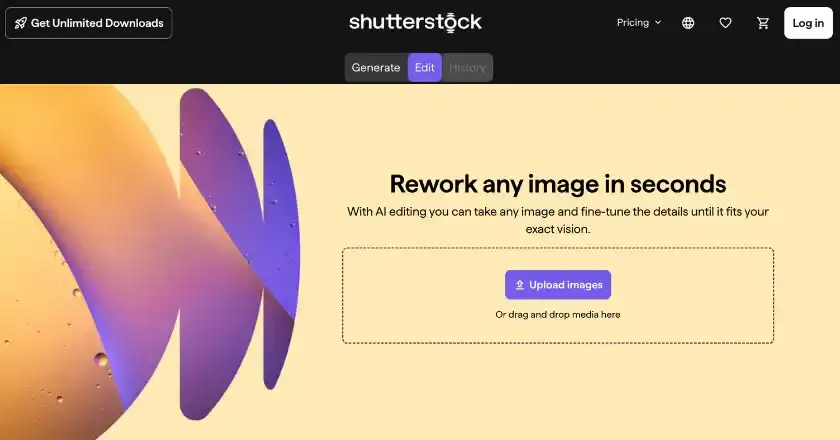
By 2024, the focus shifted from simple "text-to-image" generation to "edit-to-needs" functionality. Today, the leading platforms offer a suite of AI-assisted tools that allow users to remove objects, swap backgrounds, and expand compositions within a library of hundreds of millions of licensed assets. This historical trajectory illustrates a clear move from passive consumption of images to active, AI-powered manipulation of professional source material.
The Shift from Finished Assets to Creative Layers
In the traditional stock model, a downloaded file was considered the finished product. In the AI-enhanced era, stock media is increasingly treated as a "creative layer"—the foundational architecture upon which a brand builds its specific identity.
This modular approach allows for unprecedented flexibility. A professional photograph of a modern office environment, for instance, can serve as the baseline visual for a global campaign. Through AI editing, the same image can be localized: the background can be subtly altered to reflect different urban skylines, the lighting can be adjusted to match a brand’s specific color palette, and the subjects can be repositioned to allow for text placement in various languages.

Industry analysts suggest that this "layering" approach solves the "uncanny valley" problem often associated with purely AI-generated images. Purely synthetic images can sometimes lack the technical precision or emotional authenticity of professional photography. By starting with a real, high-quality photograph and using AI only for adaptation, brands maintain a level of visual quality that purely generative tools have yet to consistently match.
Official Responses and Industry Perspectives
The adoption of AI-enhanced workflows has drawn significant attention from industry leaders and tech executives. Paul Hennessy, CEO of Shutterstock, has frequently emphasized that the goal of these tools is to "empower the creative journey," rather than replace the creator. In various corporate statements, the company has positioned its AI tools as a bridge between human intent and technical execution.
From a CMO perspective, the reaction has been largely pragmatic. Marketing executives at major global firms have noted that the speed of the digital economy—where a social trend can peak and fade within 48 hours—requires a "just-in-time" content strategy. "We no longer have the luxury of three-week production cycles for a single social post," noted one marketing director during a recent industry panel on AI. "We need tools that allow our designers to be directors, choosing the best starting points and guiding the AI to the finish line."
However, the transition has not been without its critics. Creative unions and photographers have raised valid concerns regarding copyright and the devaluation of manual skill. The industry’s response has been the development of "ethical AI" frameworks. Leading stock agencies now emphasize "clean" training sets—using only licensed content to train AI models—and offering legal indemnification to enterprise clients, a move that provides the security necessary for large-scale commercial use.

Broader Implications for Global Campaigns and Testing
The impact of AI-enhanced stock media extends beyond simple speed; it fundamentally changes the science of performance marketing. In the past, A/B testing multiple visual directions was cost-prohibitive because every variation required a unique production effort.
With AI-assisted workflows, the cost of variation drops to near zero. A performance marketing team can now test five different backgrounds, three different crops, and four different color treatments for the same ad campaign to see which resonates most with a specific demographic. This data-driven approach to creativity allows brands to optimize their spend and retire underperforming assets before they drain the budget.
Furthermore, for global brands, the implications for consistency are profound. Maintaining a unified brand voice across thirty different countries is a logistical nightmare. AI-enhanced stock allows for "controlled variation"—where the core visual elements remain constant while specific cultural cues are adapted. This ensures that a campaign feels local to an audience in Tokyo while remaining visually aligned with the same campaign running in London.
Conclusion: The Human-Centric Hybrid Future
As AI continues to mature, the "blank canvas" will likely become an optional starting point rather than a requirement. The future of creative production is undeniably hybrid, combining the intentionality and technical excellence of human-shot media with the speed and adaptability of artificial intelligence.
This evolution does not eliminate the need for human creative direction; rather, it elevates it. When designers are freed from the drudgery of resizing files and rebuilding backgrounds, they can focus on the higher-level strategic decisions that define a brand’s success: storytelling, emotional resonance, and strategic differentiation.
The most significant productivity gain in the AI era is not simply the ability to make more content, but the ability to make more effective content with less wasted effort. By starting several steps ahead with professional stock media, creative teams can finally match the pace of the modern digital world without sacrificing the quality that defines great advertising. The result is a more efficient, responsive, and ultimately more creative marketing ecosystem.