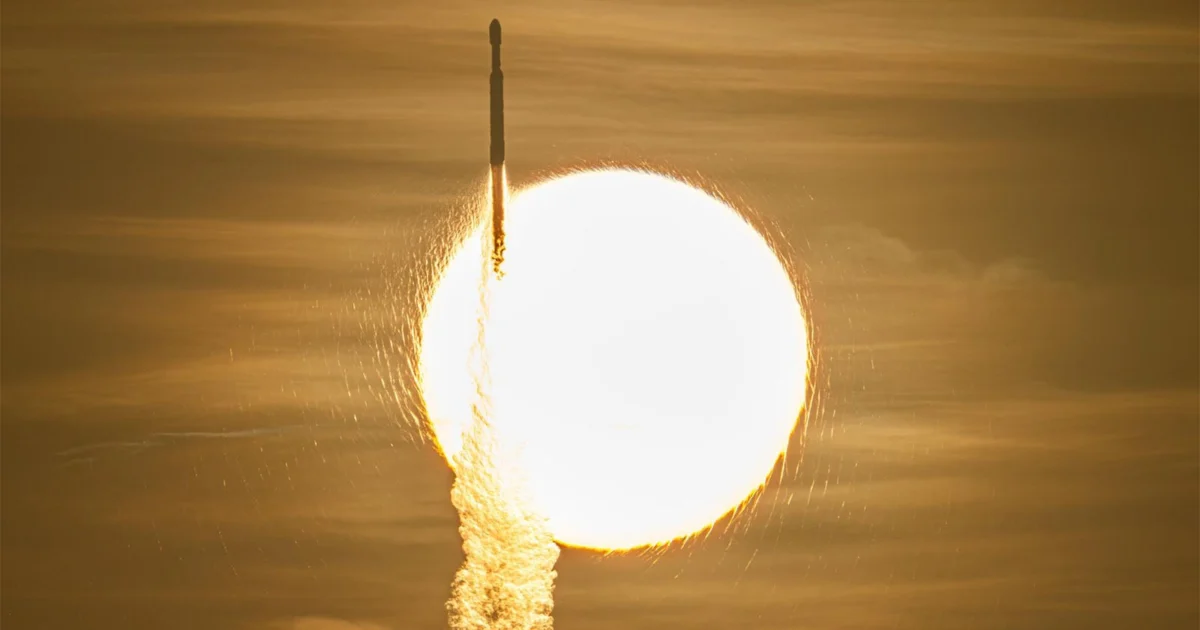
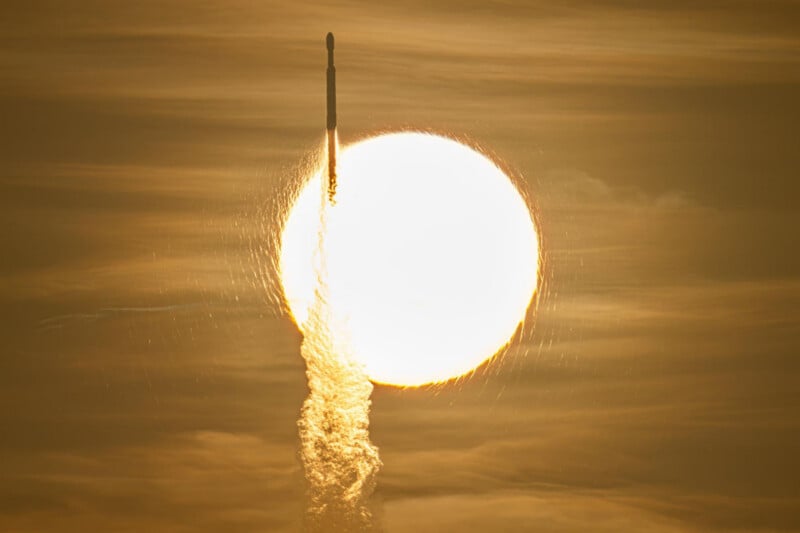
In a landmark moment for space exploration, NASA’s cutting-edge Nancy Grace Roman Space Telescope successfully launched this morning aboard a SpaceX Falcon Heavy rocket from Launch Complex 39A at NASA’s Kennedy Space Center in Florida. The launch, which occurred on Sunday, August 30, 2026, saw the powerful rocket ascend vertically, momentarily silhouetted against the bright, golden disk of the sun in a hazy sky – a breathtaking spectacle captured by NASA photographer John Kraus. This mission marks the beginning of a crucial million-mile journey for the Roman Telescope, an endeavor designed to tackle some of the most profound questions in astrophysics, including the enigmatic nature of dark energy, the elusive presence of dark matter, and the fundamental origins of the Universe itself.
A New Era of Cosmic Discovery Begins
The Roman Space Telescope, designated as NASA’s new flagship observatory, is poised to revolutionize our understanding of the cosmos with its unparalleled capabilities. At the core of its scientific arsenal is the 300-megapixel Wide Field Instrument (WFI), an infrared camera designed to capture vast swathes of the sky with unprecedented detail. Complementing the WFI are other sophisticated instruments that will enable the telescope to investigate a diverse range of phenomena, from charting the distribution of dark energy and dark matter to scrutinizing distant exoplanets and studying cosmic objects in deep space. Ultimately, the mission aims to chart a new course for humanity’s comprehension of the universe, building upon the legacies of its predecessors like the Hubble Space Telescope and the James Webb Space Telescope.

The journey to its operational outpost, Lagrange point two, or L2, will take Roman approximately three months. This gravitationally stable point in space, about 1.5 million kilometers (roughly a million miles) from Earth in the direction opposite the Sun, is a favored location for deep-space observatories due to its stable thermal environment and unobstructed views of the cosmos, minimizing interference from Earth and the Sun. Once established at L2, the Roman Telescope will commence its primary scientific operations, leveraging its advanced instrumentation to gather an immense volume of data.
The Power of the Wide Field Instrument (WFI)
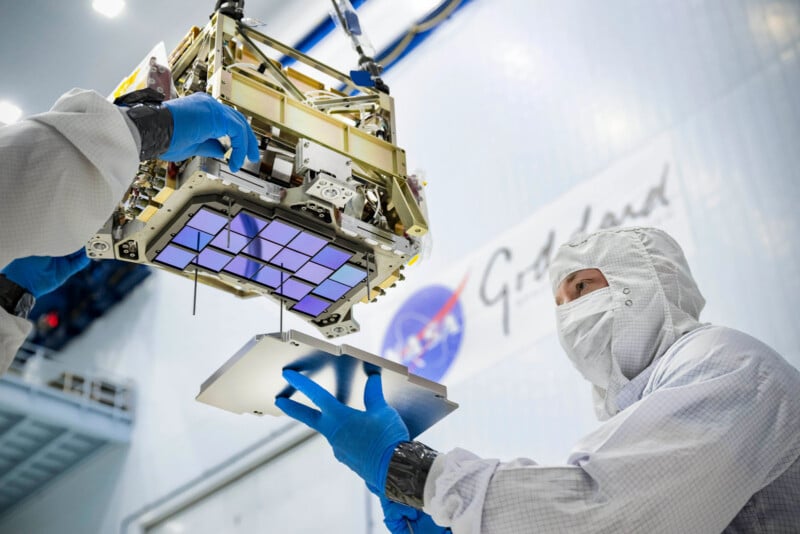
The Wide Field Instrument (WFI) is the Roman Telescope’s technological marvel and its primary scientific tool. Technically featuring 300.8 megapixels, this infrared camera is a mosaic of 18 individual detectors, or image sensors, each measuring 4,096 x 4,096 pixels. This innovative design combines to deliver a colossal active pixel count exceeding 300 million, making it one of the most powerful cameras ever sent into space. The WFI is exquisitely sensitive across a broad range of infrared wavelengths, from 0.5 to 2.3 microns, allowing it to peer through cosmic dust and gas that obscure visible light, revealing hidden stellar nurseries, distant galaxies, and the faint glow of early universe objects.
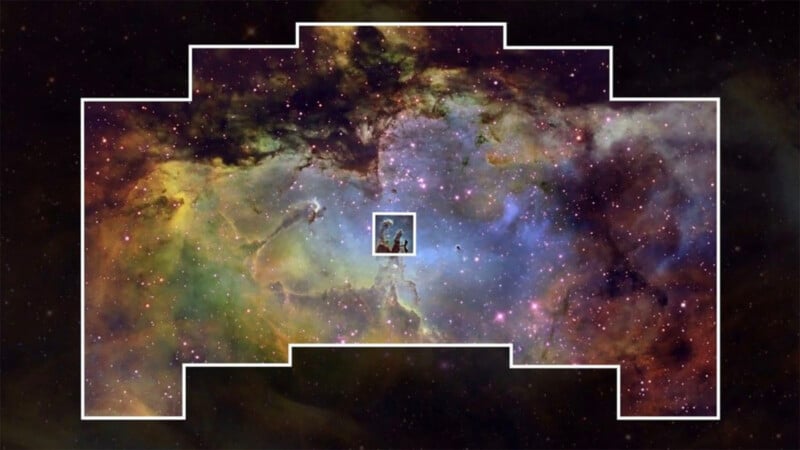
What truly sets the WFI apart is its remarkably wide field of view, spanning 0.281 square degrees. To put this into perspective, this is roughly 100 times the area covered by the Hubble Space Telescope’s Advanced Camera for Surveys (ACS) or the Near-Infrared Camera (NIRCam) on the James Webb Space Telescope in a single pointing. Furthermore, Roman’s WFI covers approximately 200 times the area of Hubble’s Wide Field Camera 3. This expansive field of view, combined with the spatial resolution comparable to Hubble, means Roman can survey vast regions of the sky much faster than any previous observatory, creating enormous panoramic images of the universe. This capability is critical for statistical surveys of cosmic phenomena, from mapping the large-scale structure of the universe to conducting comprehensive censuses of exoplanets.
Unveiling the Universe’s Deepest Secrets
NASA emphasizes Roman’s unique combination of a large field of view and crisp infrared vision, which will enable it to “explore vast swaths of the sky and probe deeply into cosmic history.” The mission’s main science goals are ambitious and far-reaching, encompassing some of the most perplexing mysteries in modern astronomy:
- Dark Energy and the Accelerating Universe: Dark energy is the mysterious force believed to be responsible for the accelerating expansion of the universe. Roman will employ several independent methods to measure its effects, including precise measurements of Type Ia supernovae at various distances and observations of the large-scale structure of the universe through baryonic acoustic oscillations (BAO) and weak gravitational lensing. By charting the distribution of galaxies and galaxy clusters over cosmic time, Roman will help astronomers understand how dark energy has influenced the universe’s expansion history and whether its properties have changed over billions of years. This could lead to a fundamental revision of our cosmological models.
- Mapping Dark Matter: While dark matter does not interact with light, its gravitational effects are evident in the rotation of galaxies and the clustering of matter. Roman will map the distribution of dark matter across the universe using weak gravitational lensing, a technique that detects subtle distortions in the shapes of distant galaxies caused by the gravity of intervening dark matter. These vast, detailed maps will provide crucial insights into the nature of dark matter and how cosmic structures have evolved.
- Exoplanet Census and Characterization: The Roman Telescope is expected to discover thousands of new exoplanets using the microlensing technique. This method relies on observing temporary brightenings of distant stars as an unseen exoplanet (or star) passes in front of them, bending the light. Microlensing is particularly effective at finding exoplanets that are far from their host stars, similar to Jupiter or Saturn in our solar system, or even free-floating planets that are not gravitationally bound to any star. Roman’s wide-field surveys will build a statistically robust census of exoplanets, shedding light on the diversity of planetary systems in our galaxy and the frequency of different planet types. This data will lay essential groundwork for future missions aiming to characterize potentially habitable worlds.
- General Astrophysics and Deep Space Surveys: Beyond its primary objectives, Roman’s capabilities will support a broad range of research, extending far beyond its main science goals. Its deep infrared surveys will allow astronomers to peer back to the earliest epochs of galaxy formation, observing the universe when it was just a few hundred million years old. It will help study the evolution of galaxies, star formation in distant environments, and the properties of quasars and black holes. The sheer volume of data will provide a treasure trove for unforeseen discoveries.
The Legacy of Nancy Grace Roman
The telescope is named in honor of Dr. Nancy Grace Roman (1925-2018), often referred to as the "Mother of Hubble" for her pivotal role in planning and developing the Hubble Space Telescope. As the first Chief of Astronomy in NASA’s Office of Space Science, Dr. Roman was a tireless advocate for space-based astronomy and instrumental in transforming the concept of a large space telescope into a reality. Her visionary leadership and dedication paved the way for decades of groundbreaking discoveries. Naming this next-generation observatory after her underscores her enduring legacy and her profound impact on the field of astrophysics. The Roman Space Telescope embodies her spirit of pioneering exploration and scientific inquiry.
Operational Timeline and the Data Deluge
The journey to L2 is only the first phase of Roman’s mission. Upon arrival, the telescope will undergo an intensive commissioning and calibration period. A few weeks from now, while Roman is still en route, its Wide Field Instrument will be activated. Each of its 18 4K detectors, each roughly the size of a saltine cracker, will be brought online, and scientists will begin the meticulous process of calibrating every aspect of the instrument. This critical calibration phase is expected to take several months, ensuring that the telescope delivers the highest quality scientific data. NASA anticipates publishing Roman’s highly anticipated first images by early 2027, which are expected to be breathtaking and scientifically profound.
Once the primary mission is fully active, the Roman Space Telescope will embark on an unprecedented data transmission regimen, sending an astonishing 1.4 terabytes of data back to Earth every single day. This represents the highest data rate of any NASA astrophysics mission in history, presenting both a challenge and an immense opportunity for the scientific community. The sheer volume of information will require sophisticated data processing, archiving, and analysis techniques, fostering new collaborations and computational innovations. This deluge of data promises to keep astronomers busy for decades, extracting insights into the universe’s most elusive components.
Official Perspectives and Future Outlook
Nicky Fox, associate administrator for the Science Mission Directorate at NASA Headquarters in Washington, D.C., articulated the profound expectations for the mission. “Roman will be a discovery machine that will bring us closer than ever before to answering humanity’s most profound questions about our cosmic history,” Fox stated. She further emphasized the telescope’s transformative potential: “With its large field of view and fast survey speeds, Roman will usher us into a new era of discovery and make the invisible visible, setting the foundation for humanity’s search for life beyond our solar system.”
Julie McEnery, Roman’s senior project scientist at NASA Goddard, echoed this excitement, highlighting the unprecedented nature of the observations. “We’ve never been able to view the universe with eyes like Roman’s before,” McEnery remarked. “There’s no telling what more we’ll know and have seen by this time next year.”
The scientific community widely anticipates that Roman will not only achieve its primary goals but also yield unexpected discoveries that will reshape our understanding of the universe. Its complementary capabilities to the James Webb Space Telescope (which excels at extremely deep, narrow-field observations) and the Hubble Space Telescope (with its visible and ultraviolet prowess) will create a powerful synergy, offering a multi-wavelength, multi-scale view of the cosmos. Roman’s ability to conduct rapid, wide-field surveys will allow it to identify targets of interest for more detailed follow-up observations by JWST, creating a dynamic interplay between these flagship missions.
Ultimately, the Nancy Grace Roman Space Telescope represents a bold leap forward in humanity’s quest to comprehend its place in the universe. By pushing the boundaries of technology and scientific inquiry, it promises to inspire new generations of scientists and engineers, fostering a deeper appreciation for the mysteries and wonders that lie beyond our home planet. The next few months and years will undoubtedly be a period of unprecedented discovery, as Roman begins to paint a grander, more detailed picture of the cosmos than ever before.