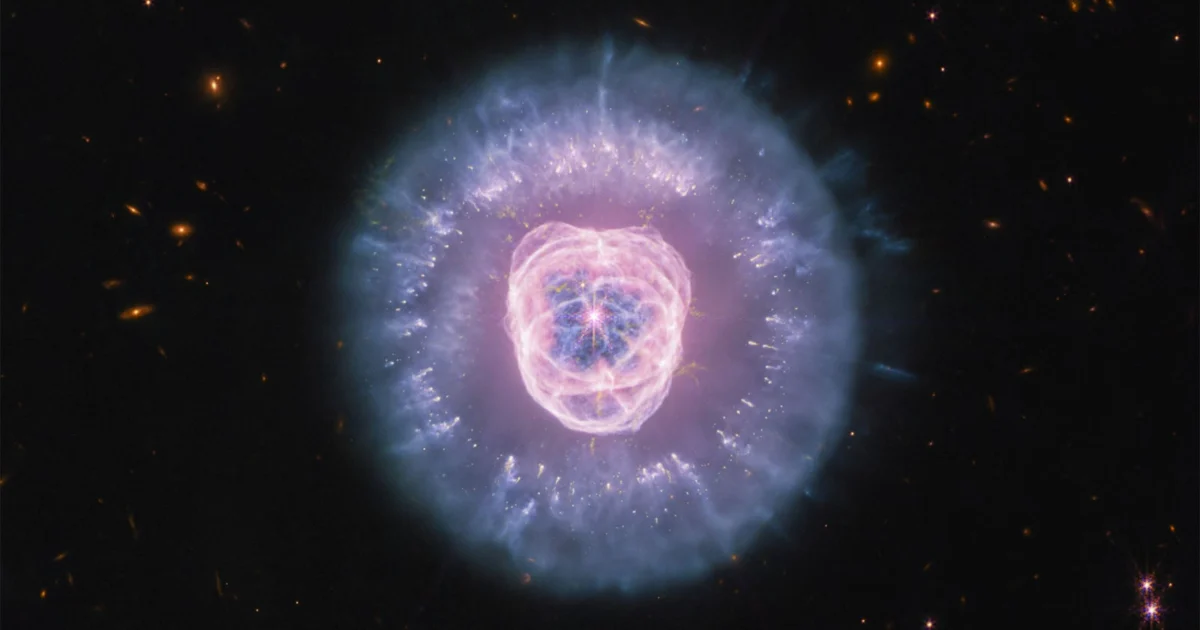
The cosmos has once again revealed its breathtaking artistry, this time through the unparalleled gaze of the James Webb Space Telescope (JWST), which has delivered exquisite new infrared images of the Lion Nebula, officially cataloged as NGC 2392. These latest observations not only showcase the nebula’s intricate beauty with a level of detail previously unimaginable but also emphatically demonstrate JWST’s superior imaging capabilities, particularly in the infrared spectrum, compared to its esteemed predecessor, the Hubble Space Telescope. The images provide astronomers with a sharper, more penetrating view of this celestial phenomenon, pushing the boundaries of our understanding of stellar death and the complex processes that shape the universe.
A New Perspective: JWST’s Infrared Advantage
The James Webb Space Telescope, a collaborative endeavor by NASA, the European Space Agency (ESA), and the Canadian Space Agency (CSA), was designed specifically to observe the universe in infrared light, a capability that sets it apart from the Hubble Space Telescope, which primarily operates in visible and ultraviolet wavelengths. This fundamental difference is critical for studying objects like planetary nebulae. Infrared light can penetrate the thick veils of gas and dust that often obscure visible light, allowing JWST to reveal cooler, more intricate structures and chemical compositions that remain hidden from optical telescopes.
When compared to Hubble’s visible-light images of the Lion Nebula, famously captured in early 2000, JWST’s new portraits offer a significantly sharper and more revealing perspective. Hubble’s iconic photograph, characterized by its striking orange and blue palette, lent the nebula its endearing "Clownface" or "Lionface" moniker, evoking a distinctly lion-like appearance with its shaggy mane. While aesthetically captivating, Hubble’s view was limited by its spectral range. JWST, equipped with its Near-Infrared Camera (NIRCam) and Mid-Infrared Instrument (MIRI), goes beyond mere aesthetics, enabling scientists to observe never-before-seen details in the nebula’s complex structure and composition.
NIRCam is JWST’s primary imager and its most sensitive instrument, capable of detecting light from the earliest stars and galaxies, as well as providing high-resolution imaging of nearby objects. MIRI, on the other hand, is crucial for observing longer infrared wavelengths, allowing astronomers to peer through thick dust clouds and study cooler objects, such as dust grains and molecules, which are abundant in planetary nebulae. Together, these instruments provide a comprehensive infrared survey, allowing for a deeper understanding of the physical processes at play.
Unraveling the Lion Nebula’s Cosmic Tapestry
NGC 2392, commonly known as the Lion Nebula or sometimes the Clownface Nebula, is a prime example of a planetary nebula, a term coined in the 18th century by astronomer William Herschel due to their often-round, planet-like appearance through early telescopes. Despite the name, these objects have no direct relation to planets; rather, they represent the final, spectacular stages in the lives of low-to-intermediate mass stars, like our own Sun. Located approximately 4,000 to 6,000 light-years away in the constellation Gemini, the Lion Nebula is a relatively small, bright nebula, spanning roughly one light-year in diameter.
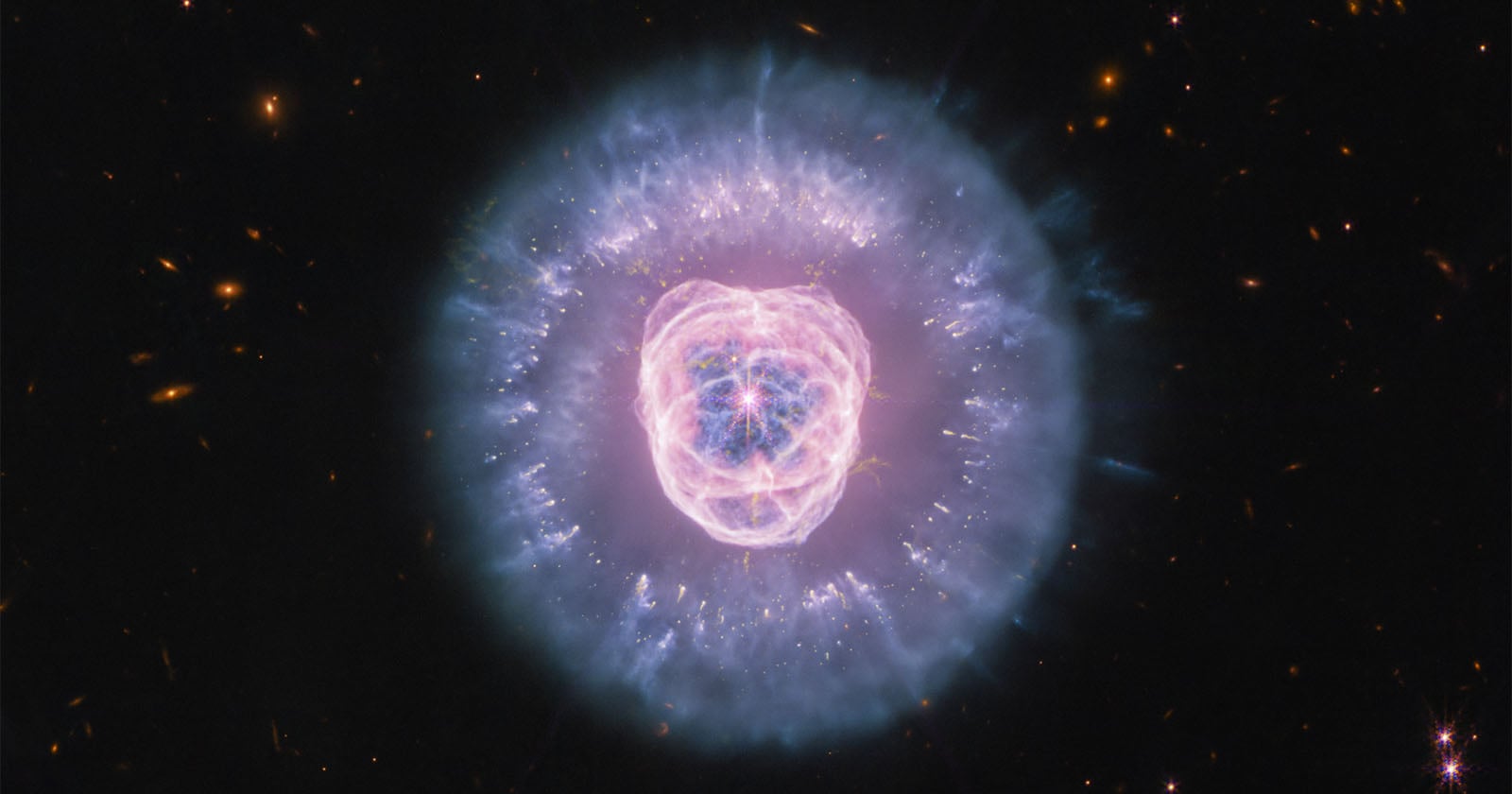
NASA scientists explain that Webb’s infrared vision specifically highlights features like compact clumps of dust and an expansive haze of ionized gas, which were less discernible in previous observations. These elements are not static; the nebula has taken several thousand years to reach its current elaborate shape, and its components continue to be altered by the powerful forces emanating from its dying central star.
The distinct appearance of the Lion Nebula is directly attributable to the remains of this star at its core. This intensely bright, albeit tiny, central dot is a white dwarf, the super-dense, exposed core of what was once a star similar in mass to the Sun. This white dwarf is the engine generating the immense energy and radiation that sculpts the nebula’s intricate and ever-changing structure.
The Lifecycle of a Star: A Violent Farewell
To understand the Lion Nebula, one must first grasp the lifecycle of its progenitor star. Stars like the one at the heart of NGC 2392 spend the vast majority of their existence on the main sequence, fusing hydrogen into helium in their cores. For a star of modest mass, this stable phase can last billions of years. However, once the star exhausts the hydrogen fuel in its core, it begins a dramatic transformation.
The core contracts, heats up, and hydrogen fusion shifts to a shell around the core. This causes the star’s outer layers to expand dramatically, transforming it into a red giant. As the red giant evolves, its core begins to fuse helium into heavier elements like carbon and oxygen. Eventually, even this helium fuel runs out. For low-mass stars, the core is not massive enough to ignite fusion of carbon, and the star enters its final, unstable phase.
The star becomes unstable and starts pulsating, undergoing what are known as thermal pulses. These pulses generate powerful stellar winds and cause the star to shed its outer layers into space. This ejected material, consisting of gas and dust, forms the characteristic shells and rings that define a planetary nebula. The process is a relatively brief astronomical event, lasting only tens of thousands of years, a blink of an eye compared to the star’s billions of years on the main sequence.
At the very center, the remaining core of the star collapses into an extraordinarily dense white dwarf. This white dwarf, despite its small size (comparable to Earth), is incredibly hot, with surface temperatures often exceeding 100,000 degrees Celsius. Its intense ultraviolet radiation ionizes the surrounding ejected gas, causing it to glow brightly across various wavelengths, including the infrared. This is the mechanism by which the white dwarf "cooks" all the surrounding material from the inside out, creating a huge cosmic bubble of ionized gas. As this bubble expands, driven by the relentless radiation from the central dying star, it clears a path, destroying dust in its wake. Scientists continue to work diligently to understand the precise astrophysical mechanisms that cause this destroyed gas to coalesce into the complex structures of concentric rings and shells observed in many planetary nebulae.
Anatomy of a Cosmic Lion
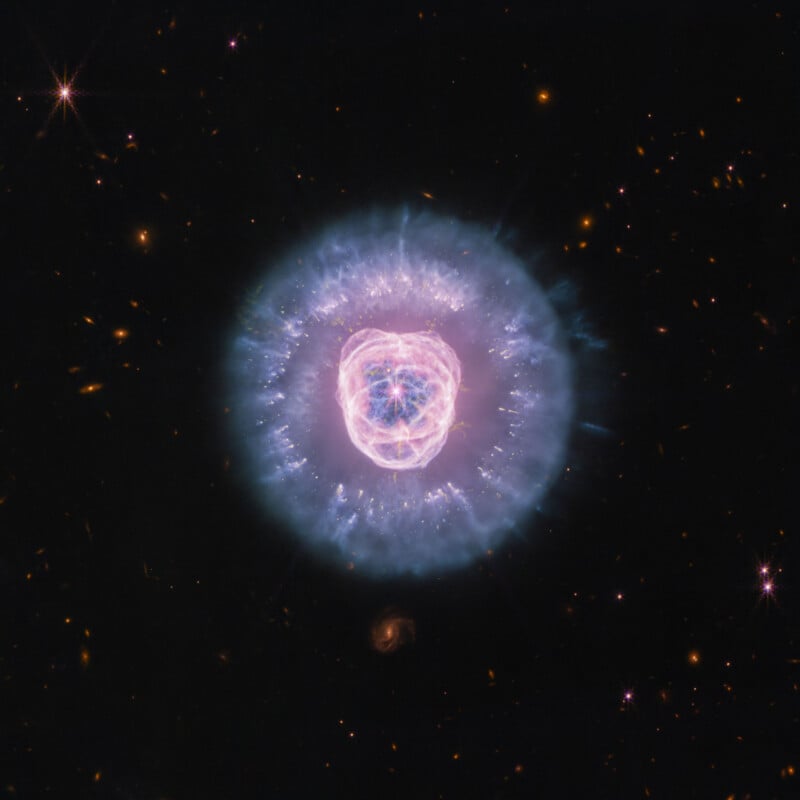
The intricate morphology of the Lion Nebula has inspired vivid analogies among astronomers. Scientists characterize the large, expanding gas bubble as the lion’s face, with the central white dwarf serving as its "button nose." The lion’s mane is interpreted as the interior of a dust shell, brilliantly illuminated by the powerful radiation of the white dwarf. Further adding to this cosmic imagery are the "tufts of hair," which are actually cometary tails of material, extending outwards from denser knots within the nebula. These details, now brought into sharper focus by JWST, provide invaluable clues about the dynamics of mass ejection and interaction with the interstellar medium.
The new images from JWST, like those captured by Hubble 26 years prior, are snapshots in time of a rapidly evolving cosmic phenomenon. On a cosmic timescale, the Lion Nebula is changing very quickly. Scientists predict that this magnificent structure will have completely dispersed within approximately 10,000 years, its gases and dust fading into the vast abyss of interstellar space. This transient nature underscores the importance of capturing such moments with cutting-edge instruments.
A Chronology of Discovery and Advanced Observation
The story of NGC 2392 began over two centuries ago. It was first discovered by the renowned astronomer William Herschel on January 17, 1789. Using his own powerful reflecting telescopes, Herschel meticulously cataloged numerous nebulae and star clusters, laying foundational groundwork for future astronomical surveys. For early astronomers, NGC 2392 appeared as a faint, diffuse patch of light, its intricate details entirely obscured by the limitations of their instruments.
As telescopic technology advanced through the 19th and 20th centuries, more features began to emerge. However, it was the advent of the Hubble Space Telescope in 1990 that truly revolutionized our view of planetary nebulae. Hubble’s observations in the early 2000s, utilizing instruments like the Wide Field Planetary Camera 2 (WFPC2), provided the first high-resolution, visible-light images of the Lion Nebula, revealing its double-shell structure and inspiring its popular nicknames. These images were crucial in advancing our understanding of the nebula’s general morphology and the distribution of ionized gases.
The commissioning of the James Webb Space Telescope in 2021 and its subsequent operational phase in mid-2022 marked the beginning of a new era. With its primary mirror spanning 6.5 meters (compared to Hubble’s 2.4 meters) and its specialized suite of infrared instruments, JWST was poised to deliver unprecedented detail. Operating from a stable orbit at the second Sun-Earth Lagrange Point (L2), approximately 1.5 million kilometers from Earth, JWST benefits from an extremely cold and stable environment, essential for its sensitive infrared detectors. This precise positioning and its advanced technology have now culminated in the breathtaking new views of the Lion Nebula, offering insights that were previously unattainable.
Scientific Insights and Broader Implications
The new JWST images of the Lion Nebula are far more than just beautiful pictures; they are critical data points that will refine our understanding of several key astrophysical phenomena.
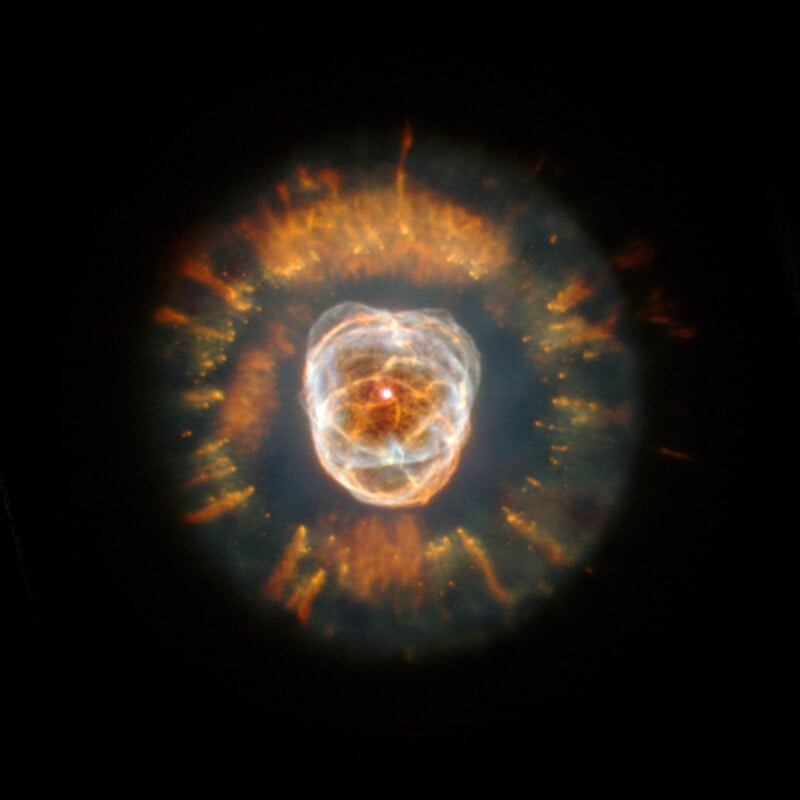
Understanding Stellar Demise: These observations provide invaluable empirical data for theoretical models of stellar evolution and mass loss. By precisely mapping the distribution of dust, gas, and different elemental compositions at various temperatures, scientists can fine-tune their simulations of how stars shed their outer layers, the dynamics of stellar winds, and the interaction between the central white dwarf’s radiation and the ejected material. The unique "face-like" morphology of NGC 2392, with its complex rings and cometary knots, offers specific challenges and opportunities for understanding the factors that shape these diverse structures, such as the influence of binary companion stars, magnetic fields, or stellar rotation during the red giant phase.
Chemical Enrichment of the Universe: Planetary nebulae play a crucial role in the cosmic cycle of matter. They are significant contributors to the chemical enrichment of the interstellar medium, returning heavy elements synthesized within their progenitor stars (like carbon, nitrogen, and oxygen) back into space. These elements are the building blocks for future generations of stars, planets, and even life itself. JWST’s ability to identify specific molecules and dust types in the nebula provides a direct census of these elements, helping astronomers trace the cosmic chemical evolution of the galaxy.
Dust Formation and Evolution: Dust, while seemingly mundane, is fundamental to astrophysics. It absorbs and re-emits starlight, plays a role in star and planet formation, and is a key ingredient in planetary nebulae. JWST’s infrared sensitivity allows for unprecedented studies of dust properties within NGC 2392, including its temperature, composition, and distribution. Understanding how dust forms and evolves in these energetic environments provides insights into the dust cycle across different astrophysical settings.
The Transient Beauty and Future Research: The realization that the Lion Nebula is an ephemeral structure, destined to disperse in a mere 10,000 years, underscores the importance of current observations. Such a short lifespan, astronomically speaking, means that these nebulae are dynamic laboratories for studying rapid cosmic change. Future research will likely involve spectroscopic analysis of the JWST data to determine precise velocities of different gas and dust components, allowing for 3D modeling of the nebula’s expansion and evolution over time. This could provide a more accurate prediction of its ultimate dispersal and shed light on the forces driving its current transformation.
Official Statements and Collaborative Spirit
The successful imaging of the Lion Nebula is a testament to the international collaboration behind the James Webb Space Telescope. Scientists from NASA, ESA, and CSA, along with researchers worldwide, have expressed immense enthusiasm for these new images. A representative from NASA’s science mission directorate, speaking generally about JWST’s impact, remarked, "These observations from Webb are pushing the boundaries of our understanding of stellar death and the intricate processes that sculpt these magnificent cosmic structures. The clarity and depth of these infrared images are simply astounding, revealing details we could only speculate about before." Such statements underscore the collective excitement and the profound scientific value derived from JWST’s continued operational success. The image processing, a crucial step in transforming raw data into stunning visual representations, was carried out by experts like A. Pagan at the Space Telescope Science Institute (STScI), further highlighting the collaborative effort required for such discoveries.
The images of the Lion Nebula serve as a powerful reminder of the universe’s dynamic nature and the continuous cycle of stellar birth, life, and death. They inspire not only scientific inquiry but also public wonder, reinforcing humanity’s enduring fascination with the cosmos and our relentless pursuit of knowledge about our place within it. As JWST continues its mission, it promises to unveil even more of the universe’s hidden wonders, deepening our appreciation for the transient and breathtaking beauty that unfolds across the cosmic stage.