The Evolution of the MARK5 Series and the Digital Revolution
The lineage of the GEPRC MARK series is rooted in the early days of 5-inch freestyle frames, where durability and serviceability were the primary metrics of success. The earlier MARK4 was celebrated for its balanced center of gravity and ruggedness, but the emergence of digital HD video transmission—pioneered by DJI—forced a radical redesign of the internal architecture. When the DJI O3 Air Unit was released, it offered 4K/60fps recording and a 1080p low-latency feed, effectively eliminating the need for a separate action camera like a GoPro for many professional applications.
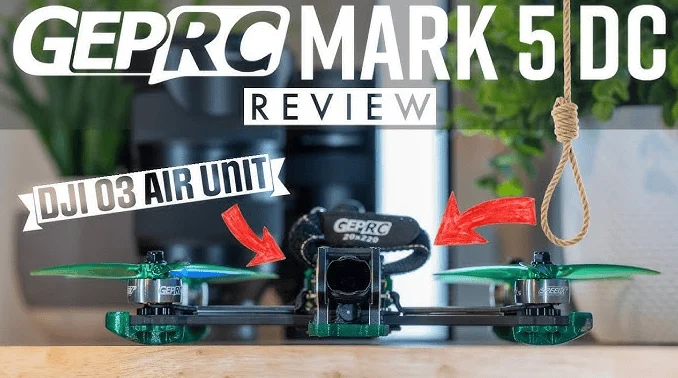
The GEPRC MARK5 DC HD O3 was engineered specifically to house this advanced hardware. Unlike traditional "X" frames where the propellers often appear in the periphery of the camera’s wide-angle view, the DeadCat (DC) configuration pulls the front arms backward. This architectural adjustment ensures that the 155-degree field of view provided by the O3 camera remains entirely clear of spinning blades, providing a cinematic experience that mimics larger, more expensive aerial platforms while maintaining the agility of a racing drone.
Technical Specifications and Propulsion Dynamics
The performance of the GEPRC MARK5 DC HD O3 is underpinned by a meticulously selected array of high-end components. At the heart of the propulsion system are the SPEEDX2 2107.5-1960KV motors. These motors are optimized for 6S (six-cell) LiPo battery configurations, which have become the industry standard for 5-inch drones due to their high voltage efficiency and reduced voltage sag during high-throttle maneuvers.
Flight Controller and Electronic Speed Controller (ESC)
The drone utilizes the GEP-F722-45A AIO or a stack-based equivalent featuring an F7 processor. The F7 chip is critical for modern FPV flight, as it allows for higher PID (Proportional-Integral-Derivative) loop frequencies and supports the latest versions of Betaflight firmware. This processing power translates to a smoother flight feel and better handling of external disturbances like wind or "prop-wash"—the turbulence created by the drone’s own propellers during sharp descents.
The accompanying 45A BLHeli_32 ESC provides the necessary current to the motors, supporting advanced features like bi-directional DShot and ESC telemetry. This allows the flight controller to communicate with the motors in real-time, filtering out specific vibration frequencies and ensuring the motors run as cool and efficiently as possible.
The DJI O3 Air Unit Integration
The inclusion of the DJI O3 Air Unit is the centerpiece of this model. Featuring a 1/1.7-inch sensor, the camera produces a dynamic range that far exceeds previous digital FPV systems. It supports D-Cinelike color profiles, which allow professional colorists to grade the footage in post-production to match traditional cinema cameras. Furthermore, the unit includes RockSteady electronic image stabilization (EIS), which smooths out high-frequency vibrations that the mechanical frame cannot fully absorb.
Structural Integrity and Cooling Innovations
One of the primary challenges with the DJI O3 Air Unit is thermal management. Because the unit processes high-resolution video data in a compact form factor, it generates significant heat. GEPRC addressed this by incorporating a CNC-machined aluminum camera cage. This serves a dual purpose: it provides a rigid, protective shell for the expensive camera sensor and acts as a heat sink, dissipating thermal energy into the surrounding airflow during flight.
The frame itself is constructed from high-quality T700 carbon fiber. The side plates are reinforced, and the arm thickness—typically 5mm on the MARK5—is designed to withstand high-velocity impacts. In the FPV world, crashes are an expected part of the lifecycle; therefore, the "easy-swap" arm design of the MARK5 allows pilots to replace broken components in the field with minimal tools, a feature highly valued by professional film crews on tight schedules.
Comparative Market Analysis
In the competitive landscape of 5-inch FPV drones, the GEPRC MARK5 DC HD O3 competes directly with models like the iFlight Nazgul Evoque and the Lumenier QAV-S. However, the MARK5 distinguishes itself through its specific "DeadCat" geometry and the refinement of its vibration damping. While "X" frames are often preferred for pure racing or symmetric freestyle due to their perfectly balanced flight physics, the "DC" frame is the undisputed choice for videographers.
Data from recent FPV community surveys suggests that the transition to 6S power systems has improved average flight times by approximately 15-20% compared to older 4S systems, while providing more "punch" at the top end of the throttle. The GEPRC MARK5 leverages this by recommending 1300mAh to 1500mAh 6S batteries, which typically yield 5 to 8 minutes of flight time depending on the pilot’s aggression.
Industry Implications and Professional Adoption
The rise of drones like the GEPRC MARK5 has fundamentally changed the economics of aerial cinematography. Previously, achieving 4K stabilized footage from a drone required either a large DJI Mavic/Inspire (which lacks agility) or a custom-built FPV drone carrying a $400 GoPro. The MARK5 DC HD O3 consolidates these requirements into a single, durable package.
Professional drone pilots in the film industry have noted that the O3 system’s reliability has reduced the "technical failure" rate on sets. In the past, analog interference or GoPro SD card errors were common points of failure. The integrated recording and transmission system of the MARK5 provides a redundant layer of security, as the pilot can see exactly what is being recorded in their goggles in high definition.
Operational Optimization and Best Practices
To extract the maximum potential from the GEPRC MARK5 DC HD O3, pilots must adhere to specific operational protocols. The drone’s weight-to-power ratio is high, meaning it can reach speeds exceeding 100 mph (160 km/h) in seconds.
Software Tuning and Firmware
Most units ship with a "factory tune" from GEPRC, which is designed to be safe and stable for most users. However, professional pilots often utilize Betaflight’s "Blackbox" logging to fine-tune the PID gains. This involves recording flight data to an onboard flash chip and analyzing the gyro traces to eliminate micro-oscillations, ensuring the O3’s RockSteady stabilization has the cleanest possible data to work with.
The Role of ND Filters
Because the DJI O3 camera has a fixed aperture, controlling exposure in bright conditions requires the use of Neutral Density (ND) filters. These filters act like sunglasses for the drone, allowing the pilot to maintain a lower shutter speed (typically double the frame rate, e.g., 1/120s for 60fps). This creates "motion blur," which is essential for making high-speed FPV footage look natural and cinematic rather than jittery.
Safety, Regulation, and the Future of FPV
As drones like the MARK5 become more capable, they also fall under increasing regulatory scrutiny. In the United States, the Federal Aviation Administration (FAA) requires Remote ID (RID) for drones over 250 grams. The GEPRC MARK5, with a typical takeoff weight of approximately 600-700 grams, falls into this category. GEPRC and other manufacturers have begun integrating RID-compliant modules or providing easy ports for external modules to ensure pilots remain compliant with local laws.
Looking forward, the success of the MARK5 DC HD O3 suggests a trend toward "integrated intelligence." While current FPV drones are mostly manual, we are beginning to see the inclusion of GPS-assisted return-to-home (RTH) features as standard. The MARK5 often comes with a GPS module pre-installed, providing a safety net for pilots who might lose their video signal behind obstacles.
Conclusion
The GEPRC MARK5 DC HD O3 FPV is more than a recreational toy; it is a sophisticated piece of aerospace engineering that represents the current pinnacle of the 5-inch FPV class. By combining the rugged, time-tested MARK5 frame with the revolutionary DJI O3 digital system, GEPRC has created a tool that serves the dual masters of freestyle performance and cinematic excellence. As the technology continues to mature, platforms like the MARK5 will likely remain the gold standard for those who require a high-speed, high-definition eye in the sky. Whether for capturing high-speed automotive chases or performing gravity-defying acrobatic maneuvers, this drone offers a level of versatility that continues to push the boundaries of what is possible in modern aerial media.